Best indoors for portable promos—trade shows, conferences, retail POS, pop‑ups, foyers and short‑term wayfinding; fast setup and strong impact.
This guide explains where retractable (pull up) banners perform best, how to design them for maximum impact and what to consider for Australian conditions. It draws on Sign Portal’s in-house wide-format production experience to help you specify confidently and avoid common pitfalls.
What a pull up banner does well
A pull up banner is a portable display where a printed graphic retracts into a weighted base cassette. Also called retractable, roll-up or banner stands, they prioritise speed of setup, small footprint and ease of transport.
They are ideal when you need a professional, branded message that can move between locations without tools or a complex installation.
Looking for a robust option for frequent travel and reuse? See ourPremium Pull Up Bannerfor long-term programs, roadshows and corporate environments.
Typical specs at a glance (Sign Portal stocked systems): 850–1000 mm wide x 2000–2200 mm tall graphics; standard cassette weight ~2.8–3.5 kg; premium wide‑base ~4.8–6.0 kg; setup in ~60 seconds; pack‑down in ~45 seconds.

The retract mechanism protects the print during transport and storage, while the pole and rail system keeps the graphic flat for crisp, vertical presentation.
Where they work best
Because they pack into a carry bag and set up in seconds, pull up banners shine in dynamic environments with changing messages or locations.
- Trade shows and exhibitions where booths must build and dismantle quickly.
- In-store promotions beside fixtures, counters or product launches.
- Conference rooms, foyers and theatres for agendas, sponsor walls and wayfinding.
- Pop-up retail, markets and brand activations where space and time are limited.
- Training, inductions and information points at venues and workplaces.
They are less suited to high-wind outdoor areas or long-distance viewing, where fixed signage, large-format walls or engineered outdoor banners may be more effective.
For programs with repeated use across teams or locations, specify the same cassette family so graphics, poles and rails remain interoperable and spares are truly useful in the field.
Event and exhibition use
At trade shows and expos, pull up banners provide fast, high-impact vertical visuals. They frame a booth entry, bookend a table, or add content zones without blocking aisles. The narrow footprint keeps within exhibitor boundaries and reduces trip hazards.
For multi-day events, consider a premium cassette for reliability, stable bases on carpeted halls and a scuff-resistant print finish. Where multiple banners form a backdrop, align design elements so join lines appear intentional.
Tip for crews: pre-pack pole segments and rails with labels (e.g., Hall A, Breakout 2) and add QR-coded asset tags to each cassette so the right graphic finds the right room quickly during bump-in.
Sign Portal can pre‑apply durable asset labels and supply a master kit list linked to our internal barcode tracking so replacements can be ordered by asset ID without re‑measuring.
Retail and point-of-sale
Retail floors change frequently. A pull up banner makes seasonal offers, brand stories and launch messages easy to deploy, relocate and remove without tools. It works well beside gondola ends, near demo tables or at store entry where you can intercept traffic.
Choose simple, high-contrast messaging that can be understood at a glance. If customers must walk past closely, prioritise image quality and a clean finish; a protective laminate can help reduce scuffs during handling.
For multi‑site retail drops, we can pre‑pack store‑labelled shipper cartons with route‑optimised consignments and despatch in waves by state for smoother rollouts.
Conferences, foyers and corporate communications
Hotels, training centres and offices use pull up banners to signpost registration, acknowledge sponsors and display agendas. The stand works alongside digital screens to broaden visibility and provide a fallback if screens fail or content changes late.
For corporate foyers, a premium base with a refined finish complements reception spaces. Clear brand colours and consistent typography help align with other wayfinding and identification signage.

Ask about ourPremium Pull Up Bannerwith clamp rail for quick re‑skins between quarterly campaigns and investor briefings.
Temporary wayfinding and information points
Pull up banners can guide guests through venues for short periods: entry queues, room changes, breakout directions or sponsor lounges. They are useful at induction spaces or temporary information desks on construction or campus sites.
They should not be used to replace regulated safety signage or road-traffic control devices.
Outdoor and semi-outdoor use
Pull up banners are primarily designed for indoor environments. In Australia’s sun, heat and wind, semi-outdoor placements (under awnings or in sheltered courtyards) can be viable for short periods if wind is minimal and the ground is level.
- Wind: Avoid exposed locations. A gust can topple the stand or crease the print.
- UV: Sunlight fades inks over time; under cover and short durations reduce exposure.
- Rain: Moisture can affect some banner films and cassettes; keep dry where possible.
For ongoing outdoor messaging, consider alternatives such as fence banners, A-frames or fabricated panels selected to suit the site and exposure.
If placing near automatic doors, air curtains or fans, position the stand outside the airflow to prevent oscillation that can loosen pole collars over time.
Design choices that work
Clarity beats detail. A person often views a pull up banner from 1–3 metres while moving. Use a strong headline, one visual hook and a clear call-to-action (URL, QR code or short instruction). Avoid long paragraphs.
- Hierarchy: Headline at eye height, key visual mid-zone, contact/action near base.
- Contrast: Dark on light or light on dark; avoid low-contrast photo overlays.
- Typography: Bold, legible fonts; avoid fine serifs that break up at distance.
- Images: Supply high-resolution images; avoid web screenshots that will pixelate.
- QR codes: Test from the printed size and expected distance before sign-off.
Practical sizing: QR codes used at 1–3 m viewing distance typically scan reliably at 25–35 mm printed size with medium or higher error correction; keep at least 4–6 mm clear space around the code.
Artwork preparation and proofing
Production-ready artwork benefits everyone. Supply vector logos, a clean cut/trim box, correct finished dimensions and any bleed required by the print system. Convert fonts to outlines or include them, and separate any special instructions clearly from print layers.
Sign Portal provides artwork proofing before manufacture so you can check wording, spelling, colours, dimensions, quantities and layout.
Sign Portal templates specify typical allowances to suit our hardware: 100 mm bottom allowance (inside the cassette), 10–15 mm safe area at the top under the rail, and 5 mm side safe areas. Supply final art at 1:1 scale with 150–200 ppi effective image resolution at size. If colour-critical, include Pantone references and request a printed swatch on the chosen media.
Preferred file delivery: press‑ready PDF/X‑4 with live transparency preserved; embedded images at 150–200 ppi at size; all spot colours named. For colour‑critical work, provide a reference proof or request ours on target media.
Choosing a base and print system
Not all cassettes are the same. A standard base suits light, occasional use. Premium bases increase stability and longevity, and often present a more refined profile for corporate or retail environments.
| Feature | Standard base | Premium base |
|---|---|---|
| Use frequency | Occasional events and short campaigns | Frequent deployments, multi-venue programs |
| Stability | Good on flat indoor floors | Enhanced weight and stance for busy foyers |
| Appearance | Functional, simple profile | Refined finish for corporate spaces |
| Durability | Suitable for light to medium handling | Built for repeated transport and setup |
| Typical value | Cost-effective for one-off or seasonal use | Best long-term value over many uses |

Hardware specifics our team checks during quoting and production:
- Rail type: clamp rail (quick change) vs adhesive channel (slimmer look). Premium rails reduce edge curl and make re-skins faster.
- Pole: three-piece bungee (fixed height) vs telescopic (variable height). Telescopic poles on premium units help with uneven floors or stage risers.
- Base design: swing-out feet vs wide base. Wide bases improve stability in foyers; feet are compact for tight aisles.
- Warranty: our stocked standard cassettes carry 1-year hardware warranty; premium cassettes carry up to 5 years for manufacturing defects.
Additional technical checks at Sign Portal: spindle straightness (dial gauge), spring recoil smoothness (no step in final 200 mm), foot fastener torque (verified on assembly), and end‑cap fit (no rattle) for a premium appearance on site.
Ready to spec the right hardware? Compare features and order thePremium Pull Up Bannerfor high-frequency programs.
Above: original comparison photos from our Brisbane workshop show a standard swing‑foot cassette beside our premium wide‑base unit, plus a close‑up of the clamp rail mechanism versus adhesive rail for quick reference during spec discussions.
Manufacturing approach and finish
In Brisbane, Sign Portal produces banner graphics in-house using wide-format digital printing. This supports short runs, one-offs and brand-consistent sets for national programs. Where a particular surface finish or abrasion resistance is required, a compatible protective laminate can be specified for suitable media.
Colour is influenced by the ink set, media and lighting. If corporate colours are critical, provide recognised colour references and, where needed, request a printed sample for confirmation before the full run.
First‑party process and equipment at Sign Portal:
- Media: premium anti‑curl PET greyback 280–300 μm for long life; cost‑effective PP stay‑flat 200–225 μm for short campaigns; soft‑touch matte overlaminate (70–80 μm) available for abrasion resistance.
- Finishing: Seal 62 cold laminator, Keencut Evolution3 bench for square trims, and Summa S2 tangential cutter for precision cut accessories.
- Colour: Caldera RIP with device‑link ICC profiles; verification using an X‑Rite i1Pro 3 spectrophotometer to keep delta‑E within agreed tolerances on brand colours.
- Assembly: dedicated banner benches with torque‑limited drivers; leader tape applied with high‑shear 3M 9087 adhesive for long‑term hold.
- QC: barcode job tracking, visual inspection under D50 lighting, and a pull‑test on rails and leader joints before bagging.
- A retailer runs quarterly pull up swaps using the same premium cassettes to reduce waste and freight cost.
- A conference packs ten stands into a hatchback for a multi-city roadshow, relying on consistent artwork and quick setup.
- A university uses a colour-standardised template so different faculties can order event banners without drifting from brand guidelines.
Additional in‑house controls: media acclimatisation is done overnight at 20–24 °C and 45–55% RH; prints rest post‑cure for at least 2 hours before lamination; all laminated edges are pressure‑burnished to resist edge lift in high‑touch environments.
Storage, transport and care
Retract the banner slowly and squarely into the cassette to prevent edge scuffing. Always use the supplied carry bag, and avoid stacking heavy objects on top in vehicles. Keep graphics away from sharp edges and grit to prevent surface scratches.
- Cleaning: Use a soft, non-abrasive cloth. Avoid aggressive solvents.
- Heat: Do not store in hot cars for extended periods; heat can affect some films.
- Moisture: Keep dry; if damp occurs, extend and air at room temperature before storage.
Some stands allow the graphic to be replaced while reusing the base. This depends on the cassette model and is best assessed case by case.
Transport tip: where kits are shipped nationally, we can supply wheeled hard cases with foam sleeves and desiccant; each case can be asset‑tagged and documented with a contents sheet for faster bump‑ins.
Inspection before and after events
Build an inspect routine into your bump-in and bump-out to extend service life and avoid on-site surprises:
- Base and feet: check for dents, loose end caps and that swing feet lock flat; confirm the base sits level with no rock.
- Retract action: pull up and retract slowly; listen for spring grinding or uneven tension that can skew the graphic.
- Pole integrity: ensure segments click fully; on telescopic poles confirm the lock collars hold without slip.
- Top rail: verify the clamp bites evenly across the width; look for lifting adhesive tape at the edges.
- Leader tape and edge curl: inspect the bottom leader joint and side edges for adhesive creep or curl.
- Graphic surface: check for creases, scuffs or ink abrasion; wipe dust and grit before bagging.
- Bag and zip: ensure the carry bag zip runs freely and shoulder strap is intact for safe handling.
In-field fixes you can do safely:
- Leaning stand: rotate the pole 180° or reseat the pole pin fully; verify feet are fully deployed on carpet.
- Minor edge curl: gently reverse‑roll the outer 20–30 mm by hand just before setup; long‑term cure is a re‑tape or rail service.
- Top rail slip: re‑clamp with even pressure across the width; avoid over‑tightening one end which can skew the sheet.
- Sticky retract: let the last 100–150 mm feed in under hand control; do not allow the print to snap inside the base.
Planned maintenance: for high‑use kits, schedule a workshop service every 10–15 deployments to check spring tension, rail liners and leader bond. We provide a simple inspection log on request.
Repair and re‑skin options
Most issues can be repaired, especially on premium hardware designed for serviceability. Sign Portal offers workshop servicing in Brisbane with national return freight.
Considering frequent changes? Start with thePremium Pull Up Banner—its clamp rail and serviceable base cut re‑skin time and cost over the life of the program.
Service workflow at Sign Portal: we issue an RMA and shipping label; on arrival, your unit is photographed, assessed and quoted; urgent re‑skins go to a same‑day bench where possible; all serviced units are pull‑tested and bagged with a QC slip before despatch.
Case study: multi‑city conference roadshow using reusable cassettes
A healthcare client ran a 12‑week national roadshow across 8 Australian cities, rotating three concurrent event kits. Sign Portal produced 24 premium pull up banners and 12 spare graphics (for session‑specific agendas), all colour‑matched to the client’s brand palette.
- Approach: premium wide‑base cassettes with clamp rails, anti‑curl PET greyback (300 μm), matte overlaminate; each cassette asset‑tagged and kitted per city.
- Process: single master artwork system with variable session titles; colour verified using i1Pro 3 swatches; consolidated proofing to one sign‑off round.
- Logistics: each kit packed into two hard cases with foam sleeves; all items labelled by venue and day.
- Results: 42% reduction in freight volume versus one‑off banners; zero on‑site failures across 36 event days; 16 re‑skins executed mid‑tour in 72 hours with overnight freight; estimated 160 kg less waste by reusing cassettes.
Outcome: the client retained the hardware for future CPD events. Subsequent campaigns required only graphics, cutting lead times and total cost per event by more than a third.
Sign Portal equipment used: HP Latex 570 (8‑pass settings) for consistent colour between batches; Seal 62 laminator for matte finish; Caldera RIP with saved presets per venue lighting condition. All units passed our D50 booth check prior to case‑up, and barcodes tied each cassette to the correct agenda file for error‑free bump‑ins.
Ordering checklist
A brief, complete specification streamlines production and reduces back-and-forth.
- Quantity, deadline and event dates.
- Banner size and orientation.
- Standard or premium base preference.
- Single-sided or double-sided (if applicable).
- Artwork files, fonts and linked images supplied.
- Brand colour references or sample requirement.
- Delivery address(es) and contact for national freight.
Sign Portal’s artwork proofing confirms the final layout before manufacture. For multi-site programs, structured ordering and variable data can help manage venue names, dates or QR codes consistently.
Optional add‑ons: asset tags with QR links to artwork, wheeled hard cases, pre‑printed contents sheets, and city‑by‑city despatch scheduling.
When another product is better
Choose a different system where the environment or objective demands it:
- High wind or large outdoor areas: consider fence banners, A-frames or engineered panels.
- Wide, immersive backdrops: fabric tension walls or modular exhibition systems.
- Permanent signage: rigid panels such as acrylic or aluminium composite panel.
- Floor-based messaging: use dedicated floor graphics with suitable laminate and slip-performance data.

Unsure which system suits your program? Talk to us about site conditions, frequency of use and logistics, or order ourPremium Pull Up Bannerwhen reliability and re‑skin efficiency are priorities.
Related Sign Portal resources: Premium Pull Up Banners · Custom Floor Decals for Safety & Promotions · Property - Push Pull Set White Portrait Sign
Frequently Asked Questions
Are pull up banners suitable for outdoor use?
They are primarily indoor displays. Short-term, sheltered outdoor use can work in low wind, but for ongoing outdoor exposure consider alternatives such as A-frames, fence banners or rigid panels suited to the site and conditions.
What size works best for events and retail?
Choose a size that fits the available footprint and viewing distance. Keep the headline near typical eye height for fast recognition and avoid overloading the banner with text.
Can you replace the graphic in an existing cassette?
Sometimes, depending on the cassette model and condition. Share photos or bring the base in so we can advise whether a replacement graphic is practical.
How long will a pull up banner last?
With careful handling and indoor use, a well-made banner can serve across multiple campaigns. Life depends on handling, transport, exposure and storage conditions.
Do you colour match to brand guidelines?
Yes. Supply recognised colour references and we can confirm with a printed sample if colour is critical. Final colour depends on media, ink and lighting.
What artwork files should I supply?
Vector logos (AI, EPS, PDF) and high‑resolution images. Include fonts or outline them, provide finished dimensions and any required bleed, and separate trim or special instructions from the print layers.
Can I add a QR code to a pull up banner?
Yes. Make it large enough to scan at the expected distance, ensure good contrast and test from a printed sample before approving production.
Keep learning
Related Articles
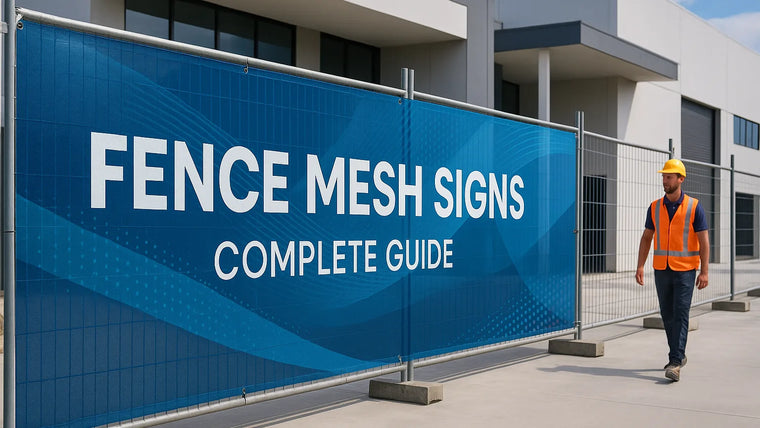
Fence Mesh Signs: Complete Guide
Fence mesh signs are printed mesh banners used on temporary fencing and hoardings. The perforated material allows airflow compared with a solid banner, while...
Best Materials for Crowd Control Barrier Graphics
For most outdoor events in Australia, perforated mesh banner is a versatile option because airflow can help reduce wind effects and it’s quick to...
Crowd Barrier Signage for Construction Sites
Crowd barrier signage for construction sites uses panels, banners or decals mounted to portable barriers to guide pedestrians, brand perimeters and reinforce safety messages....