Pick feather flags for height and movement; teardrops for windy or tight sites with taut, readable graphics.
Choose feather flags when you want height, more vertical print area and lively movement for long‑view visibility. Choose teardrop flags when you need a compact footprint, tighter footpath clearance and steadier readability in breeze. This guide drills into how each shape behaves so you can spec the right option for your site, artwork and budget.
Quick verdict
If you need height and a lively, waving profile to catch the eye from further away, a feather flag is typically the better choice. If your priority is tidy presentation, tighter footpath clearance and keeping the design readable when it’s breezy, a teardrop flag usually wins.

Shape and visibility
Feather flags have a tall, rectangular body with a rounded top and a free-flying outer edge. This maximises vertical presence and gives you a long column for stacked logos or messages. They ‘read’ like a banner pole, which helps when you want height without a rigid structure.
Teardrop flags have a curved leading edge and a tapered tail that loops back to the pole tip. The fabric is tensioned across the arc, reducing flutter. The silhouette is compact with the widest area near the top, putting key branding at eye‑line level — on medium sizes, that sweet spot typically sits about 1.4–1.8 m above ground in pedestrian zones.
- Best for tall messages: feather — more vertical graphic area.
- Best for tight spaces: teardrop — arched head and shorter tail reduce overhang.
- At-a-glance recognition: teardrops concentrate the logo in a stable zone.
Wind behaviour and stability
Because feather flags have a loose outer edge, they flutter more in wind. That movement can increase attention but may distort fine text. Teardrop flags are held under greater fabric tension, so the main graphic stays flatter and easier to read when it’s gusty.
Neither shape is a substitute for safe installation. Always match the base to the surface and expected conditions, and remove flags in severe weather to protect people and property.
Practical thresholds for pack-down: if steady winds exceed roughly 35–40 km/h or gusts exceed 50–55 km/h (around Beaufort 6–7), remove the flags and store them flat. Sites with funnelling winds between buildings can see brief higher gusts — choose a heavier base or reduce flag height where this is common.
Graphic area and messaging
Feather flags favour vertical layouts, stacked typography and elongated graphics. They can carry more copy, but that doesn’t mean they should — distance legibility improves with fewer elements and strong contrast.
Teardrop flags concentrate the usable area near the top curve. This suits single logos, short words and icon‑forward branding. The natural arc can clip the extremes of wide artwork, so keep critical elements inside a safe margin.
- Keep essential graphics 50–100 mm in from the fabric edge (allow a safety margin appropriate to the final size).
- Use high‑contrast colour pairs; avoid thin serifs and hairline strokes.
- Plan left/right variants so arrows and direction‑specific icons point the right way.
Bases and installation surfaces
Choosing the right base matters more than the flag shape. Select based on the surface, foot traffic and whether the flag will be moved often.
- Ground spike: soft ground, turf and sand. Quick to deploy at sporting fields and temporary event sites.
- Cross base with water ring: hardstand and footpaths; adds ballast while keeping a low profile.
- Heavy plate base: durable footprint for forecourts and foreseeable breeze exposure; check trip‑clearance around the base.
- Car wheel base: retail pop‑ups and market stalls — uses the vehicle tyre for anchoring.
Technical notes to fine‑tune selection:
- Spigot compatibility: check pole‑mount spigot diameter; common spigots are 12–16 mm. Avoid mixing bases/poles with mismatched tolerances.
- Cross bases: 600–800 mm span is typical; pair with a 12–15 L water ring for medium flags. Add a 3 mm EPDM pad under the feet on polished concrete.
- Plate bases: 10–25 kg, 6–10 mm thick steel with galvanised or powder‑coated finish. Heavier plates present neater posture in breezy forecourts.
- Ground spikes: 350–450 mm for turf; 450–600 mm auger for loose sand. Confirm underground services (irrigation, power) before insertion.
- Coastal sites: prefer galvanised or marine‑grade powder‑coating and rinse with fresh water periodically to reduce salt build‑up.
How to choose a flag base for your site
Match the base to the surface, exposure and duty cycle. Use this quick method for a safe, tidy setup that suits Australian retail and event environments:
- Confirm the surface and if penetration is allowed
- Soft ground (turf, soil, sand): use a ground spike or auger. Choose 350–450 mm length for turf; longer auger for sand.
- Hardstand (concrete, pavers, timber deck): use a non‑penetrating base — cross base with a water ring, or a 10–20 kg steel plate.
- Vehicle‑bay pop‑ups: use a car wheel base (drive‑on).
- Estimate exposure (typical vs gusty) and pick ballast
- Sheltered urban footpath: 8–10 kg total ballast for small/medium teardrops, 12–15 kg for medium feathers.
- Open forecourt or coastal breeze: 15–20 kg for medium teardrops, 20–25 kg for medium feathers. Remove in strong winds.
- Rule of thumb: base weight in kg ≈ 8–12 × the sail area (m²) for sheltered sites, 15–25 × for exposed sites.
- Check clearance and trip safety
- Maintain a continuous pedestrian clearway (often 1.8 m minimum; check local council guidance).
- Choose low‑profile bases on narrow footpaths; add a water ring for ballast without broad corners.
- Place bases in line with existing furniture (bollards/planters) to avoid new pinch points.
- Plan for movement and servicing
- Frequent moves (markets, expos): cross base + water ring is lighter and drains for transport.
- Static installs (entrances, forecourts): heavy plate offers durable stability and neat presentation.
- Vehicle anchoring: car wheel base for rapid setup at pop‑ups without loose ballast.
Additional checks most teams miss:
- Confirm spigot height clears the pole butt when the sleeve is fully tensioned; avoid sleeve chafe on the base hub.
- On pavers with fall, shim plate bases to level the spigot so the pole tracks vertical.
- If you use multiple bases, colour‑dot the spigots to the matching pole sets to speed pack‑in/pack‑out.
- New soft‑ground sites: lodge a Dial Before You Dig (1100) enquiry before using long spikes or augers.
- Suburban café strip (narrow footpath): small teardrop + cross base with water ring keeps the clearway unobstructed.
- Auto dealership forecourt: medium feather + 20 kg plate base to maintain posture in variable wind and around vehicles.
- Beachside market: medium teardrop + long ground spike set clear of irrigation lines; flags removed during strong afternoon sea‑breeze.
Portability and set-up
Both shapes use sectional poles and soft‑fabric graphics, making them easy to transport in a carry bag. Assembly is typically tool‑free: join the pole sections, sleeve on the flag, tension the tail and mount on the chosen base. Teardrop sleeves can feel a touch tighter because of the arc — that’s by design to keep the face taut.
- Set‑up sequence that avoids scuffing: assemble base first, insert pole, then sleeve the graphic from the tip down on clean ground or a mat.
- Tail tension: secure the bungee to the base or lower pole eyelet without over‑stretching — aim for firm, not guitar‑string tight.
- Pack‑down: brush off grit, coil the bungee separately, and store the print dry in the supplied bag to prevent edge rub.
- A weekend market stall picks teardrop flags on cross bases so aisles stay clear and logos remain readable in an onshore breeze.
- A sports club uses feather flags with ground spikes on the oval sidelines to create visible wayfinding from a distance.
Side-by-side comparison
| Feature | Feather flag | Teardrop flag |
|---|---|---|
| Shape profile | Tall, rectangular body with rounded top and free-flying edge | Arched leading edge, tapered tail, fabric held under tension |
| Readability in gusty wind | More flutter; bold, simple designs recommended | Generally steadier face; graphics stay more consistent |
| Movement/attention | High movement draws the eye | Lower flutter; cleaner presentation |
| Graphic fit | Suited to vertical logos and stacked type | Suited to compact logos and short words near the top |
| Footpath clearance | Longer tail may require more lateral space | Compact arc reduces overhang into walkways |
| Typical base options | Compatible with spikes, cross bases, plates and wheel bases | Compatible with spikes, cross bases, plates and wheel bases |
| Best use cases | Sports fields, long-view retail, entrances needing height | Busy footpaths, markets, courtyards, breezier locations |
Design and artwork preparation
Production‑ready artwork speeds manufacturing and improves print accuracy. Supply vector logos where possible, keep raster images at 100–150 ppi at final size, and include clear finished dimensions. A dedicated safe area keeps critical elements clear of the sleeve seam and edge curves.
Artwork proofing is a formal checkpoint before production. It lets you verify spelling, colours, placement and quantities — essential when events have immovable deadlines. At Sign Portal, proofing is a core production control; where a sign is regulated (e.g. safety signage), use proofing alongside a compliance review rather than as a substitute.
Colour matching for brand‑critical graphics benefits from recognised colour references and, if required, a printed sample to reconcile the difference between screen and print under real lighting. Base fabric tone/whiteness, ink set and surface sheen can shift perceived colour; this is normal in print and should be allowed for during approval.
Manufacture at Sign Portal (Brisbane)
Our flags are produced in‑house in Brisbane using commercial dye‑sublimation on durable knitted polyester, then finished for Australian outdoor conditions. The process is controlled end‑to‑end to keep colour, sizing and fit consistent across repeat orders.
- Print: high‑resolution dye‑sub on 110–135 gsm knitted polyester for single‑sided (mirror‑reverse) or two prints with an internal blockout liner for double‑sided options.
- Heat‑set: graphics are fused in a temperature‑controlled calender for wash‑fast colour and reduced ink migration.
- Cut & seal: panels are laser‑cut to shape to minimise fray, then checked against size jigs for consistent fit on pole sets.
- Sew: sleeves are reinforced with heavy webbing at the pole tip, and hems are double‑stitched using UV‑stable polyester thread for edge durability.
- Hardware: sectional fibreglass/composite poles matched to flag size; bases in galvanised or powder‑coated steel with optional water ballast rings.
- Quality controls: barcode job tracking, visual seam inspection, and spot colour checks against approved proofs under D50 lighting. Material safety data and flame‑retardant fabric options (tested to common event requirements) are available on request.
Typical lead times are 3–5 business days from proof approval for standard runs, with expedited production available for event deadlines. Consolidated proofing allows colour and layout to be locked once, then applied consistently to flags, fence mesh and portable displays.
Additional manufacturing detail that improves outcomes:
- Pre‑press: RIP‑managed colour with ICC profiles and Pantone references; approvals assessed under D50 (≈5000 K) viewing conditions for consistency.
- Transfer: calibrated temperature/time dwell on the heat calender to control density and mitigate panel‑to‑panel shift.
- Tolerances: sleeve circumference and overall luff length are held to tight internal tolerances so flags track correctly on our pole sets.
- Stitch spec: UV‑stable polyester thread with double‑needle lockstitch on load paths; 25–38 mm webbing reinforcement at the pole tip to resist blow‑outs.
- Edge durability: laser‑sealed perimeters reduce fray compared to cold‑knife cutting, especially on frequent pack‑in/pack‑out duty.
Sizes and site planning
Before locking in a size, walk the site. Check ceiling or awning clearances, door swings, pedestrian pinch points and prevailing wind. Taller isn’t always better if the flag will foul eaves or encroach on footpaths.
Plan the base layout early for multi‑flag installs. Spacing that looks generous on paper can feel tight once people queue or merchandise racks move into the walkway. If the flag needs to be visible over parked cars or pop‑up stalls, consider a taller feather; if you need a short, tidy marker at a doorway, choose a compact teardrop.
- Confirm left‑ and right‑hand orientations so pairs mirror symmetrically along an entry path.
- Allow room to rotate the flag with wind shifts without striking signage, bollards or umbrellas.
- If installing near traffic or public roads, follow the relevant traffic‑management requirements for the site.
Care and safety
Outdoor exposure in Australia is tough: UV, heat and wind accelerate wear. Inspect flags regularly and replace when fading or fraying reduces brand presentation. Removal during severe weather protects both your equipment and the public.
Clean gently with methods compatible with the printed fabric. Avoid harsh solvents, abrasive pads and high‑pressure jets that can damage fibres or edges. Check bases, tie‑downs and pole connections during routine set‑up; loose components increase risk in gusts.
- Rotate multiple sets for frequent events — it balances exposure and extends overall service life.
- Store dry and folded loosely; avoid compressing damp fabric in carry bags.
- Replace when colour loss or edge wear affects readability or safety.
Repair, refurbishment and spares
Many common issues can be repaired to extend service life and reduce waste. Sign Portal offers practical repairs and spare parts for our flag systems.
- Sleeve repairs: re‑stitch or replace a worn pole sleeve; add a fresh reinforcement patch at the tip to prevent blow‑outs.
- Hem and edge repairs: re‑hem frayed edges and heat‑seal loose fibres to curb further fray.
- Hardware: replace individual pole sections, tips or bases without buying a full set.
- When to replace: if fabric has severe UV fade, print cracking, or tears longer than 150 mm, a new panel will usually present better value.
DIY note: if you’re handy with a machine, use UV‑stable polyester thread and a double‑needle lockstitch. Avoid cotton thread outdoors — it degrades faster in Australian UV.
- Quick repair method for small edge nicks: trim loose fibres, apply a narrow heat‑seal, then run a short reinforcing stitch across the end of the nick to stop creep.
- Tip‑sleeve refresh: add a 25–38 mm webbing cap inside the sleeve at the pole tip and re‑stitch load‑bearing seams to restore tension strength.
- Spare kits: keep a spare bungee, pole tip and one lower pole section per site for rapid field fixes.
Ordering and delivery
Coordinated event branding often pairs flags with other portable systems such as pull up banners, corflute wayfinding, window decals and temporary fence banners. Sign Portal manufactures a wide range of printed signage in‑house in Brisbane using wide‑format and UV printing, laser cutting and CNC routing. That makes it practical to align artwork across formats, proof once and ship together. Explore our Pull up banners collection for complementary indoor displays.
For projects across multiple sites, national freight is available. Packaging should protect printed faces and fibre edges during transport; large or fragile bundles may require reinforced cartons or separation to avoid transit rub. Confirm delivery windows early for events and launches.
- Provide final artwork and quantities in a structured brief; it reduces rework and speeds approval.
- Ask for a consolidated proof set when flags are part of a broader campaign.
- If you anticipate reorders, keep a simple schedule of sizes, bases and artwork file names.
Frequently Asked Questions
Which flag shape is better in windy conditions?
A teardrop flag typically keeps the print flatter and more readable because the fabric is held under greater tension. In strong or hazardous winds, remove any flag regardless of shape.
Do feather flags or teardrop flags have more print area?
Feather flags generally provide more vertical print area for stacked text and long graphics. Teardrops concentrate usable space near the top, which suits compact logos and short words.
What base should I use on a footpath?
For hard surfaces, use a cross base with a water ring or a heavy plate base. Check trip hazards, keep clear of door swings and pick a weight appropriate to local wind exposure.
Can I use detailed text on promotional flags?
You can, but it often reduces legibility. Flags work best with bold logos, short words and high contrast. Keep fine details away from the sleeve and curved edges.
How do I supply artwork for flags?
Provide vector logos where possible, supply images at suitable resolution for final size, include finished dimensions and keep critical elements inside a defined safe area. Approve an artwork proof before production.
Are feather and teardrop flags suitable for coastal sites?
They can be used, but coastal UV, wind and salt increase wear. Choose sturdy bases, inspect more frequently and plan for earlier replacement if exposure is severe.
Can I match my corporate colours accurately on flags?
Colour can be matched closely when you supply recognised references and allow for print-on-fabric characteristics. A printed sample under site lighting is the best way to confirm critical colours.
Keep learning
Related Articles
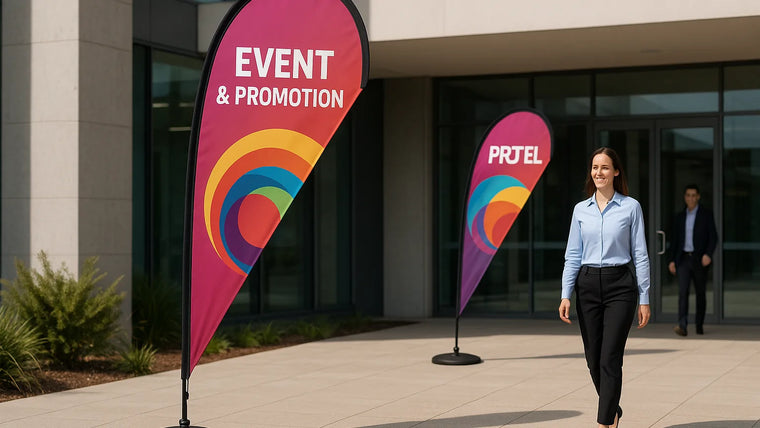
Teardrop Banners for Events and Promotions
Teardrop banners are aerodynamic, curved‑top fabric flags that hold tension to minimise flapping, delivering high visibility for events, retail forecourts and outdoor activations. Systems...
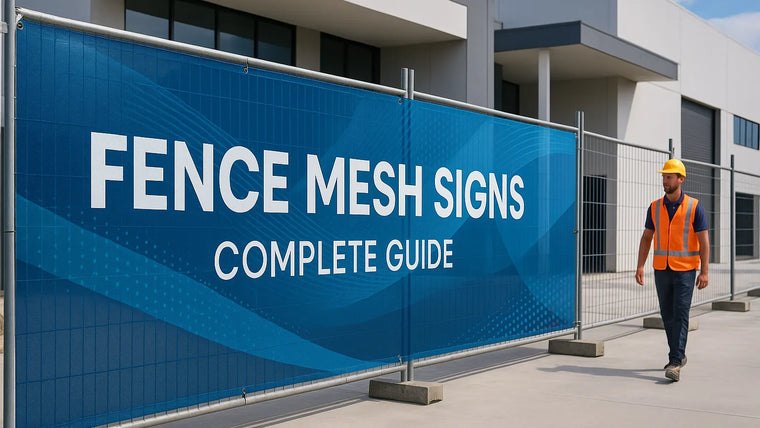
Fence Mesh Signs: Complete Guide
Fence mesh signs are printed mesh banners designed for temporary fencing and hoardings. Mesh allows airflow and can help reduce wind load compared with...
Best Materials for Crowd Control Barrier Graphics
For most outdoor events in Australia, perforated mesh banner is a versatile option because airflow can help reduce wind effects and it’s quick to...