The quickest way to waste a signage budget is to select the wrong material for the job. In safety-critical environments, an incorrect substrate or finish can also undermine recognition, shorten service life or create the impression that rules are optional. Choosing a sign manufacturer is therefore not just about price and turnaround — it is about whether they understand materials, processes and standards well enough to recommend the right construction for your site.
What changes when the right material is chosen
Correct material selection determines how a sign prints, installs, survives outdoors and remains legible over time. It also influences whether recognised safety conventions are preserved where relevant, and whether future maintenance is straightforward. If you’re unsure, complete the interactive material selection checklist or review our material explainers for ACP vs solid aluminium and anti-graffiti laminates before you lock in artwork.
- Compliance preserved: recognised formats and colours are kept where a standard applies, avoiding lookalike signs that weaken recognition.
- Durability matched: UV, heat, rain, wind and coastal exposure are addressed with suitable substrates, inks and laminates.
- Install made practical: panel thickness, rigidity and fixing points are compatible with posts, walls or equipment.
- Lifecycle controlled: the face can be renewed when needed without scrapping a good structure.
- Project constraints considered: where fire or engineering requirements exist, select suitable grades (for example, FR ACP where specified) and document these in the checklist.

Compliance and safety meaning depend on construction choices
In Australian workplaces, safety-sign categories follow recognised conventions described in AS 1319 (see our AS 1319 guide). While the standard does not prescribe a single substrate for every sign, the construction still matters: a flimsy or poorly finished sign can be overlooked, and brand colour substitutions can reduce quick recognition of mandatory or prohibition formats.
For traffic-related or road-adjacent requirements, refer to the relevant part of the AS 1742 series and the specified reflective material class (selected using AS/NZS 1906.1 for traffic control materials — see how to choose reflective classes and our reflective films explainer). A workplace sign should not be treated as a road sign without checking the site context and authority specification.
Durability is a system, not a sticker
Outdoor service life is driven by the complete system: substrate, ink set, laminate, fixings and installation quality. In Australia, north- and west-facing exposures receive intense UV. Coastal locations add salt and wind-borne abrasion. A suitable construction for a sheltered foyer will not automatically suit a sun-exposed yard or a marine environment. Our production QA includes adhesion checks (tape-pull on sacrificial strips), solvent-rub spot tests and outdoor exposure panels at our Brisbane facility to validate combinations before wider release.
- Substrate: Solid aluminium is often preferred for robust, long-term external safety signs; ACP is excellent for many general panels but should be checked against any project fire or structural requirements (see ACP vs solid aluminium).
- Print system: UV flatbed printing can be used directly on compatible rigid panels; wide-format printing on self-adhesive media is useful where reflective, specialty films or later face replacement are expected (see reflective films).
- Lamination: Protective overlaminates add abrasion resistance and can assist with UV protection. Anti-graffiti films help in public spaces but must be compatible with the print system (see anti-graffiti laminates and approved cleaning methods).
- Fixings: Mechanical fixing is preferred for larger or wind-exposed signs. Adhesive-only mounting suits small, indoor or smooth-surface applications when the surface is compatible. For detailed methods, see fixing aluminium/ACP panels.

Print method and finish selection
There are two common approaches for rigid sign faces: direct print to panel, or print to film then apply to a panel. Each has benefits depending on the environment, colour expectations and whether future renewal of the sign face is likely. When reflective performance is required under AS/NZS 1906.1, a film-applied system is typically used — see our reflective films and overlaminates guide.
- Direct print: Fewer layers and efficient production when the panel is compatible with UV ink and the colour target can be achieved.
- Printed film applied: Offers flexibility in film grades, reflective options and laminate systems — useful for safety and traffic-related signage where specific sheeting or overlaminate performance is specified.
- White ink and specialty cases: When printing on clear or coloured substrates, white ink underbases preserve colour density; reverse printing to clear acrylic protects the image behind the face.
| Feature | Option A | Option B |
|---|---|---|
| Construction | Direct UV print to compatible rigid panel | Printed self-adhesive film applied to a panel |
| Layer count | Single print layer on substrate | Film + adhesive + optional laminate on substrate |
| Colour/finish flexibility | Good; dependent on ink/substrate combo | High; broad film and laminate choices |
| Reflective options | Limited | Wide range via reflective films |
| Face replacement | Usually replace full panel | Can replace film/face only if structure is sound |
| Edge handling | Print to edge; durable if cured correctly | Edges need correct sealing and application |
| Typical use | General panels, ACM/aluminium, indoor/outdoor | Safety signs needing specific films or laminates; reflective; anti-graffiti upgrade |

Fabrication and installation consequences of material choice
Material is inseparable from how a sign is made and mounted. CNC routing is used for thicker sheets, large shapes, rebates and holes on materials like aluminium composite and selected plastics. Laser cutting excels on acrylic letters, panels and small components, delivering clean edges on suitable grades. Digital contour cutting creates custom-shaped decals and labels where a rectangle would add visual clutter. We preflight drawings to ensure hole layers, cut paths and finishing notes meet our artwork specification before machining.
- Cut-to-shape: Ensure artwork includes accurate cut paths and clearances around critical text.
- Installation planning: Consider wind load, bracket type, access and whether a sign needs to be panelised into manageable sections before printing.
- Fixing method: Match fasteners and structural supports to the substrate and environment; avoid galvanic corrosion combinations in coastal areas and use isolation washers/tapes where dissimilar metals cannot be avoided.
- A yard entry sign in a coastal town specified with solid aluminium, printed film and anti-graffiti laminate to balance corrosion resistance and cleanability.
- A factory hazard suite produced as direct print to ACP for speed, with mechanical fixing to concrete walls where adhesive would have underperformed.
- A reception directory reverse printed to clear acrylic to protect the graphic from handling and cleaning.
- A pedestrian crossing inside a logistics yard upgraded to Class 1 reflective legend per AS 1742 context using a film-applied face — see reflective class selection.
Workflow signals that indicate strong material competence
Ask how a manufacturer controls quality across materials and processes. Practical signals of material competence include:
- Artwork proofing step: A documented check for wording, colour and layout before production.
- Prototyping when novel: Trialling unusual combinations or complex fixings before a volume run.
- Colour management: Requesting recognised colour references and, when critical, providing printed samples for approval.
- Variable-data discipline: Using structured spreadsheets for sequential labels so sizes and terminology stay consistent.
- Panelisation planning: Designing joins and supports before print for large-format installs.
- Freight preparation: Packaging that protects corners, edges and printed faces; special arrangements for oversized or fragile items.
- Adhesion verification: Evidence of in-house tape-pull/solvent rub checks and edge-seal practice when films are cut to size.
Questions to ask a prospective supplier
These questions reveal whether material advice is based on experience:
- Which substrate do you recommend for this environment and why?
- Will you direct print or use printed film on a panel, and what does that change for future maintenance?
- What laminate, if any, is appropriate for abrasion, UV or anti-graffiti?
- How will the sign be fixed, and is that compatible with the substrate and structure?
- Does any part of this project relate to AS 1319 or AS 1742 requirements, and how will the reflective or colour performance be met if applicable?
- Can we prototype an unusual element before full production?
- How will packaging and freight protect the product to site?
- What is the expected service life for this construction in my exposure, and how is that validated?
Branding on safety signs without losing clarity
Adding a logo or contact detail is often acceptable if the core safety message remains prominent and the recognised format is preserved where a standard applies. Avoid replacing standard colours, symbols or signal words with brand elements. The goal is to improve relevance, not to compete with the safety message. If in doubt, cross-check against AS 1319 conventions.
How Sign Portal applies material knowledge
Manufacturing in-house in Brisbane allows printing, cutting, engraving and fabrication to be coordinated within one workflow. UV flatbed printing, wide-format printing, CNC routing and laser cutting are operated side by side, so the construction of a sign can be tuned to the site requirement rather than forced into a single method. Co-located lamination and routing means film-applied faces are matched with compatible overlaminates and edge-handling steps without cross-facility delays.
- Direct printing on panels: Using UV flatbed capability on compatible ACP and aluminium for efficient production.
- Film-based systems: Wide-format print with protective or anti-graffiti laminates where specific film performance or reflective treatments are required.
- Precision fabrication: Laser cutting for acrylic components, CNC routing for thicker panels and complex cut-outs, and digital contour cutting for decals and labels.
- Short-run agility: Prototypes, one-offs and variable-data labels produced without long tooling lead times.
Ordering, delivery and lifecycle
Before production, provide the required message, dimensions, material preference (if any), viewing distance, exposure and installation method. If a standard, regulation or site rule applies, supply it with the order. Artwork should include vector cut paths where needed, suitable image resolution and clear separation of drill holes or special finishing from print layers — see artwork specification for setup details.
For delivery, robust packaging should protect printed faces, edges and corners. Large or fragile assemblies may need reinforced packaging or specific freight arrangements. After installation, clean using manufacturer-compatible methods, and inspect periodically — frequency should reflect risk, exposure and the consequence of reduced legibility. For anti-graffiti sets, follow the cleaning guide to preserve the laminate surface.
Replace signs when fading, delamination, corrosion, impact or graffiti prevents reliable recognition. Where the structure remains sound, consider replacing only the graphic face to reduce waste and cost.

Related guides, specifications and tools
- Guide: Understanding AS 1319 safety sign categories
- Guide: Choosing reflective classes under AS/NZS 1906.1 for AS 1742 signage
- Material explainer: ACP vs solid aluminium for safety signs
- Material explainer: Anti-graffiti laminates and compatibility
- Material explainer: Reflective films and overlaminates
- Process guide: Fixing aluminium/ACP panels to walls, posts and fences
- Artwork specification: File setup, cut paths and hole layers
- Maintenance: Cleaning methods for anti-graffiti films
- Service: Repair and re-face of existing signs
- Interactive tool: Material selection checklist and Download the checklist as a PDF
Case study: Coastal safety signage package — solid aluminium + anti-graffiti
Site: Council depot, Central Queensland coast. Environment: Full sun, sea breeze with salt spray, public interface prone to tagging. Scope: 48 safety and information signs (Danger/Mandatory/Notice), gate panels and directional blades.
- Construction: 3 mm solid aluminium panels, etched/pre-treated, face finished with high-tack printed engineering-grade reflective film and fluoropolymer anti-graffiti overlaminate. All corners R6 and deburred.
- Fixings: 316 stainless rivets/bolts with nylon isolation washers; isolating tape between panel and galvanised steel posts to minimise galvanic coupling.
- Print/finish: Film-printed with solvent/latex inks for reflective compatibility; overlaminated with non-sacrificial anti-graffiti film rated for repeated solvent cleaning.
- Installation: Panelised for wind loads; thread-locked fasteners and tamper-resistant heads at public-facing locations.
- Quality controls: Adhesion checks on sacrificial tabs, edge-seal on cut reflective faces, and documented job traveller sign-offs at print/laminate/pack stages.
- Asset tracking: Each panel laser-marked on rear with item code and location ID to streamline reorders and future maintenance.
Measured outcomes after 18 months: No blistering or edge lift; colour shift within acceptable safety tolerance; 5 graffiti removal events completed with citrus and alcohol-based cleaners without ghosting or ink pick. Routine rinse-down adopted quarterly.
See more projects like this: Coastal safety signage case studies
Technical specifics to guide material choice
- Typical substrates: Solid aluminium 1.6–3 mm for external safety; ACP 3 mm for general panels; acrylic (3–6 mm) for interiors; polycarbonate for impact-prone areas.
- Reflective classes (AS/NZS 1906.1): Engineer Grade (EGP) for general workplace reflectivity; Class 1 (Class 400/1W) where road-adjacent or authority-specified.
- Laminates: UV durable clear (matte/gloss) for abrasion; fluoropolymer or PVDF anti-graffiti for public spaces; ensure adhesive system suits the ink/film.
- Edges and holes: Round corners (R3–R6) and de-burr. Pre-drill with correct clearance for thermal movement; seal cut film edges where exposed.
- Fixings: Use 316 stainless in coastal/wet areas; match post spacing to panel stiffness; consider backing rails for large spans and high-wind sites.
- Mounting height and glare: Typical eye-level installs place the sign bottom edge ~1500–1700 mm above FFL indoors; outdoors adjust for sightlines and vehicle traffic. Use matte laminates to reduce glare in sunlit corridors.
Repair, renewal and reorder
Safety signage is a lifecycle asset. Plan for repair and straightforward reordering to keep messages legible without overspending.
Repair and re-face
- Re-face where structure is sound: If the substrate and fixings are intact, we can strip and reapply a new face film/laminate to extend life and reduce waste. See repair and re-face service.
- Surface preparation: Old films are heat-released and adhesive residues removed; the face is cleaned, lightly abraded if required, solvent-wiped, then re-faced and edge-sealed (when film edges are exposed).
- Minor damage: Replacement of individual panels within a set is viable when colour-managed to the original drawdown.
- Graffiti events: Non-sacrificial anti-graffiti laminates allow repeated cleaning. Follow our cleaning guide to avoid dulling or edge lift.
- Turnaround options: SEQ clients often opt for swap-over: pre-made faces/panels are delivered, damaged items returned for workshop refurbishment.
Reorder made simple
- Reorder codes: Every Sign Portal job ships with a delivery docket listing item codes, sizes and material stacks. Quote this code to reorder instantly.
- Artwork/version control: We archive approved PDFs and production profiles. Reorders use the last signed-off version unless you request an update.
- Asset tags: On request, we add a discreet QR/reorder ID on the reverse to scan and prefill a reorder cart.
- Kitting: Multi-site packs ship with location schedules and spare fixings to reduce install time and mismatch risk.
- Turnaround: Common safety formats are kept as calibrated presets, enabling priority reprints for critical replacements.
Material selection checklist
Use this checklist to align material choice with environment, compliance and lifecycle. Complete the interactive web checklist or download the PDF to share with your team.
- Is the sign governed by AS 1319 or road-adjacent AS 1742? If yes, confirm symbol set, colours and any reflective class.
- Exposure: sun orientation, shade, temperature extremes, coastal/spray, vandalism risk.
- Substrate: solid aluminium, ACP, acrylic or other — consider stiffness, corrosion and fire/project requirements.
- Face: direct UV print or printed film (reflective/specialty) — is future re-facing desirable?
- Laminate: standard UV protective or anti-graffiti; matte vs gloss for glare control.
- Fixings: posts/walls/fences — fastener type, spacing, isolation from dissimilar metals.
- Edges and holes: corner radius, hole positions, film edge sealing needed?
- Cleaning regime: approved cleaners, frequency and responsibility.
- Identification: item codes, location plans and reorder IDs captured?
- Site constraints: access equipment, heights, clearances, power isolation or permits required for install.
First-party capability: equipment, controls and results
- Equipment: UV LED flatbed printers (with white ink for underbasing), 1.5–1.6 m wide roll printers for films/reflectives, CNC routing with vacuum hold-down for metals/ACP, CO₂ laser cutting for acrylics, and digital cutters with optical registration for precision decals; rotary engraving for durable plates and tags.
- Process control: Spectrophotometer-based colour management, documented job travellers, press/laminate/pack QC sign-offs, and material lot traceability on dockets.
- Compliance practice: Use of films and overlaminates specified to AS/NZS 1906.1 where applicable; layouts reviewed against AS 1319 formats when requested.
- Real results: Multi-site industrial clients report 5–7 year legibility on external aluminium sets under routine cleaning; anti-graffiti films supporting 20+ clean cycles without image loss when cleaned per our guide.
Practical install notes
- Pre-mark hole centres in artwork layers to avoid clashes with symbols or text.
- Use backing rails or channel for spans over 1200 mm or in high-wind corridors.
- On masonry, prefer mechanical fixings with stand-offs rather than adhesive-only mounting.
- Seal penetrations and cut edges where water ingress is likely.
- Tighten fasteners to snug plus a quarter-turn on softer aluminium panels to avoid dimpling; use isolation washers with dissimilar metals.
If you need help selecting a construction, start a quote and attach the completed checklist: Material selection checklist.
Related Sign Portal resources: Aluminium Composite Signs
Frequently Asked Questions
How does material choice affect safety-sign compliance?
Standards like AS 1319 define recognised formats for workplace safety signs. While they do not mandate one substrate, the construction must preserve legibility, contrast and the recognised format. Poor material choices can undermine recognition or durability.
When should I use solid aluminium instead of ACP?
Choose solid aluminium for robust, long-term external signs, higher impact resistance or when a non-composite metal sheet is specified. ACP is excellent for many general panels but should be checked against project fire and structural requirements.
Do I need a laminate on outdoor printed signs?
Often yes. A protective laminate can improve abrasion resistance and cleanability, and some laminates assist UV resistance. Match the laminate to the print film and application; a laminate does not make every system suitable for every environment.
Is direct print better than applying printed film?
Neither is universally better. Direct print reduces layers and is efficient on compatible panels. Printed film offers broader material and reflective options and can make face-only replacement easier later. Choose based on environment, specification and maintenance plan.
What information should I provide when ordering a custom safety sign?
Supply the message, sign category, dimensions, viewing distance, location photo, exposure, fixing method and any governing standard or site specification. Provide vector artwork and recognised colour references where colour is critical.
Can I add branding to a safety sign?
Yes, provided the required safety meaning, colours and symbols remain prominent and unchanged where a recognised format applies. Branding should not compete with the safety message.
How often should installed safety signs be inspected?
Inspection frequency depends on risk and exposure. High-risk, vandalism-prone or harsh-environment signs need more frequent checks than stable indoor identification signs. Add inspections to your site maintenance system.
Keep learning
Related Articles
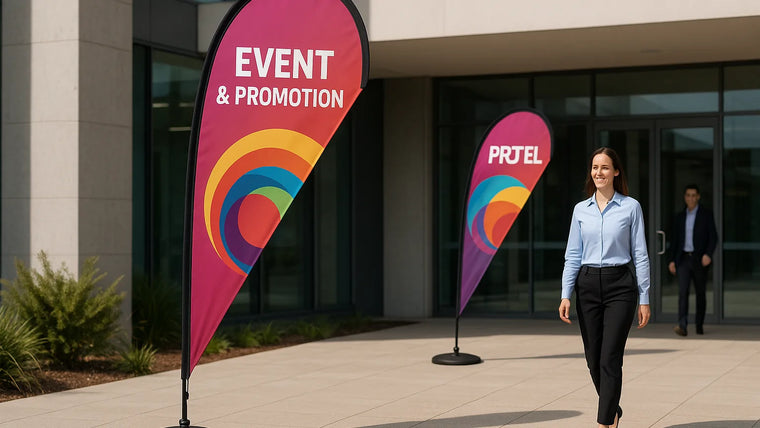
Teardrop Banners for Events and Promotions
Teardrop banners are aerodynamic, curved‑top fabric flags that hold tension to minimise flapping, delivering high visibility for events, retail forecourts and outdoor activations. Systems...
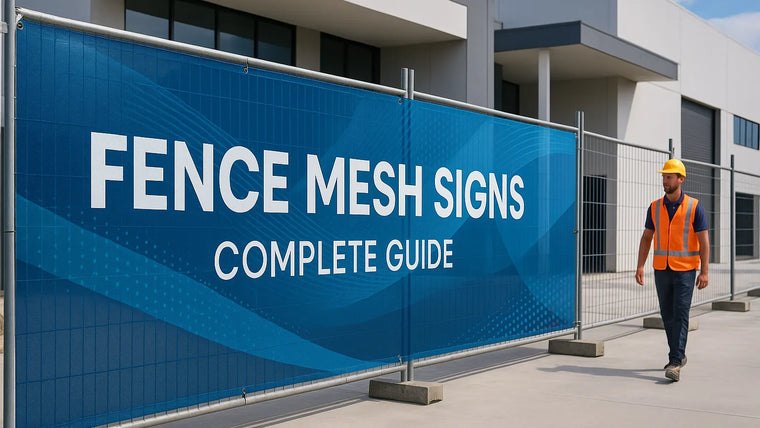
Fence Mesh Signs: Complete Guide
Fence mesh signs are printed mesh banners designed for temporary fencing and hoardings. Mesh allows airflow and can help reduce wind load compared with...
Best Materials for Crowd Control Barrier Graphics
For most outdoor events in Australia, perforated mesh banner is a versatile option because airflow can help reduce wind effects and it’s quick to...