Long-term: 3–4 mm FR ACP or 2–3 mm solid aluminium with cast vinyl + laminate. Short-term: Corflute or PVC banners.
The best materials for outdoor business signs in Australia depend on lifespan and exposure. For multi‑year installs, specify aluminium composite panel (ACP) or solid aluminium with a compatible protective laminate. For weeks‑to‑months campaigns, choose Corflute, solid polypropylene, or event banners. Always treat print, laminate and fixings as one system—our UV, heat, wind and coastal salt punish mismatched components. If a landlord, centre or precinct has a signage manual, start there and match their material and fire-performance notes before you order. This guide shows where ACP, solid aluminium, acrylic, Corflute, polypropylene, banners, vinyl films, reflective and specialist materials fit, and when to add lamination or anti‑graffiti films. Scope: brand, wayfinding and promotional signage for businesses and venues (not regulated hazard/traffic devices).
Quick recommendations: best materials for outdoor business signs
If you need a fast shortlist, choose the material by how long the sign must last and the conditions it will face. Then confirm the print method, laminate and fixing approach as a complete system.

- Short campaigns (weeks to a few months): Corflute (fluted polypropylene) or lightweight polypropylene sheets; event banners (mesh or solid) with hem and eyelets.
- Seasonal and medium term: ACP with printed self‑adhesive vinyl and protective laminate; quality banners tensioned properly; changeable panels in existing frames.
- Long term and coastal: Solid aluminium panels with printed/laminated film; ACP where suitable and allowed by the site specification; reverse‑printed acrylic for premium faces under shelter.
- High‑abuse or public areas: Add anti‑graffiti laminate to printed faces; consider engraved laminates for labels and identification plates.
Looking to specify now? See product options: Aluminium Composite Panel (ACP) signs and Solid aluminium signs.
Key outdoor factors for outdoor business signs in Australia
Material choice is only part of outdoor performance. UV intensity, heat, wind, moisture and coastal salt all interact with the substrate, inks, adhesive and laminate. Orientation and shading matter too: north‑ and west‑facing signs typically see greater solar exposure.
- UV and heat: Accelerate ink fading and can stress plastics; use outdoor‑rated inks, laminates and substrates.
- Coastal exposure: Promotes corrosion; prefer corrosion‑resistant metals, compatible fixings and regular inspection.
- Wind loading: Large flexible areas (e.g., banners) need tensioning and allowance for gusts; rigid panels need adequate structure.
- Vandalism and cleaning: Public‑facing signs benefit from anti‑graffiti laminates and compatible cleaning methods.
- Thermal movement: Aluminium/ACP expand ~0.23–0.25 mm per metre per 10 °C. Allow slotted/oversize holes on long runs and use washers.
Options and where each fits
Aluminium composite panel (ACP) for outdoor business signs
ACP is a rigid sheet with thin aluminium skins and a lightweight core. It offers good flatness at low weight and is widely used for shopfronts, building identification and general panels. Suitability should be assessed for the actual location and any fire‑performance requirement specified by the site.
- Typical uses: Fascia panels, directional boards, wall‑mounted signs, changeable faces on existing frames.
- Strengths: Flatness, light weight, economical for many panel sizes.
Where fire properties are specified, select FR‑core ACP to the project documentation; use PE‑core only where permitted. Minimum fold radius, groove depth and skin thickness vary by brand—test before production, especially for tight folds or cold weather installs.
Explore specs and ordering: ACP signs.
Solid aluminium for outdoor business signs
Solid aluminium sheet is preferred where a non‑composite metal, greater impact resistance or a project specification calls for it. It can be direct UV‑printed or faced with printed vinyl (including reflective where relevant). Select thickness, alloy and fixing method for sign size, wind exposure and mounting structure.
- Typical uses: Long‑term external panels, coastal sites, durable identification, regulatory environments outside road traffic.
- Strengths: Robust, corrosion‑resistant when finished appropriately, suitable for heavy‑duty fixings.
- Consider: Weight versus substrate strength; compatible fasteners to avoid galvanic corrosion.
- Common alloys: 5005 (good for anodising/flatness) and 5052/5251 (tough, marine environments). Choose 2.0–3.0 mm for most wall panels; 3.0 mm+ for posts and cantilever brackets.
Edge finishing options include deburr + seal, powder coat, or full‑face vinyl wrap with returned edges where geometry allows.
See options and pricing: Solid aluminium signs.
Acrylic (PMMA) for outdoor business signage
Acrylic provides a premium, glass‑like appearance for directories, reception faces and display panels. Reverse printing to the rear protects the graphic behind the clear face. For outdoor use, choose grade and thickness for the environment and mounting method, and avoid treating acrylic like sheet metal in design.
- Typical uses: Branded panels under awnings, directories, stand‑off wall plates.
- Strengths: High visual clarity; laser‑cut edges present cleanly.
- Consider: Thermal movement, impact risk and mounting clearances.
Corflute (fluted polypropylene) for outdoor signs
Corflute is lightweight and economical for temporary and short‑term outdoor signs. It is easy to transport and install but less rigid and durable than metals or acrylics. Consider wind exposure, fixing method and viewing life before using in exposed locations.
- Typical uses: Real estate boards, construction notices, temporary wayfinding, event signage.
- Strengths: Low cost, fast turnaround for short runs.
- Consider: Bowing in wind, reduced lifespan under strong UV, secure fixing.
Polypropylene sheet (solid) for temporary outdoor business signs
Solid polypropylene sheets can be used for lightweight signs where moisture resistance and low weight are useful. Stiffness, print compatibility and UV exposure vary by grade; select the product for the actual environment rather than assuming all sheets perform the same.
Ask for an outdoor‑rated, UV‑stabilised grade and confirm ink/laminate compatibility if the sign is expected to last beyond a few months.
Banner materials for outdoor business signs (mesh and solid)
Outdoor banners suit events, hoardings and temporary branding. Material weight, edge finishing (hems, eyelets, pockets) and tensioning are critical. On fences and structures, size and fixing should match wind exposure; large banners may require engineering or approval depending on the installation.
- Mesh banner: Allows air to pass and reduces wind load on large spans.
- Solid banner: Strong colour density where wind exposure is managed.
Rule of thumb: Common mesh has ~30–40% open area—helpful, but not a substitute for good tensioning and sufficient fixing points.
- Street fence branding: A 5 m mesh banner with webbed hems and 300 mm eyelet spacing fixed with bungee loops at each eyelet—no more torn corners compared to the earlier cable‑tie setup.
- Pop‑up market stall: Solid banner under an awning with pole pockets top/bottom for even tension; colour density stays strong out of direct wind.
Self‑adhesive vinyl films for outdoor business signs
Printed vinyl films are applied to panels, windows and vehicles. Media and adhesive vary widely; choose for the surface, exposure, durability and removal needs. Add a compatible protective laminate where abrasion, cleaning or UV exposure are significant.
- Polymeric calendered: Cost‑effective for flat panels, typical outdoor life 3–5 years with laminate.
- Cast film: Best conformance and stability for curves/edges; longer life, premium finish.
- Adhesives: Permanent (high tack) for textured/low energy surfaces; removable for face‑change systems; air‑release for easier application on larger panels.
- Lamination: Match manufacturer family (ink/media/laminate) to maintain warranty and avoid shrink/curl.
Reflective sheeting for outdoor business signage
Reflective films improve night‑time visibility. For regulated traffic applications, use the reflective class and construction specified by the road authority and relevant standards. For general business signs near roads, reflective may still be useful but should not be assumed to meet traffic‑sign requirements.
Engraving laminates and phenolic labels for durable outdoor signage
For durable identification plates and equipment labels, multi‑layer engraving laminates and phenolic sheets produce permanent contrast without surface ink. Select by UV, temperature and chemical exposure when used outdoors.
Thickness and span quick guide for rigid outdoor sign panels
- Up to 600 × 900 mm: 3 mm ACP or 2.0–3.0 mm aluminium for walls; add larger washers in public areas.
- Up to 1200 × 2400 mm: 4 mm ACP or 3.0 mm aluminium; fix to a batten/frame grid at ~400 mm centres.
- 3000 mm length or longer: Use panel splits, concealed stiffeners, or step up to 5 mm ACP where allowed; allow for thermal movement.
- Post‑mounted: Prefer 3.0 mm aluminium; use double posts for widths ≥900 mm.
ACP vs solid aluminium: best materials for outdoor business signs
Many projects narrow quickly to ACP versus solid aluminium for rigid panels. The matrix below highlights practical differences to help specify the right option for site and lifespan.
| Feature | Aluminium composite panel (ACP) | Solid aluminium |
|---|---|---|
| Rigidity vs weight | High stiffness at low weight; good flatness for large faces | Rigid and robust; heavier for the same area |
| Impact resistance | Good for general use; core can dent under heavy impact | Better resistance to dents and edge damage |
| Coastal suitability | Project‑specific; confirm product and fixings for salt exposure | Generally preferred with compatible finishes and hardware |
| Print approach | Direct UV print or printed vinyl + laminate | Direct UV print or printed vinyl (incl. reflective) + laminate |
| Fire and specification | Often selected where non‑composite metal is specified | |
| Cost efficiency | Often more economical for many panel sizes | |
| Typical uses | Shopfronts, fascia panels, general branding | Long‑term external panels, coastal sites, heavy‑duty |
Print methods and protective finishes for outdoor business signs
Rigid signs can be produced by printing directly to a compatible panel (UV flatbed) or by printing to self‑adhesive film and applying it to the panel. Direct printing simplifies construction; printed film expands media choices, laminate options and future face renewal.
- UV flatbed printing: Direct to ACP, acrylic (where appropriate) and metals when adhesion is suitable. Sign Portal operates two Mimaki JFX EX flatbed UV printers for large, rigid work.
- Printed film + laminate: Offers gloss/matte choices, anti‑graffiti options and reflective variants; easier to replace just the face later.
- White ink layers: Useful for clear or coloured substrates to maintain colour strength and opacity.
- Reverse‑printed acrylic: Protects the image behind the clear face for a premium finish.
UV printing durability for outdoor business signs (Mimaki JFX EX)
Our Mimaki JFX EX flatbeds use LED‑cured UV inks with variable‑dot control for crisp text and smooth gradients on rigid panels. Typical outdoor life on suitable media is 3–5 years unlaminated; add a matched laminate for extended UV protection, easier cleaning and added chemical resistance in high‑touch or coastal environments.
- Adhesion: Optimised print profiles and primers (where required) for aluminium and ACP to resist edge lifting during washing.
- Finishes: Choose gloss, satin or matte laminates; anti‑graffiti films resist repaint, marker and aerosol tagging with approved cleaners.
- Maintenance: Wash with pH‑neutral detergents and soft cloths; avoid aggressive solvents such as MEK or thinners on printed faces.
Capabilities reference: bed size to 2500 × 1300 mm, media up to ~50 mm thick, pin registration for panel sets, and colour management with ICC workflows for consistent repeat runs.
Fabrication and mounting for outdoor business signs
Correct fabrication and fixing can matter as much as material choice. Poorly supported panels, incompatible fasteners or under‑sized frames accelerate failure outdoors.
- CNC routing: Ideal for ACP, aluminium and many plastics when cutting larger shapes, holes and rebates. Sign Portal routes on a MultiCam SM2412.
- Laser cutting: Delivers clean acrylic letters and shapes on our Trotec Speedy 500 and large‑format CO2 laser where geometry suits laser processing.
- Cut‑to‑shape: Digital cutting enables custom outlines for logos and directional panels; ensure artwork includes accurate cut paths and bleed.
- Mechanical fixing: Use screws, bolts, brackets or posts sized for wind and substrate. Avoid galvanic corrosion by matching metals appropriately.
- Adhesive mounting: Suitable for smooth, clean surfaces with compatible adhesives; avoid textured, contaminated or low‑energy plastics without appropriate media.
- Large‑format planning: Big signs may require panel splits for printer width, transport and access. Plan joins and alignment early.
Routed ACP edges and finishing for outdoor signs
Well‑finished edges improve longevity and presentation:
- Edge quality: Use sharp carbide tools and correct chip‑load to minimise burring on ACP skins; de‑burr lightly without thinning the face sheet.
- V‑groove folding: For folded returns, V‑groove route leaving ~0.3–0.5 mm aluminium skin + minimal core; pre‑test fold angles to avoid cracking paint layers.
- Sealing: For exposed cores (e.g., cut‑outs), seal edges with compatible sealant or edge‑cap to reduce water ingress in harsh environments.
- Stand‑off trims: Consider U‑channel or dress trims on public‑touch edges to resist prying and delamination.
- Corner design: Use ≥3 mm internal corner radii on cut‑outs to reduce crack initiation at sharp inside corners.
Bonding and hybrid fixings for outdoor business signs
- Tape + adhesive method: For flat, unseen mounts, combine a structural tape (for immediate hold) with a compatible construction adhesive (for long‑term strength). Surface prep: degrease with IPA, abrade as specified, then prime if required. Clamp to cure.
- Thermal movement: Use vertical tape strips and discrete adhesive dabs to allow breadth‑wise movement on long fascias.
- Fastener torque: “Nip tight, not crushed” on ACP—over‑tightening dimples skins and invites water ingress. Use large OD washers.
Post‑mounted and projecting outdoor business signs
- Posts: 50 × 50 mm SHS or Ø60–76 mm round posts for typical site signs; embed or bolt to engineered bases.
- Panel thickness: Prefer 3.0 mm aluminium for blade/flag signs; add anti‑vibration stiffeners on spans >600 mm.
- Banding: Stainless band clamps on poles—use rubber isolators to prevent bimetallic contact and slip.
- Projecting brackets: Keep bracket centres ≤600–800 mm apart for A3‑ish blades; reduce spacing in windy corridors.
- Retail fascia: ACP panels contour‑cut for letters, printed film + matte laminate for brand colours, fixed to battens with concealed screws.
- Coastal facility: Solid aluminium plates with printed reflective faces for wayfinding; stainless fixings to avoid galvanic corrosion.
- Event precinct: Mesh banners on temporary fencing with reinforced hems and corner eyelets to reduce sail effect.
Wind exposure and fixing spacing for outdoor business signs (technical guidance)
This section offers practical, non‑engineered guidance for common sign panels in typical Australian conditions. Always assess the actual site, height above ground, terrain, shielding and wind region per AS/NZS 1170.2. For large panels, elevated installations, cyclonic regions (C/D) or critical safety locations, obtain project‑specific engineering.
Site factors that change fixings for outdoor business signs
- Wind region: A/B (most inland/coastal metro) vs C/D (cyclonic northern WA/QLD, some coastal exposures).
- Height and terrain: Roof parapets and exposed corners experience higher local pressures than ground‑level walls.
- Substructure: Fix to studs/battens, not cladding alone; confirm substrate pull‑out capacities.
Fastener types and washers for outdoor business signs
- ACP to timber/steel: 4.8 mm aluminium or stainless rivets with 12–16 mm heads, or No.8–No.10 pan‑head screws with 16–19 mm OD washers.
- Aluminium to masonry: M6 mechanical anchors or appropriate screw + nylon plug; use nylon isolators where dissimilar metals contact.
- Coastal: Prefer 316 stainless fixings and isolate from copper/treated timber to reduce galvanic action.
Fixing layout by panel size for outdoor business signs
Assumes wall‑mounted panels at low level in Regions A/B, serviceability deflection limit approx. L/60–L/100. Use closer spacings or thicker material for higher exposures. Edge distances measured from panel edges to fastener centres.
| Panel size (mm) | Substrate | Minimum thickness | Perimeter fixing spacing | Internal fixing grid | Notes |
|---|---|---|---|---|---|
| 600 × 900 | ACP | 3 mm | ~150–200 mm | None required | 4–6 fixings total; use washers in public areas |
| 600 × 900 | Solid aluminium | 2.0–3.0 mm | ~150–200 mm | None required | Consider 3.0 mm if cantilevered or post‑mounted |
| 1200 × 900 | ACP | 3–4 mm | ~200 mm | 1 mid‑span row at ~400–450 mm | Add centre fixings to reduce oil‑canning |
| 1200 × 2400 | ACP | 4 mm | ~200 mm | Grid at ~400 mm centres | Fix to batten frame; consider 5 mm in high wind |
| 1200 × 2400 | Solid aluminium | 3.0 mm | ~200 mm | Grid at ~400–500 mm | Heavier panel; confirm wall capacity |
| 1500 × 3000 | ACP | 4–5 mm | ~150–200 mm | Grid at ~300–400 mm | Engineer for Region C/D or elevated positions |
- Edge distance: Keep fixings at least 20–25 mm from ACP edges (centre of hole) and 15–20 mm for solid aluminium to reduce tear‑out.
- Oversize holes: Allow 2–3 mm clearance for thermal movement on long runs; use washers or slot holes in one axis.
- Frames: For panelised fascias, a 50 × 50 mm aluminium angle/batten grid at 400–600 mm centres improves stiffness and fixing quality.
Post spacing guide for outdoor business signs (non‑engineered)
- 600 mm wide panel: single post acceptable for small blades; prefer two posts for public areas.
- 900–1200 mm wide: two posts, centres at 600–900 mm. Add rear stiffener if flutter observed.
- 1200–1800 mm wide: two posts at ~75–85% of panel width; consider a third rear brace in windy sites.
Need panels supplied pre‑drilled to a fixing plan? Order via ACP signs or solid aluminium signs and attach your hole drawing.
Recommendations by application: best materials for outdoor business signs
Shopfront fascia and building identity: outdoor business signs
ACP with printed/laminated film offers flatness and efficient coverage for large faces. Where higher impact resistance or coastal conditions apply, solid aluminium with printed/laminated film is a robust alternative. Stand‑off acrylic logos add premium detail to sheltered locations.
Fast ordering links: ACP fascia panels or solid aluminium fascia panels.
Wayfinding and site directories: outdoor business signs
Rigid panels in ACP or aluminium with replaceable printed faces support updates as tenancies change. Consider anti‑graffiti laminate in public spaces and ensure arrows and contrast are clear for legibility.
Construction hoardings and projects: outdoor signage materials
Mesh or solid banners for big spans; Corflute for temporary notices. For extended projects, ACP/aluminium panels with printed film withstand weather and allow face refreshes if project branding changes.
Car parks and near‑road edges: outdoor business signs
If a sign functions as a road traffic device, follow the relevant authority requirements and standards for reflective classes and layouts.
Events and pop‑ups: outdoor business sign materials
Banners and Corflute are practical for rapid deployment and economical replacement. Use mesh where wind is a concern and ensure secure fixings to fencing or frames.
Artwork and ordering essentials for outdoor business signs
Good artwork and approvals reduce delays and rework. Production‑ready files should include vector logos where possible, correct dimensions, suitable image resolution and clearly separated cut/print layers. Where contour cutting is used, provide a clean vector cut path and adequate bleed.
- Artwork proofing: Check wording, spelling, colours, dimensions, quantities and layout before manufacture.
- Colour matching: Supply recognised colour references or approved samples; printed colour is influenced by substrate, ink set and lighting.
- Variable data: Spreadsheets can drive sequential labels and asset numbers accurately when checked carefully prior to production.
- Short‑run efficiency: Digital printing, laser cutting and CNC routing support one‑offs and prototypes without tooling, but consistent specs still help.
- Panel splits: Where artwork exceeds ~2500 mm on the short side, plan for a join aligned to a natural graphic break (our flatbeds print to 2500 × 1300 mm in one piece).
- Fonts and links: Convert text to outlines and embed/package placed images to prevent missing‑font or relink issues at print time.
- Safe areas: Keep critical content 10–15 mm inside panel edges and away from fixings. For banners with hems/eyelets, allow 40–50 mm margin clear of text and logos.
Care, inspection and replacement for outdoor business signs
Outdoor signs last longer with appropriate cleaning and periodic checks. Use cleaning methods compatible with the substrate, print and laminate; avoid aggressive solvents and abrasive pads unless specified by the material manufacturer.
- Inspection frequency: Match to risk and exposure; public‑facing or high‑risk areas may need more frequent checks.
- UV fading and wear: Replace when legibility or recognition is compromised; do not rely on age alone as a trigger.
- Face‑only renewal: Some systems allow replacing just the printed face while retaining frames or posts after structural inspection.
- Coastal care: Clean more frequently to remove salt deposits and inspect fixings for corrosion.
- Fastener check: Look for loose or corroded screws/rivets, elongated holes and panel chatter; replace with like‑for‑like or upgraded stainless hardware.
- Cleaning: Use pH‑neutral detergents and microfibre cloths; test anti‑graffiti cleaners on an inconspicuous area first.
- Records: Keep a simple log of installation date, materials and any cleaning/repairs to predict renewal cycles.
Repair and mid‑life interventions for outdoor business signs
Not every issue requires full replacement. The following approaches can extend service life safely and economically.
- Graphic refresh on ACP/aluminium: Remove the existing vinyl face with controlled heat (~50–70 °C) and plastic scrapers; clean adhesive residue with a citrus or adhesive remover approved for the laminate, then re‑apply new printed/laminated film.
- Re‑skin steps (panels): 1) Degrease with IPA, 2) Light scuff if face is glossy and being wrapped, 3) Tack hinge and apply with felt‑edged squeegee, 4) Post‑warm edges, 5) Trim and seal edges if exposed.
- Graffiti removal: Use an approved anti‑graffiti cleaner for the laminate type. If ghosting remains, consider applying a new anti‑graffiti over‑laminate or full face re‑skin.
- Dents and edge damage (ACP): Minor corner crushes can be trimmed square and fitted with an aluminium edge trim. Significant core damage in load paths warrants panel replacement.
- Dents (solid aluminium): Light dents may be disguised with re‑skin (printed film + laminate). Structural bends or creases typically require replacement.
- Fixing holes: If holes have elongated, install a backing plate or larger washer; if movement persists, add a new fixing into sound structure and plug old holes to prevent water ingress.
- Loose panels: Add intermediate fixings or a stiffener bar across the rear to reduce flutter; verify substructure integrity first.
- Acrylic scuffs: Light abrasions may polish out; deep cracks near fixings are a replacement scenario due to brittle propagation risk.
- Edge reseal: Where ACP cores are exposed, clean and re‑seal edges to slow moisture ingress—use a compatible edge sealant.
- Spare faces strategy: For multi‑site programs, keep one spare printed face per size in storage for fast swap‑outs.
When in doubt, send photos and dimensions. We can advise whether a re‑skin, edge trim, hardware upgrade or full replacement is the safest path. Ready to replace a face or panel? Order panels via ACP signs or solid aluminium signs and note “re‑skin” in your brief.
Related reading and resources on materials for outdoor business signs
Frequently Asked Questions
Which material lasts the longest outdoors for a business sign?
For many long‑term installations, solid aluminium or ACP with a suitable printed film and protective laminate are reliable options. In harsher or coastal locations, solid aluminium with compatible fixings is often preferred.
Is ACP suitable near the coast?
It can be, but the specific ACP product, finishes and fixings should be reviewed for coastal exposure and any site specification. Solid aluminium is often chosen where corrosion resistance and impact resistance are priorities.
Do I need a laminate on an outdoor sign?
A protective laminate can improve abrasion resistance, cleanability and UV performance for printed films. It does not replace choosing the correct media and ink for the environment, and it should be compatible with the print film and application.
What’s the difference between direct UV printing and vinyl applied to a panel?
Direct UV printing places ink straight onto a compatible panel and reduces material layers. A printed film with a laminate can expand finish options, reflective choices and can make future face replacement simpler. The preferred method depends on the substrate, durability requirement and finishing needs.
What’s best for short‑term promotions?
Corflute and banners are economical and quick to install for temporary applications. Select mesh or solid banner materials and ensure secure fixing and edge finishing suited to the site’s wind exposure.
Can you manufacture custom shapes for outdoor signs?
Yes. Digital cutting, CNC routing and laser cutting support custom outlines, holes and components. Provide accurate cut paths and allow clearances for fixings.
Do you ship to regional and remote areas?
Yes. Sign Portal dispatches nationally. Packaging is planned to protect printed faces and edges, and large or fragile items may require reinforced packaging or project‑specific freight arrangements.
Keep learning
Related Articles
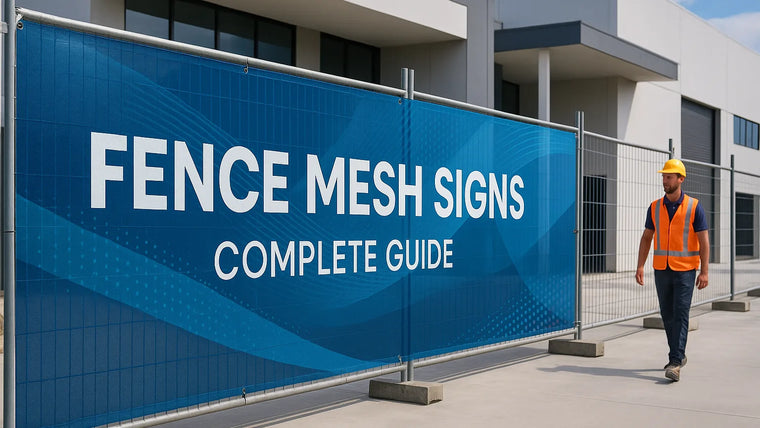
Fence Mesh Signs: Complete Guide
Fence mesh signs are printed mesh banners used on temporary fencing and hoardings. The perforated material allows airflow compared with a solid banner, while...
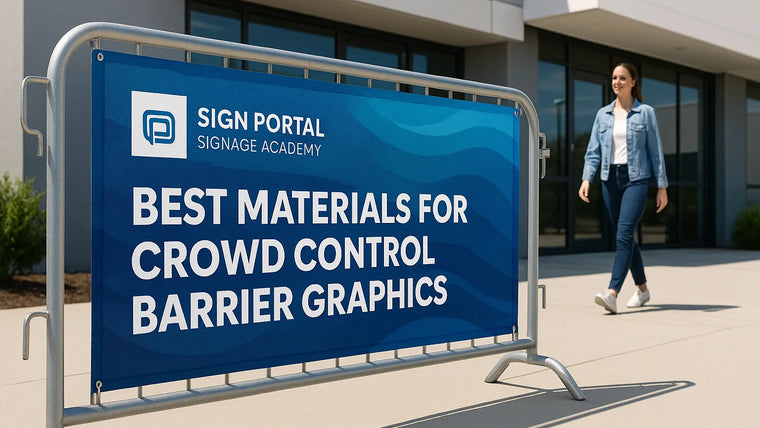
Best Materials for Crowd Control Barrier Graphics
For most outdoor events in Australia, perforated mesh banner is a versatile option because airflow can help reduce wind effects and it’s quick to...
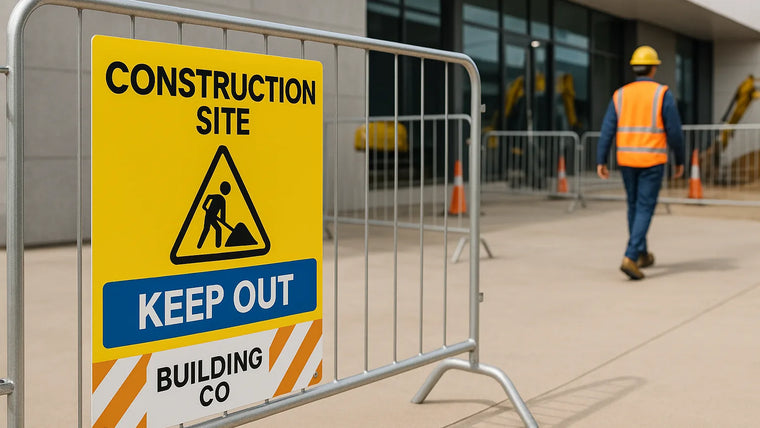
Crowd Barrier Signage for Construction Sites
Crowd barrier signage for construction sites uses panels, banners or decals mounted to portable barriers to guide pedestrians, brand perimeters and reinforce safety messages....