Choose 1.6–2.0 mm marine‑grade aluminium or 3 mm ACP/ACM for long‑term parking signs; add AS/NZS 1906.1 reflective and anti‑graffiti as required.
Choosing the right substrate for traffic and parking signage affects durability, visibility, installation method and lifetime cost. This guide explains the strengths and trade-offs of aluminium, ACP, steel, polycarbonate, acrylic and Corflute in Australian outdoor conditions, and how Sign Portal manufactures each using in-house UV printing, routing and finishing.
Quick answer and selection criteria
For most permanent car parks and private roads, aluminium sheet or 3 mm aluminium composite panel (ACP/ACM) offer the best balance of outdoor durability, flatness and cost. Where vandalism or heavy impact is likely, consider steel plates or a polycarbonate protective cover. For temporary events and short-term wayfinding, Corflute is the economical choice.
- Permanent, outdoor, non-regulatory: ACP or aluminium with UV print and protective laminate.
- Permanent, outdoor, regulatory: aluminium or ACP with specified reflective film as required by the road authority.
- High-abuse areas: steel plates or aluminium with a polycarbonate cover and anti-graffiti laminate.
- Short-term or moveable: Corflute or lightweight ACM with cable ties or temporary fixtures.
Typical sizes: 450 x 300 mm, 600 x 450 mm, 600 x 600 mm, 900 x 600 mm and 1200 x 300 mm blades. Common hole patterns: 2–4 holes at 8–10 mm diameter with 50 mm edge clearance; channel spacing typically 100–150 mm from top and bottom for post-mount brackets.
Ready to order durable plates? See our Aluminium Parking Signs for standard sizes, reflective options and fast turnaround Australia-wide.
Material options explained

Aluminium sheet
Aluminium sheet remains a top pick for outdoor parking signs because it is rigid, corrosion-resistant and relatively light for its stiffness. It copes well with Australian UV and rain and does not rust in coastal air like untreated steel can.
At Sign Portal we can print direct to aluminium on our Mimaki JFX EX UV flatbeds or apply printed graphics produced on our Roland VG-640. Corners can be radiused and mounting holes routed accurately on our MultiCam SM2412, which helps reduce sharp edges and speeds installation.
We commonly manufacture small to medium plates in 1.6 mm and 2.0 mm aluminium, with optional rear channels riveted for bracket mounting. When reflective graphics are required, we apply AS/NZS 1906.1 compliant films (Class 2, Class 1 or Class 1W microprismatic) and finish with a clear protective or anti-graffiti laminate for serviceability.
Thickness selection guide (typical):
- Up to 600 x 450 mm: 1.6 mm aluminium with channels or 2 x 8–10 mm fixing holes.
- 600 x 600 to 900 x 600 mm: 2.0 mm aluminium with channels for post mounting, or 4-point wall fix.
- Over 900 mm longest edge or exposed to wind/impact: 2.5–3.0 mm aluminium, additional fixings, and anti-graffiti laminate.
Hardware notes: use stainless steel (304 inland, 316 coastal), isolate dissimilar metals from galvanised posts with nylon washers or rubber gaskets, and maintain 50 mm minimum edge clearance to avoid tear-out.
Best use cases: post-mounted parking blades, wall plates in exposed car parks, and long-term directional signs that must stay flat and readable for years.
Aluminium composite panel (ACP/ACM)
ACP is a sandwich of thin aluminium skins bonded to a polyethylene core, typically at 3 mm overall thickness. It is very flat and lighter per square metre than solid aluminium of comparable stiffness, making it easy to handle and mount to walls, fences and frames.
Sign Portal routinely UV prints ACP on our Mimaki JFX EX for crisp, durable graphics. We can also apply printed and cut self-adhesive films from the Roland VG-640 for layered designs, then trim or shape-route on the MultiCam. For high-traffic environments, a protective overlaminate or anti-graffiti film is recommended.
We only specify sign-grade ACP for parking applications to ensure aluminium skin thickness and paint systems are suitable for exterior use. For larger wall panels, ACP minimises oil-canning and keeps panels flat with fewer fixings. FR-grade ACP can be supplied where building fire engineering requires it in internal car park zones.
Thermal movement: allow 2–3 mm expansion on long runs and avoid over-tightening fixings; use oversize holes with washers where panels are fixed directly.
Best use cases: large wall-mounted parking boards, directional panels in multi-storey car parks, and cost-effective replacements where weight and flatness matter.
Galvanised steel
Steel provides excellent impact resistance and a dense feel, which can be useful on bollards and in high-abuse zones. However, it is heavy to install and can corrode if protective coatings are damaged, especially near the coast. It is less common for everyday parking signage but has a place where vandalism is frequent.
Graphics are typically applied as printed vinyl with laminate rather than direct print. Where steel is used, ensure mounting hardware is appropriate for the added weight and check substrate coatings periodically. For longevity, specify hot-dip galvanised or zinc-coated plate with an etched, primed and enamel topcoat before graphics.
Polycarbonate panels and overlays
Polycarbonate is a tough, transparent plastic with high impact resistance. While it is not usually the primary sign substrate for flat plates, it excels as a protective cover in vandal-prone areas. A printed panel (aluminium or ACP) can be placed behind a clear polycarbonate sheet to shield it from scratches and graffiti.
Polycarbonate can also be used for custom guards and protective faces in car park equipment. It is more impact-resistant than acrylic, although it may scratch more easily without a hard-coat; pairing with an anti-graffiti film helps. Typical overlay thickness: 3–6 mm. Allow for thermal expansion (leave a 2–3 mm perimeter gap on A1-size covers) and use oversize holes with soft washers to avoid stress cracking.
Acrylic (PMMA)
Acrylic offers a premium gloss finish and excellent optical clarity but is more brittle than polycarbonate. Outdoors it performs well when mounted to a backing, but repeated impacts can cause cracking. It is popular for internal car park wayfinding or covered areas where a crisp, architectural look is desired.
We laser cut acrylic precisely on our Trotec Speedy 500 and large-format CO2 laser for plate covers, spacers and branded features. For primary car park blades exposed to impact, aluminium or ACP is generally the safer choice. Cast acrylic is preferred for routing/laser polish; extruded is acceptable for simple plates where cost is critical.
Corflute and other temporary options
Corflute (fluted polypropylene) is lightweight, inexpensive and quick to install with cable ties or temporary fixings. It is ideal for events, short-term detours and temporary directional parking signs. However, it is not designed for long-term exposure — UV and wind can fatigue it over time, and edges can crease.
We print Corflute with high coverage and can add eyelets or cut it to shape. For repeating use, consider ACP for longevity while maintaining manageable cost. Choose flute orientation to suit mounting (vertical flutes for cable ties on fence mesh) and 5 mm thickness for outdoor durability; 3 mm is suited to short indoor runs.
Environmental and use-case considerations
Australian conditions can be harsh on signage. High UV exposure, summer heat, torrential rain and coastal salt all influence material choice. In exposed car parks, wind loads and the risk of accidental impact from vehicles and trolleys are part of the equation.
- UV and heat: Favour aluminium or ACP with UV-stable inks and a suitable overlaminate for longer colour life.
- Coastal exposure: Aluminium and ACP resist corrosion; inspect steel coatings more frequently if steel is used.
- Impact risk: Add polycarbonate covers or choose thicker metal plates and robust fixings.
- Visibility at night: Use reflective films where required by policy or site conditions.
- Graffiti risk: Specify anti-graffiti laminate or a replaceable face layer.
Allow for thermal expansion: metal plates move less than plastics; leave clearance in slots and avoid clamping plastics hard. Isolate dissimilar metals to reduce bimetallic corrosion, especially where aluminium plates meet galvanised posts or stainless fixings in coastal air.
For regulatory signage on public roads or where a road authority mandates it, we build to AS/NZS 1906.1 retroreflective classes and AS 1743 sign layouts when specified. For private car parks, we match site standards while prioritising legibility, contrast and durability.
Side-by-side comparison table

| Feature | Aluminium sheet | ACP (ACM) 3 mm |
|---|---|---|
| Weight vs stiffness | Heavier than ACP for similar stiffness; very rigid in smaller plates | Lighter; excellent flatness across larger panels |
| Corrosion resistance | Very good; does not rust | Very good; aluminium skins protect core |
| Impact resistance | Good; edges remain strong | Good; core can dent under point loads |
| Print method | Direct UV print or applied vinyl | Direct UV print or applied vinyl |
| Reflective film compatibility | Common and reliable | Common and reliable |
| Typical mounting | Posts, walls, gates | Walls, fences, frames, posts |
| Edge finishing | Radius corners, deburr, drilled holes | Radius corners, chamfer, routed slots |
| Relative cost | Moderate | Cost-effective for larger sizes |
| Best for | Long-term plates, post-mounted blades, coastal sites | Large panels, interior ramps, wall boards |
Printing and finishing options
Direct UV printing: Our Mimaki JFX EX flatbeds cure ink instantly onto aluminium and ACP for sharp colour and fast turnaround. Where layered graphics or complex colours are preferred, we produce high-resolution vinyl on the Roland VG-640 and apply it to the substrate.
Protective films: For high-touch areas, specify a clear protective or anti-graffiti laminate to make cleaning easier and extend the readable life of the sign. This is especially useful for car parks with frequent tagging or trolley scuffs.
Cutting and hardware prep: The MultiCam SM2412 CNC router delivers accurate outer shapes, corner radii and hole patterns for posts and brackets. Consistent hole centres reduce onsite drilling, helping installers keep timelines tight.
Quality control unique to Sign Portal: closed-loop colour management with on-press verification, barcode job tickets for traceability, and batch labels on the rear of each plate (sign code, level, material and film lot). Reflective faces are edge-sealed per film technical data sheets to reduce moisture ingress. As-built packs include panel schedules and fixing maps on request.
Installation basics
Mounting methods depend on substrate and site. Post-mounted plates commonly use channel and brackets; wall-mounted plates use screws and wall anchors; fences often use stainless cable ties or screw-on clamps. Always consider wind exposure and ensure fixings suit the substrate and surface.
- Posts: Use compatible brackets or channels; pre-drilled hole centres help alignment. For small plates, allow at least 50 mm edge clearance to all holes.
- Walls and columns: Masonry anchors or Tek screws with appropriate washers; seal penetrations outdoors.
- Fences and rails: Stainless cable ties, U-bolts or clamps; avoid over-tightening on ACP.
- Bollards and guards: Heavier plates (aluminium or steel) resist knocks; inspect fixings periodically.
Additional guidance:
- Channel spacing: typically 100–150 mm from panel ends; match existing site standard for swap-outs.
- Clearances: keep the bottom edge of wall signs ≥1600 mm above floor near traffic lanes to avoid bumper/scuff damage.
- Dissimilar metals: isolate aluminium plates from galvanised or steel structures with nylon spacers to minimise galvanic action.
- Torque: tighten banding/brackets firmly but avoid crushing ACP cores; use washers on oversize holes to allow movement.
Site-specific engineering may be required for large panels or cyclonic regions. When in doubt, choose a smaller plate or additional fixings rather than oversizing a single panel.
Artwork and ordering tips
Provide vector artwork (PDF, AI, EPS) for symbols and arrows so we can route accurate edges and keep icons crisp. For raster elements, supply high-resolution CMYK images and include bleed where the design runs to the edge.
Outline fonts or supply font files, and specify any reflective areas if films are being layered. Trade customers can streamline repeat car park orders through our Trade Portal with customer-specific catalogues and saved specifications.
Legibility tips: maintain high contrast (e.g. white on red, black on white), keep minimum stroke weight at ≥2.5 mm for small type at distance, and avoid placing critical legends within 20 mm of fixing zones.
Cost drivers and timelines
Material choice, panel size, finishing (corner radius, holes), print method (direct UV vs layered films), protective laminates and installation hardware are the major cost drivers. ACP often wins on larger wall panels for its flatness-to-weight ratio; aluminium excels for smaller, post-mounted blades and coastal use.
Consolidating multiple signs into a single production batch helps efficiency. Pre-specifying hole centres and bracket types reduces installation time and rework.
Typical lead times: standard non-reflective plates 3–5 business days; reflective or anti-graffiti laminate add 1–2 days; large multi-level programs scheduled as staged drops. For standard formats, you can order directly via Aluminium Parking Signs.
Case study — Multi-level car park re-signage
Client: 7-level CBD parking facility (mixed retail/commercial). Scope: replace ageing wayfinding and parking control plates across entries, ramps and pedestrian paths.
- Manufacture: 186 panels across 32 sizes. Materials: 3 mm ACP for wall boards; 2.0 mm aluminium for post-mounted blades.
- Graphics: Direct UV print for non-regulatory messages; AS/NZS 1906.1 Class 2 reflective with anti-graffiti laminate for night-critical locations.
- Process: Colour-managed on press (device-link profiles, X‑Rite verification), barcode job tracking, and kitted by level with install maps.
- Finishing: MultiCam-routed corner radii and hole centres to match existing brackets; rear labels printed with sign code, level, and material batch.
- Install: Night works (10 pm–5 am) over three nights in a live facility; zero call-backs.
Outcome: Delivery in 7 business days from artwork approval; installer hours reduced by 24% vs previous program due to matched hole patterns and kitted packs; after 12 months, no delamination or fading observed — only routine wipe-downs in quarterly cleans. Two impact-damaged blades were replaced within 48 hours using our archived cut files.
Additional detail: traffic management and SWMS were prepared for night shifts; reflective faces were edge-sealed and batch-logged for traceability; as-built documentation supplied with panel schedule, bracket matrix and cleaning guide to hand over to facilities.
- Strata car park blades upgraded from Corflute to ACP with anti-graffiti film reduced replacements over 12 months.
- Retail centre loading dock signs moved from steel to aluminium to cut installation weight while maintaining durability.
- University campus car park: standardised hole centres and channel spacing allowed mixed crews to install 90 plates in one shift.
- Hospital multistorey: Class 1W reflective applied only to critical approach signs cut material cost by ~30% without reducing legibility.
Maintenance and longevity
Wipe down printed faces with mild detergent and water; avoid harsh solvents unless an anti-graffiti film is specified and tested for compatibility. Inspect fixings every few months in exposed car parks, tightening brackets and replacing corroded hardware as needed.
Where reflective films are used, keep them clean for best night-time performance. If panels suffer repeated impact damage, consider a polycarbonate protective face or a heavier-gauge metal plate in that location.
Routine schedule suggestion: quarterly clean (pH‑neutral), six-monthly fixing and bracket torque check, annual audit for faded/damaged plates with a simple photo log of each location code. Keep spares on hand for the most frequently struck positions.
Repair and refurbishment
- Face replacements: If the substrate is sound, we can remove the existing graphic and re-skin aluminium/ACP with fresh print and laminate to extend service life.
- Reflective repairs: For best uniformity, replace the full face rather than patching small sections of reflective film.
- Vandalism recovery: With anti-graffiti laminate, most marker and paint can be removed using approved cleaners — test in a corner first.
- Spare faces: For large sites, we can manufacture spare faceplates with identical hole centres, labelled and stored onsite for rapid swap-outs.
- Hardware refresh: Replace worn brackets, bands and fixings during any face change to prevent recurrence of rattles or tilt.
Tip: Photograph the installed plate and note bracket type and hole centres before requesting a repair — we can then match the pattern exactly and minimise downtime.
How to request a repair with Sign Portal:
- Send a photo of the installed sign showing damage and surroundings (for access notes).
- Quote the rear label code (we label by level/zone/sign number) or original order reference.
- Measure hole centres or channel spacing if the sign predates our labelling.
- Confirm whether the face is reflective and if anti-graffiti film is required.
- We’ll retrieve the archived cut file, produce a matched replacement and ship kitted with fixings. Express production is available for time-critical positions.
For standard formats and quick replacements, you can also order direct via Aluminium Parking Signs.
Common mistakes and how to avoid them
- Using temporary substrates (e.g., Corflute) for long-term outdoor plates — upgrade to ACP or aluminium.
- Skipping protective laminate in graffiti-prone areas — adds cost later in cleaning or replacement.
- Not allowing edge clearance for brackets — keep critical graphics away from bolt zones.
- Underspecifying fixings in windy, exposed positions — add fixings or choose thicker substrate.
- Specifying higher reflective class than needed — on private sites, targeted use of Class 2/1W where visibility is critical can optimise cost.
Summary recommendations
If you need set-and-forget durability, choose aluminium or ACP with quality print and a protective laminate. Add reflective films where your site or authority requires it. For temporary changes, Corflute is fine; for vandal-prone spots, pair metal plates with anti-graffiti film or polycarbonate covers. We manufacture all common options in-house — UV print, route, drill and finish — so you receive panels ready to install.
Explore standard sizes or request a custom cut: Aluminium Parking Signs.
Related Sign Portal resources: Traffic and Parking - Loading and Unloading Zone Sign · Traffic And Parking - Customer Parking Sign · Traffic and Parking - Authorised Vehicles Only Sign
Frequently Asked Questions
Which is better for parking signs, aluminium or ACP?
Both perform well outdoors. Aluminium suits smaller post-mounted plates and coastal sites; ACP is lighter and very flat for larger wall panels. Choose based on size, mounting and vandalism risk.
Do my parking signs need to be reflective?
Private car parks often choose reflective for visibility, but only road authorities can set regulatory requirements. If signs control public-road traffic, confirm the specification with the authority.
What thickness should I use?
For permanent plates, aluminium or 3 mm ACP are common choices. The exact gauge depends on size, mounting span and wind exposure. Ask us to recommend a practical gauge for your layout.
Can you add anti-graffiti protection?
Yes. We can apply a clear protective or anti-graffiti laminate over printed graphics to make cleaning easier and extend service life.
How do I mount signs to chain-link fences?
Use stainless cable ties, U-bolts or clamp kits through pre-drilled holes. Avoid over-tightening on ACP to prevent panel deformation.
Do you print directly onto metal?
Yes. Our Mimaki UV flatbeds print directly to aluminium and ACP. We also produce printed-and-cut films on our Roland for layered graphics or reflective applications.
Do you ship to regional and remote areas?
Yes. Sign Portal ships Australia-wide, including regional and remote delivery.
Keep learning
Related Articles
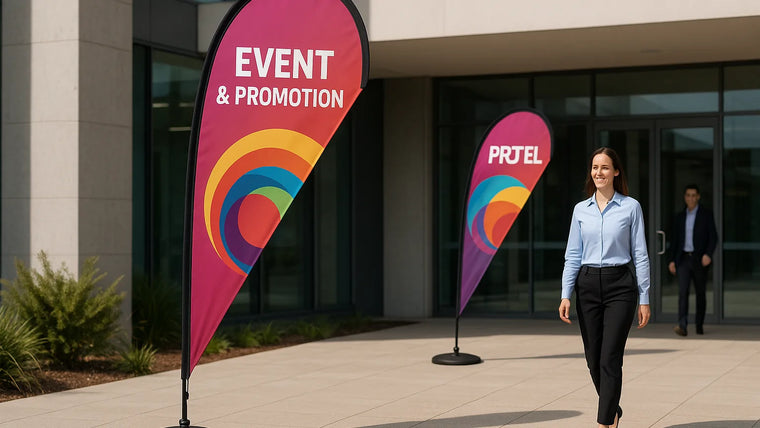
Teardrop Banners for Events and Promotions
Teardrop banners are aerodynamic, curved‑top fabric flags that hold tension to minimise flapping, delivering high visibility for events, retail forecourts and outdoor activations. Systems...
Fence Mesh Signs: Complete Guide
Fence mesh signs are printed mesh banners designed for temporary fencing and hoardings. Mesh allows airflow and can help reduce wind load compared with...
Best Materials for Crowd Control Barrier Graphics
For most outdoor events in Australia, perforated mesh banner is a versatile option because airflow can help reduce wind effects and it’s quick to...