Use ACP or solid aluminium with UV print and overlaminate; add reflective if needed. For machinery use anodised or Traffolyte; corflute for temporary.
Choosing the best materials for warning & caution signs starts with where the sign lives and how long it must last. For most jobs, pick ACP or solid aluminium for permanent outdoor installs, Traffolyte for small long‑wearing tags, polycarbonate where impact is likely, and corflute for temporary worksites. Add reflective film for low light and use laminates where frequent cleaning or abrasion is expected. Australia’s UV, heat, salt and dust punish weak substrates and finishes — this guide shows what to use where and how we manufacture it in-house for clear, compliant results. When in doubt, build to the harshest condition on site — it’s usually cheaper than a second visit and a reprint.
Quick recommendations: best materials for warning & caution signs
If you need a fast decision, match your environment and timeframe to these go-to options:
- Permanent outdoor walls and fences: Aluminium composite panel (ACP) with direct UV print and optional laminate.
- High-abuse or impact zones: Polycarbonate panel printed and mounted, or ACP with rounded corners and robust fixings.
- Harsh industrial/machinery: Engraved laminate (Traffolyte) for small labels and plates; durable vinyl decals with laminate for larger panels.
- Temporary worksites: Corflute signs cable-tied to mesh or fencing; removable vinyl decals where needed.
- Coastal exposure: Solid aluminium or high-grade ACP with sealed edges and stainless fixings.
- Low-light or vehicle visibility: Add reflective vinyl accents to the sign face.
Ready to order? Explore: ACP Safety Signs, Traffolyte Labels, Corflute Safety Signs and Reflective Decals.
Rule-of-thumb add-ons that improve service life without much cost: R6–R10 rounded corners on rigid panels, anti-graffiti laminate for public-facing areas, and stainless hardware in coastal or washdown zones. If you’re unsure, email a photo of the mounting surface and we’ll recommend a substrate and fixing pattern the same day.
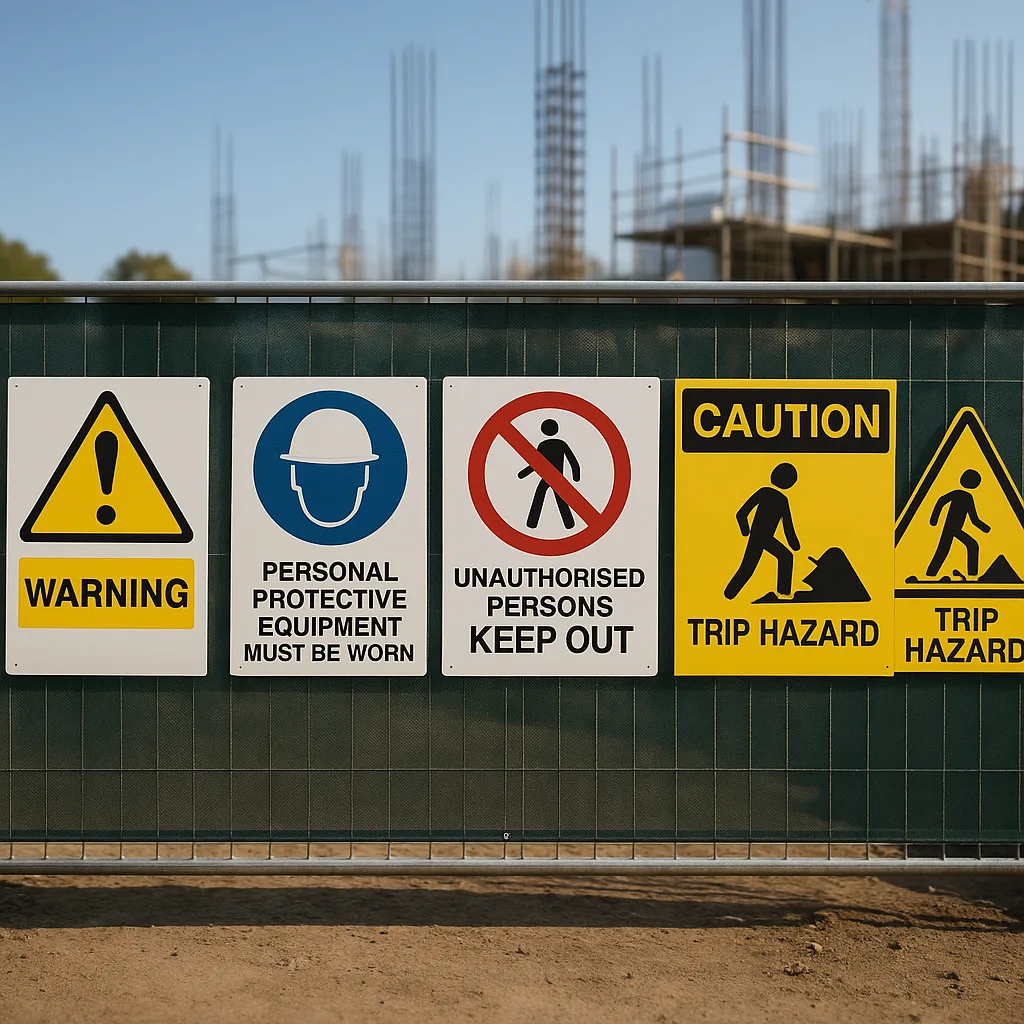
Key selection factors in Australia: best materials for warning & caution signs
Before choosing a substrate, confirm where the sign will live, how long it must last and how it will be mounted. These variables strongly influence the best material and finish.
- Location: Indoor, undercover outdoor, or full sun/rain exposure. Australian UV can fade poor inks and brittle some plastics over time.
- Duration: Temporary weeks/months vs permanent multi-year service.
- Size and wind load: Large panels need rigid substrates and proper fixings.
- Impact and abrasion: Forklifts, tools and cleaning can scuff or crack weaker materials.
- Chemical exposure: Oils, solvents and disinfectants may attack some plastics and inks.
- Visibility requirements: Reflective accents or high-contrast colours may be appropriate for low-light areas.
- Mounting surface: Fencing, posts, walls, machinery housings or glass — each favours different fixings or adhesives.
Safety sign material selector checklist: best materials for warning & caution signs
Use this quick checklist to match a substrate and finish to your site. Tick all that apply and then choose the first option that satisfies the harshest condition.
- Environment
- ☐ Full sun / high UV
- ☐ Coastal / salt spray
- ☐ High heat cycles
- ☐ Chemicals / frequent cleaning
- ☐ High impact / knocks
- ☐ Indoor controlled environment
- Duration
- ☐ Days–weeks (temporary)
- ☐ Months (short term)
- ☐ 1–5 years (permanent)
- ☐ 5+ years (long-term asset)
- Mounting and surface
- ☐ Chain mesh / temp fencing (cable ties)
- ☐ Walls / posts (screws, rivets, VHB)
- ☐ Machinery / curved housings (adhesive labels)
- ☐ Glass / smooth panels (self-adhesive vinyl)
- ☐ Ferrous steel (magnetic)
- Visibility and performance
- ☐ Low light or near vehicles (reflective RA1/RA2 to AS/NZS 1906.1)
- ☐ Anti-graffiti / easy-clean finish
- ☐ High contrast per AS 1319 layouts
Mapping examples:
- Coastal + multi-year + screws/rivets → ACP or solid aluminium with sealed edges, stainless 316 fixings, optional anti-graffiti laminate.
- Temporary fencing + weeks/months → Corflute with cable-tie slots/eyelets. Consider ACP where wind load is high.
- High impact + chemicals → Polycarbonate panel or Traffolyte labels (engraved) with solvent-resistant adhesive.
- Low light + vehicle approach → ACP face with Reflective Decals to key elements or full face.
Shortlist your pick, then order online: ACP Safety Signs, Traffolyte Labels, Corflute Safety Signs, Reflective Decals.
Material profiles and best uses for warning & caution signs
Aluminium composite panel (ACP) for warning & caution signs
ACP is a rigid sandwich panel with aluminium skins and a polyethylene or mineral core. It balances stiffness, light weight and flatness, making it a staple for outdoor safety signage.
- Best for: Exterior walls, fence signs, site perimeters, plant rooms.
- Strengths: Rigid, cost-effective, excellent print surface, resists warping.
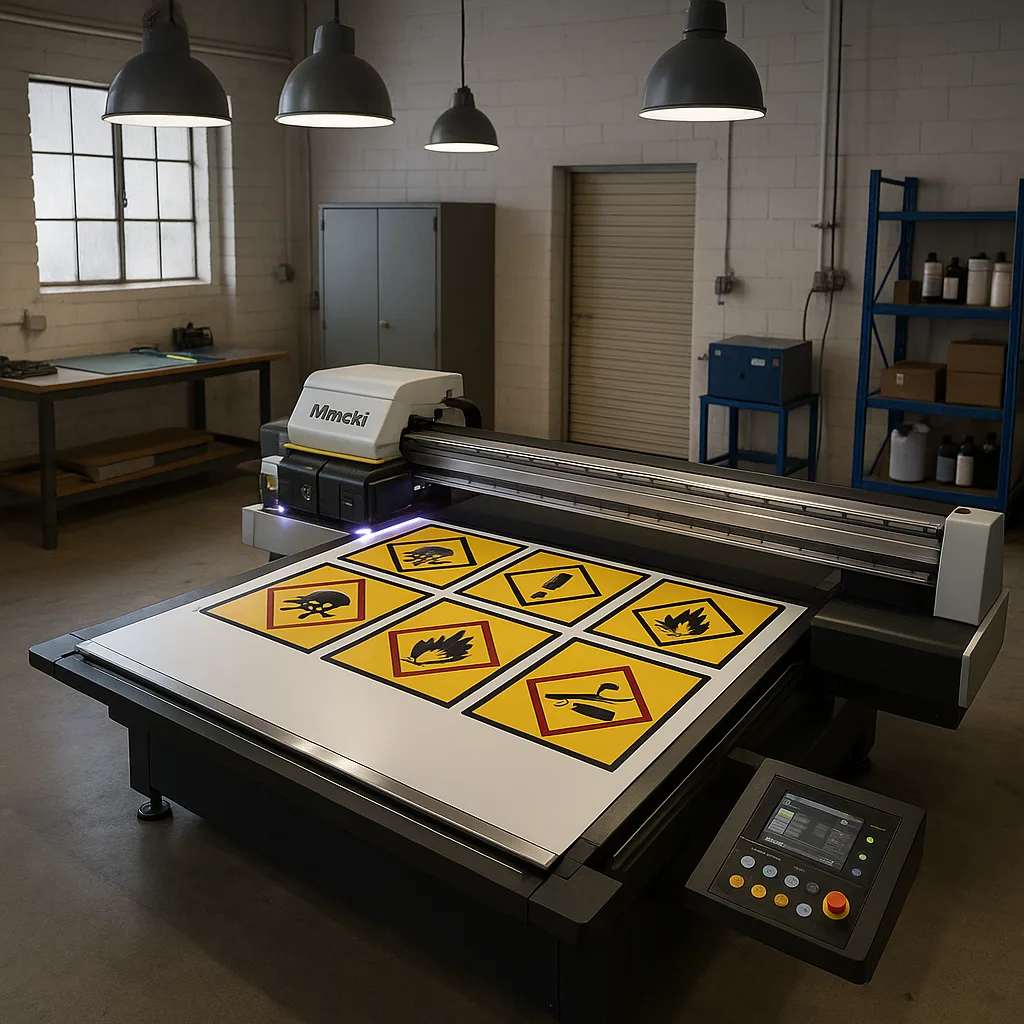
- Manufacturing: Direct UV flatbed print on our Mimaki JFX EX, then CNC-routed on the MultiCam SM2412 for clean edges and rounded corners.
- Options: Anti-graffiti or gloss/matte laminates; reflective vinyl panels applied to the face.
Technical tips: 3 mm ACP suits most wall/fence installs; step up to 4 mm for large panels or high wind. Standard hole size 6–8 mm placed 15–25 mm from corners with penny washers. For coastal sites, edge-seal exposed cores and specify stainless 316 fixings.
Where fire performance is required (e.g., internal plant rooms with policies mandating FR cores), nominate an FR-grade ACP. Order online: ACP Safety Signs.
Solid aluminium for warning & caution signs
Solid aluminium plates are robust and handle coastal environments well when properly finished. They are well-suited to smaller plaques or where thin yet strong metal is preferred.
- Best for: Coastal sites, industrial plants, gate or door plates.
- Strengths: Metal durability, good corrosion resistance with appropriate coatings, secure mechanical fixing.
- Manufacturing: UV print direct or apply printed vinyl; machine-cut and de-burred; protective laminate available.
Specify 1.6–2.0 mm for small plates, 3.0 mm for larger panels. Consider reflective overlays (RA1/RA2) where vehicle approach is likely. For maximum corrosion resistance, request powder-coat or anodised finish prior to graphics.
Engraving laminate (Traffolyte) for warning & caution signs
Engraving laminate (often called Traffolyte) is a multi-layer plastic designed to be laser-engraved, revealing a contrasting core colour. It withstands heat, abrasion and frequent cleaning — ideal for small-format safety labels.
- Best for: Machinery tags, electrical panels, valve tags, control labels.
- Strengths: Text and symbols are engraved (not printed), so they remain legible after repeated cleaning or wear.
- Manufacturing: Laser-engraved and cut on our Trotec Speedy 500 for crisp, repeatable detail; adhesive backing or fixing holes added as needed.
Polycarbonate for warning & caution signs
Polycarbonate is a tough, impact-resistant plastic used where signs may be struck or flexed. It is more resilient than acrylic to impact.
- Best for: High-traffic industrial areas, machine guards, public-facing surfaces prone to knocks.
- Strengths: Excellent impact resistance, good clarity when used as an overlay, heat-formable.
- Manufacturing: Printed graphics applied to the second surface or face; panels CNC-routed on the MultiCam for accurate fit.
For maximum wear, apply graphics to the second surface (reverse) and back with white; specify flame-polished or routed edges to suit the enclosure. Allow for thermal expansion in outdoor installs (use slotted holes and nylon washers). Typical thickness for guards and panels: 2–4.5 mm.
Acrylic (PMMA) for warning & caution signs
Acrylic provides a glossy, premium look for indoor caution notices and equipment plates. It is less impact-resistant than polycarbonate but offers optical clarity and a refined finish.
- Best for: Indoor facilities, reception or lab notices, clean environments.
- Strengths: High clarity, attractive finish, suitable for stand-off mounts.
- Manufacturing: Laser-cut on our large-format CO2 laser for polished edges; reverse-printed options available.
Use 3–6 mm acrylic for most indoor plates; pair with 12–19 mm stand-offs for a clean presentation. For washdown areas, favour Traffolyte or laminated ACP instead.
PVC foam board (Foam PVC) for warning & caution signs
PVC foam board is a lightweight indoor substrate. It prints well but is softer than ACP and can dent if mishandled.
- Best for: Indoor walls, warehouses out of harm’s way, temporary fitouts.
- Strengths: Light, economical, smooth print surface.
- Limitations: Not ideal for high-impact areas or long-term exterior exposure.
Use with light-duty screws or VHB tape on smooth indoor walls. Avoid solvent cleaners. If reusing, pre-drill new holes to prevent crack propagation.
Corflute (corrugated polypropylene) for warning & caution signs
Corflute is a go-to for temporary site signage. It’s light, economical and easy to cable-tie to fencing. Expect cosmetic wear over time outdoors.
- Best for: Temporary construction fencing, short-term projects, events.
- Strengths: Very cost-effective, fast to deploy, weather-tolerant for short stints.
- Manufacturing: Wide-format print direct or to vinyl then applied; eyelets or simple cable-tie slots.
Specify 5 mm for general temp fencing, 8–10 mm for windy or reusable applications. Add 10–12 mm eyelets or routered tie slots. Align flute direction vertically on fences to reduce sag. Order online: Corflute Safety Signs.
Magnetic sheet for warning & caution signs
Flexible magnetic sheet is useful when messages must be removable from ferrous surfaces.
- Best for: Warehouse racking, vehicle bays (low-speed environments), steel cabinets.
- Strengths: Tool-free install and repositioning, reusable.
- Limitations: Only adheres to ferrous metals; ensure clean, flat surfaces.
Round internal corners (2–3 mm radius) reduce lift. Clean surfaces with isopropyl alcohol before placement. For doors and racking, 0.8–0.9 mm magnet provides reliable holding force.
Self-adhesive vinyl decals and labels for warning & caution signs
Labels and decals suit small warnings on equipment, doors and glass. Material choice (polymeric or cast) and overlaminate influence durability.
- Best for: Machinery labels, door/glass decals, equipment pictograms.
- Strengths: Conformable, cost-effective, can be kiss-cut to shape on our Roland VG-640.
- Options: Anti-graffiti or chemical-resistant laminates; reflective films for increased night-time visibility.
For curved or textured housings choose cast vinyl with high-tack adhesive; for flat panels polymeric is usually sufficient. Radius external corners to reduce peel, and specify an overlaminate where frequent cleaning is expected. Apply above 10 °C and use firm squeegee pressure; full adhesive bond typically develops over 24–72 hours.
Reflective finishes for warning & caution signs
Reflective vinyl increases visibility under headlights or low light. It can be applied selectively to key elements (chevrons, borders, symbols) or across the whole sign face.
- Best for: Gates near traffic, vehicle-adjacent zones, low-light corridors.
- Manufacturing: Printed reflective films contour-cut on the Roland; applied to ACP or aluminium faces.
How we manufacture warning & caution signs in-house
Sign Portal produces warning and caution signage in our approximately 480 m² Australian facility with dedicated clean print rooms. In-house control improves print quality, repeatability and lead time.
- Direct UV printing: Two Mimaki JFX EX flatbed printers deliver durable, high-contrast prints onto rigid substrates like ACP and acrylic.
- Precision cutting: Our MultiCam SM2412 CNC router trims ACP, aluminium and plastics to size and shape with clean edges and radius corners.
- Laser engraving and cutting: A Trotec Speedy 500 handles Traffolyte engraving and small parts; our large-format 230 W CO2 laser cuts acrylic and plastics at scale.
- Vinyl graphics: The Roland VG-640 prints and contour-cuts decals, labels and reflective films, including kiss-cut sheets for easy application.
- Finishing: Laminating for abrasion and chemical resistance; hole drilling, eyelets, slots and hardware preparation for fast installation.
Our process control adds first-party reliability: preflight checks in RIP, substrate-specific ICC profiles, adhesion tests on first-off panels, labelled batch IDs on the reverse for exact reorders, and archived cut files to keep hole centres and corner radii consistent across runs.
Quality assurance specifics used by our team: cross-hatch tape adhesion checks on first-offs, colour target checks against stored profiles for common safety colours, and substrate mock-ups to validate mounting hole patterns before production runs. We document every job’s substrate, laminate and routing file so replacements match the original.
- Construction gate warnings on 3 mm ACP, UV printed, four corner holes and stainless screws to timber posts.
- Machinery hazard labels as engraved Traffolyte with 3M adhesive back for clean, permanent mounting.
- Warehouse column cautions as reflective vinyl decals with anti-graffiti overlaminate for easy cleaning.
- Fuel bay hazard board: 4 mm ACP with RA2 reflective chevrons and anti-graffiti laminate; M6 stainless fixings at 300 mm centres for wind region B.
- Water treatment plant: Traffolyte valve tags (1.6 mm) engraved on Trotec, numbered sets with batch IDs for exact spares years later.
Installation options and fixings for warning & caution signs
Correct fixings keep signs legible and safe. Choose methods that match substrate strength and the mounting surface.
- Walls and posts: Screws with washers; for masonry, use wall plugs. For steel, use self-drilling screws or rivets.
- Fences and mesh: Cable ties through eyelets/slots; consider backing washers to reduce tear-out on corflute.
- Adhesive mounts: VHB tapes or structural adhesives for flat, clean surfaces; ensure surface prep for maximum bond.
- Glass and smooth panels: Self-adhesive vinyl decals; use application fluid where appropriate to minimise bubbles.
- Ferrous surfaces: Magnetic sheet for repositionable messages.
Field-proven details: use 4.8–5.0 mm rivets or M5/M6 stainless screws with 18–25 mm penny washers on ACP; place fixings at 300–450 mm centres on large panels; deburr holes to prevent crack propagation; clean bonding areas with isopropyl alcohol before applying VHB (firm squeegee pressure and 72-hour cure for full strength).
Extra guidance: locate fixings 15–25 mm from panel edges; on polycarbonate, use slotted holes and avoid over-torquing; on corflute, use two ties per corner in high wind. For adhesive-only installs, prime low-energy plastics first and avoid cold installs below 10 °C.
Australian environmental considerations for warning & caution signs
Australia’s climate can be punishing for signage. UV intensity accelerates colour fade in poor-quality prints; coastal salt can attack fixings and edges; heat cycles stress adhesives.
- High UV: Prioritise UV-stable inks (direct UV print) and consider protective laminate on frequently cleaned surfaces.
- Coastal sites: Prefer solid aluminium or quality ACP with sealed edges; use stainless or galvanised fixings.
- Heat and dust: Engraved labels or laminated graphics withstand frequent wiping and abrasion better than bare prints.
- High wind: Rigid substrates (ACP, aluminium) with sufficient fixings and, for large panels, appropriate framing or posts.
ACP vs corflute: best materials for warning & caution signs on site
Both materials are common on Australian worksites. Use this quick comparison to match budget, lifespan and handling needs.
| Feature | ACP | Corflute |
|---|---|---|
| Durability | Rigid and long-lasting outdoors; resists warping | Suited to short-term use; can crease or bow over time |
| Typical use | Perimeter warnings, plant rooms, gates | Temporary fencing, events, early-stage works |
| Print method | Direct UV print; laminate optional; reflective overlays | Direct print or applied vinyl |
| Mounting | Screws, rivets, VHB tape, cable ties | Cable ties, eyelets; light screws with washers |
| Handling | Robust; rounded corners recommended | Very light; edges can fray with rough handling |
| Reuse | Good; cleans easily, especially with laminate | Limited; may show wear after multiple uses |
| Relative cost | $$ (mid) | $ (low) |

Cost versus lifespan of warning & caution sign materials
Temporary projects benefit from corflute and indoor foam PVC where short-term clarity is the goal. For multi-year warnings, ACP or aluminium with a protective laminate typically lowers replacement frequency and site visits.
Labels and decals follow the same principle: choose film and laminate to match heat and cleaning cycles. In chemical-prone areas, engraved labels avoid ink wear altogether.
Artwork and legibility tips for warning & caution signs
Warning and caution signs must be clear at a glance. Supply vector artwork (PDF, AI, EPS, SVG) with outlined fonts. Use high-contrast colour pairings such as black on yellow for caution, and ensure symbol simplicity.
- Viewing distance: As a practical rule, allow 4–6 mm of uppercase letter height per metre of viewing distance (increase for complex backgrounds).
- Finish choice: Matte or anti-graffiti laminates reduce glare and simplify cleaning.
- Shapes: Rounded corners help avoid snags and improve handling safety on rigid panels.
- Cut-to-shape: For pictograms or lockout tags, kiss-cut decals or laser-cut plates speed installation.
- Common sizes: 450 × 300 mm and 600 × 450 mm suit many AS 1319 layouts; go larger for long viewing distances.
Ordering, delivery and repeatability for warning & caution signs
For a fast, accurate quote, include:
- Install location (indoor/outdoor), size and quantity.
- Preferred substrate and mounting method (screws/rivets/VHB/cable ties).
- Any reflective (RA1/RA2) or laminate (matte/anti-graffiti/chemical-resistant) requirements.
- Clear photos of the mounting surface if you’d like our team to confirm fixings.
We manufacture in-house and ship Australia-wide, including regional and remote delivery. Panels are packed with corner protection and appropriate wrapping to arrive installation-ready.
For ongoing projects, we can set up customer-specific catalogues and repeat-order workflows so replacement or additional signs match previous batches precisely.
First-order to reprint consistency:
- We retain RIP settings, colour profiles and cut files.
- Batch IDs are marked on the back of rigid panels.
- Substrate and laminate lot records are stored so new panels match hole centres, colours and reflectivity of prior runs.
Ready to proceed now? Order online: ACP Safety Signs, Traffolyte Labels, Corflute Safety Signs, Reflective Decals.
Repair and refurbishment of warning & caution signs
Many safety signs can be repaired on site to extend service life without compromising legibility.
- Loose fixings (rigid panels): Replace with stainless hardware; upsize to the next diameter if holes have ovalled. Add penny washers to spread load.
- Edge lift (vinyl/laminate): Clean with isopropyl alcohol, trim lifted edge to sound material and reseal with compatible edge sealer. Replace panel if lift extends into the message area.
- Scuffs and graffiti (laminated faces): Use non-abrasive cleaners; for anti-graffiti laminate, use a dedicated graffiti remover per the laminate data sheet.
- Damaged reflective element: We can supply patch kits to replace a chevron/border segment without removing the whole panel. Align prismatic direction with existing film.
- Traffolyte labels: If adhesive bond fails on textured housings, clean substrate and reapply with a high-tack acrylic transfer tape or switch to mechanical fixing (2–3 mm holes with small screws).
- Corflute tears: Reinforce eyelets with backing washers or relocate ties through fresh slots away from creases; replace if flute collapse affects readability.
When in doubt, email a photo of the issue — our production team will confirm whether a field repair is appropriate or if a remanufacture is safer for compliance.
Maintenance and replacement cues for warning & caution signs
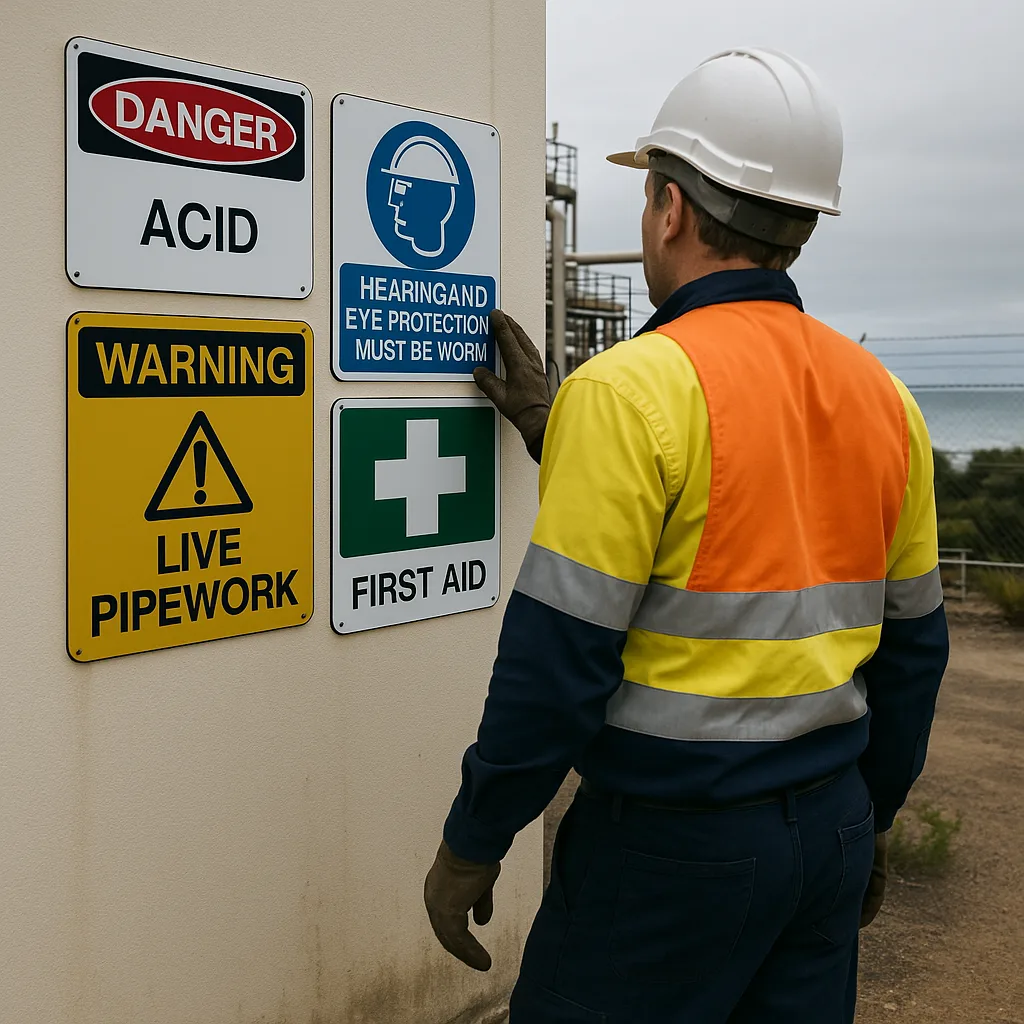
Safety signage must remain legible. Build inspection into routine checks and replace signs before clarity is compromised.
- Cleaning: Use mild detergents and soft cloths; avoid harsh solvents unless your sign uses a compatible laminate or is engraved.
- Fixings: Check for loose screws, failing ties or edge-lift on adhesives.
- Face condition: Replace if colours wash out, laminate lifts, edges delaminate, or panels crease (corflute).
- Labels: Reprint or re-engrave any labels that have abraded symbols or text.
Frequently Asked Questions
What is the most durable material for outdoor warning signs?
ACP or solid aluminium with direct UV printing and a protective laminate is a reliable, long-term choice for exterior installations.
Which material should I use for temporary construction site warnings?
Corflute is cost-effective and light for temporary fencing. Use cable ties through eyelets or slots and expect cosmetic wear over time.
Are engraved Traffolyte labels better than printed stickers on machinery?
For harsh, frequently cleaned machinery, engraved labels resist abrasion and solvents better than printed stickers, keeping text legible longer.
Do I need reflective material for caution signs near vehicle traffic?
Reflective accents improve night-time visibility and are recommended where headlights or low-light conditions are common.
What’s the best way to mount ACP warning signs to a wall?
Use screws with appropriate wall anchors for masonry, or VHB tape on smooth, clean surfaces. Rounded corners improve handling and safety.
Will PVC foam board last outdoors?
It’s best indoors. For regular exterior exposure, choose ACP or aluminium instead.
Can you supply anti-graffiti protection for safety signs?
Yes. We can apply anti-graffiti or abrasion-resistant laminates to rigid panels and decals to simplify cleaning.
What file format should I provide for symbols and text?
Vector artwork (PDF, AI, EPS or SVG) with outlined fonts ensures sharp, accurate printing and cutting.
Do you ship to regional and remote locations?
Yes. We ship Australia-wide, including regional and remote areas, with protective packaging for safe delivery.
How do I reorder matching signs later?
We can set up a customer catalogue and repeat-order workflow so new batches match previous materials, colours and finishes.
Keep learning
Related Articles
Teardrop Banners for Events and Promotions
Teardrop banners are aerodynamic, curved‑top fabric flags that hold tension to minimise flapping, delivering high visibility for events, retail forecourts and outdoor activations. Systems...
Fence Mesh Signs: Complete Guide
Fence mesh signs are printed mesh banners designed for temporary fencing and hoardings. Mesh allows airflow and can help reduce wind load compared with...
Best Materials for Crowd Control Barrier Graphics
For most outdoor events in Australia, perforated mesh banner is a versatile option because airflow can help reduce wind effects and it’s quick to...