Australian-made signage cuts lead-time and quality risk, ensures compliance and traceability, and streamlines procurement.
For procurement and project teams, signage is a small line item that can create outsized risk if it turns up late, fails early or doesn’t meet brand and safety requirements. Local, in-house manufacturing gives you control over timelines, quality and repeat supply — all while supporting Australian jobs and simplifying vendor due diligence.
Key reasons to choose local manufacturing
When signage is made locally, communication cycles are shorter, specifications are easier to validate and issues can be resolved before they derail a site opening or compliance deadline. For high-volume programmes, the ability to reorder identical items is critical — and is greatly simplified when the original files, print settings and fabrication notes are kept by a domestic manufacturer.

- Reduced lead-time risk: faster proofing, production and remakes if needed.
- Quality control you can visit: colour consistency, material verification and fabrication checks.
- Traceability: easy to match brand colours and substrates across future orders.
- Fit for local conditions: materials and inks chosen for Australian UV, heat and coastal exposure.
- Simpler vendor assurance: local credentials and clear points of contact.
- Australia-wide delivery: practical for multi-site rollouts, including regional and remote areas.
Explore our core ranges that benefit most from onshore production: Safety signs and ACP signs. Local manufacture means faster colour approvals, exact reorders and packaging optimised for Australian freight networks.
For multi-site programmes, we kitting by facility: each site pack is barcoded, corner-protected and labelled with your site code and install notes, reducing time on the ground and lost items.
What procurement teams actually measure
Most tenders and RFQs evaluate total cost of ownership (TCO), delivery certainty, risk and vendor capability — not just unit price. Local manufacturing directly supports these criteria.
Cost beyond unit price
Cheap signs that fade, delaminate or arrive late can cost more than better-built options when you factor urgent replacements, site revisits and interrupted openings. Domestic production can reduce these hidden costs through reliable timelines and repeatable quality.
Assurance and accountability
When you can pick up the phone to the factory that printed and fabricated your signs, accountability is clear. Site-specific adjustments, partial reprints and emergency rush jobs are far more achievable when dealing with an Australian team in your time zone.
Sign Portal operates documented QA work instructions aligned to ISO 9001 principles, with batch traceability from artwork to dispatch. Job jackets and QR-coded tickets travel with every order and are archived with print settings, substrates and finishing steps for auditability and exact-match reorders.
How local production reduces project risk
Risk in signage supply tends to concentrate around colour accuracy, file handling, component fit and delivery windows. In-house production shortens the loop from artwork to finished product, lowering the chance of miscommunication.
- Artwork control: direct-to-operator file checks reduce font, bleed and dieline errors.
- Proofing agility: same-day test prints are possible for critical colour approvals.
- Remake speed: if something goes wrong, a domestic factory can prioritise a rerun without international freight delay.
- Logistics alignment: local freight options suit staged site handovers and remote deliveries.

Evidence from the factory floor
At Sign Portal, production is handled in-house in a clean, dedicated facility of approximately 480 m² with specialised print rooms. This environment supports consistent outcomes for both safety and branded signage.
Print quality and durability
Direct-to-substrate UV printing on two Mimaki JFX EX flatbeds achieves sharp, colour-managed output on rigid materials such as aluminium composite panel (ACP) and acrylic. We select Mimaki LH-100 inks for high-scratch resistance on ACP and LUS-150 where additional flexibility is required. Roll-to-roll work is produced on a Roland VG-640 printer/cutter for flexible media like self-adhesive vinyl and banners.
Where additional protection is needed (public spaces, high-clean regimes), we specify 75–100 μm anti-graffiti overlaminates with fluoropolymer topcoats, or a 2K clear where warranted. Typical outdoor warranty targets are 5+ years on UV-printed ACP, extendable with AG laminate and appropriate maintenance.
Precision and repeatability
Shape and panel accuracy are maintained using a MultiCam SM2412 CNC router for routing and profiling, alongside a Trotec Speedy 500 and a large-format 230 W CO2 laser for detailed acrylic and plastic work. Keeping print, cut and finish under one roof improves registration and consistency across batches and reorders.
Typical ACP routing setup: Onsrud 63‑620 single-flute at 18,000–22,000 rpm, 2.5–3.5 m/min feed, vacuum bed hold-down and onion-skin pass to protect table skins. Countersinks and hole jigs are used for repeatable fix-point placement on multi-panel runs.
How we ensure first-pass success:
- Prepress: embedded ICC profiles verified; dielines spot-coloured and set to non-print; preflight checks run prior to RIP.
- Colour management: calibrated light booth (D50) checks; X‑Rite i1 spectro readings targeting ΔE00 ≤ 2.5 to approved swatches; RIP via Mimaki RasterLink and Roland VersaWorks with substrate-specific profiles.
- Print modes: 8‑pass 1200 × 1200 dpi for fine type and pictograms; 6‑pass for general safety panels; white-underprint for second-surface acrylic where specified.
- Durability tests: cross-hatch adhesion (ASTM D3359) targeting 4B–5B; solvent rub test on UV‑cured layers; outdoor exposure swatches kept for ongoing reference.
- Routing tolerances: ±0.5 mm typical on ACP using 6 mm single-flute tooling; vacuum bed hold-down to minimise edge burring; deburred and 3 mm corner radiused for safety.
- Traceability: every batch labelled on the reverse with job ID and date code; optional QR code for fast reorders.
Side-by-side comparison
Here’s a practical comparison of common buyer concerns when evaluating locally manufactured versus imported signage. Your priorities may differ by project, but these are typical trade-offs.
| Feature | Australian-made | Imported |
|---|---|---|
| Lead time certainty | High — domestic production and faster remakes | Variable — shipping and customs can add delay |
| Quality control | Factory visit possible; easier to audit | Harder to inspect; reliant on remote QC |
| Colour consistency | Easier to proof and match brand colours | Proof cycles slower; risk of mismatch |
| Repeat ordering | Original print files and settings retained locally | Recreating settings may be required |
| Fit for Australian conditions | Materials and inks selected for local climate | Specs may target different climates |
| Freight to remote sites | Australia-wide delivery options | International leg adds complexity |
| Vendor accountability | Clear domestic point of contact | Time zones and intermediaries involved |
| Unit price | Often higher, offset by lower risk | Can be lower, with higher risk exposure |

Fit for Australian conditions
Australia’s UV levels, heat, tropical rainfall, dust and coastal salt exposure can accelerate fading and corrosion if materials and inks are not chosen carefully. Local manufacturers understand these conditions and routinely recommend substrates and finishes that balance durability and budget.
- High UV environments: UV-cured inks on rigid substrates like ACP or acrylic provide strong outdoor performance.
- Coastal locations: choosing corrosion-resistant fixings and suitable substrates reduces early failure.
- Tropical and arid regions: laminates and films can be specified to improve cleanability and abrasion resistance.
Because prototyping and small test runs are easier domestically, you can validate a specification quickly before committing to a larger rollout.
Common ACP specs: 3 mm architectural-grade with 0.3/0.3 mm aluminium skins and LDPE or FR core as required by site policy. For enclosed spaces with strict fire regimes, consult your building fire engineer before specifying FR core signage panels.
Government and enterprise procurement advantages
For public sector and enterprise buyers, supplier credentials and audit trails matter as much as price. Local suppliers can streamline onboarding and compliance checks.
- Clear traceability: job records, materials and processes are documented and accessible.
- Local Buy credentials: Sign Portal holds Local Buy credentials, assisting eligible councils and entities to procure efficiently.
- Veteran-Owned: Sign Portal’s Veteran-Owned status reflects a commitment to service and accountability.
- Security and confidentiality: local production reduces complexity in handling sensitive or pre-release brand assets.
Our installation partners are inducted and site-ready (White Card, elevated work platforms where required). We can supply SWMS, QA packs and completion photos per site to satisfy audit trails.
From install to replace: managing the full signage lifecycle
High-performing signage programmes plan for installation, inspection, maintenance, repair and replacement from day one. The steps below align with AS 1319 for workplace safety signs and common facility practices across Australia.
Install
- Heights and placement: centreline 1500–1600 mm above finished floor for wall signs; ensure clear line-of-sight and adequate contrast to background. For poles in pedestrian areas, typical lower edge ≥ 2000 mm.
- Substrates: 3 mm architectural-grade ACP (approx. 0.3/0.3 mm aluminium skins) for long-term; 5 mm corflute or polypropylene for temporary works.
- Fixings: 316 stainless screws with nylon washers into timber or steel; M6 masonry anchors for block/brick; stainless banding for poles; large-head rivets with backing washers for sheet metal.
- Adhesives: 3M VHB 5952 tape on smooth substrates; add a perimeter bead of Sika 11FC or similar on textured surfaces and high-vibration areas.
- Edges and holes: factory-pre-drilled 6 mm clearance holes reduce onsite drilling; seal exposed cores for coastal installs.
- Tools: cordless drill/driver with clutch set 3–5 Nm, hammer drill and masonry bits, deburring tool, level, non-permanent markers, PPE (gloves, safety glasses, hearing protection).
Site-ready packs from Sign Portal include install drawings, hole patterns and fixings lists to match the wall build (masonry, cladding, timber, steel), reducing variations onsite.
Inspect
- Schedule: 30 days after install, then 6‑monthly; quarterly in coastal or high-UV zones.
- Checklist: confirm legibility at intended viewing distance; check fasteners for corrosion or loosening; look for edge lift or impact damage; verify the message is still current with WHS and site rules.
- Colour check: compare to retained approval swatch; if available, take a spectro reading — ΔE00 > 5 typically warrants replacement.
We can supply a simple digital inspection template that maps each sign to a site asset ID, due date and photo record, streamlining condition reporting and budgets.
Maintain
- Cleaning: pH‑neutral detergent and microfibre or soft brush; avoid abrasive pads. If pressure washing, keep ≥ 500 mm distance and ≤ 8 MPa.
- Graffiti: use approved citrus-based remover or IPA 70% on unlaminated UV prints; for anti-graffiti laminated signs, use compatible remover and non-scratch pads.
- Hardware: re-torque fixings; replace any non-316 components showing rust.
For sites with repeated tagging, specify anti-graffiti laminate at order time — it reduces clean-down labour and chemical dwell times across the asset life.
Repair
- Minor damage: apply printed patch overlays with ≥ 5 mm bleed, then edge-seal. Replace missing fasteners and add larger washers if holes have enlarged.
- Moderate damage: re-face intact frames or panels with new printed skins where feasible.
- Severe damage: bent ACP, substrate cracks or vandalism that compromises legibility — proceed to replacement.
Replace
- Triggers: illegible text/symbols, UV fade beyond tolerance, damaged substrate, outdated content, or standard changes.
- Sustainability: we can de-identify and consolidate retired panels for responsible disposal; aluminium offcuts are recycled where possible.
- Fast like-for-like: quote the job ID on the reverse of the panel or your portal SKU to reorder. See Safety signs and ACP signs for standard specifications.
Case study: council multi-site safety signage rollout
A coastal Queensland council needed a rapid refresh of compliant safety signage across works depots, aquatic centres, and libraries ahead of a scheduled audit.
- Scope: 1,180 safety signs across 53 facilities, staged in four waves over 10 weeks.
- Specification: 3 mm ACP for externals, polypropylene for plant rooms, anti-graffiti laminate on public-facing panels in coastal zones.
- Process: single colour master approved via same-day UV test prints; site packs kitted by facility with QR-coded manifests; deliveries sequenced to align with council maintenance teams.
- Factory capability used: dual Mimaki JFX EX for parallel UV runs; MultiCam SM2412 for precision hole patterns; on-press spectro checks to hold brand red within ΔE00 ≤ 2.2.
- Outcome: 99.1% on-time-in-full across all waves; zero colour non-conformances; five emergency additions turned in 48 hours without disrupting the schedule.
The council has since standardised future reorders via our Trade Portal catalogue, using site-specific SKUs linked to archived print settings and dielines for exact match outcomes.
Additional government programme example: a state emergency services portfolio spanning 87 sheds and five training centres required standardised hazard and wayfinding packs. We templated door schedules and room ID matrices, pre-drilled ACP for consistent fix points, and shipped in regional waves aligned to volunteer availability. Result: 98.7% OTIF, under-run on install labour by 14% due to kitted packs and hole jigs.
Ordering and repeat supply made simple
Signage programmes rarely end at the first delivery. Tenancies change, sites expand and safety requirements evolve. A domestic manufacturer can store your artwork, dielines and production notes for true like-for-like reorders.
- Customer-specific catalogues: streamline internal ordering with pre-approved items.
- Trade Portal workflows: enable quick reorders and consistent specifications.
- Consistent fabrication: the same machines and operators reproduce your items, improving batch consistency.
Standard options are available off-the-shelf in our Safety signs and ACP signs ranges, with custom variants documented for fast repeat manufacture.
Dispatch is scanned at pack-out with weight and dimensions captured for each consignment. We use protective interleaf sheets, recyclable corner boards and shrink to reduce transit damage, with carton or crate options for oversized panels bound for remote depots.
When imported product can still make sense
There are scenarios where imported components are suitable — for example, very high-volume commodity items with long lead-time tolerance or projects where the specification is extremely mature and risk is low. The key is to identify where the risk sits and whether potential savings outweigh possible delays or quality variance.
- A national retail fitout needed 200 ACP wall panels with colour-critical brand gradients. Local proofing and staged deliveries kept store openings on schedule.
- A regional hospital required safety signage replacements across multiple wings. Domestic reorders matched historic colour and size exactly from archived job records.
Practical checklist for your next RFQ
- Ask for the substrate brand and thickness to be specified (e.g., ACP grade and mm).
- Request the print method (UV flatbed vs solvent/latex) and any laminate details.
- Confirm colour management approach and proofing options.
- Clarify tolerances for cut-to-shape parts and mounting holes.
- Seek lead-time ranges for initial runs and remakes.
- Verify Australia-wide delivery capabilities, including remote and regional freight.
- Ask how artwork, dielines and job notes are archived for future reorders.

Summary
Related Sign Portal resources: Prohibition - Do Not Wear Gloves Sign · Warning - Biohazard Sharps Safety Sign · Prohibition - Fire Naked Flame Prohibited Sign
Frequently Asked Questions
How does local manufacturing reduce signage lead times?
Domestic production removes international freight and customs delays, shortens proof cycles and enables quick remakes if anything needs adjusting.
Can you deliver to regional and remote Australian sites?
Yes. Australia-wide logistics are available, including staged deliveries for multi-site rollouts and remote or regional locations.
What equipment is used for rigid panel printing and cutting?
UV flatbed printing is handled on Mimaki JFX EX units, with shape cutting on a MultiCam SM2412 CNC router and laser cutting on Trotec Speedy 500 and a large-format 230 W CO2 laser.
Will future reorders match my original colours and materials?
Yes. Files, print settings and substrate details are archived so reorders match prior batches for size, colour and finish.
Do you hold credentials relevant to government procurement?
Yes. Sign Portal is a Veteran-Owned business with Local Buy credentials, which can streamline eligible public sector procurement.
Which materials are commonly recommended for outdoor durability?
Aluminium composite panel (ACP), acrylic and quality self-adhesive vinyls printed with UV-cured inks are common choices for Australian outdoor use.
Can you help specify the right substrate for coastal sites?
Yes. We’ll recommend suitable substrates and fixings that better withstand salt exposure and UV while meeting your budget and installation method.
Keep learning
Related Articles
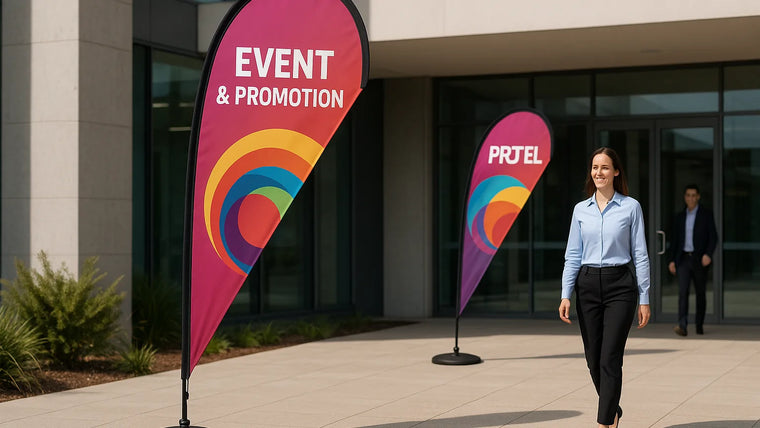
Teardrop Banners for Events and Promotions
Teardrop banners are aerodynamic, curved‑top fabric flags that hold tension to minimise flapping, delivering high visibility for events, retail forecourts and outdoor activations. Systems...
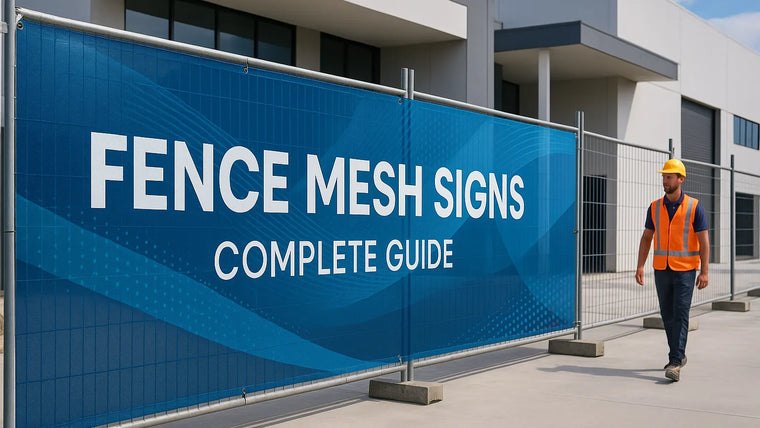
Fence Mesh Signs: Complete Guide
Fence mesh signs are printed mesh banners designed for temporary fencing and hoardings. Mesh allows airflow and can help reduce wind load compared with...
Best Materials for Crowd Control Barrier Graphics
For most outdoor events in Australia, perforated mesh banner is a versatile option because airflow can help reduce wind effects and it’s quick to...