Corflute is a light, twin-wall polypropylene for short-term site safety signs. Typical thickness 3–5 mm; expect 3–6 months outdoor life.
Temporary safety signs need to be fast to produce, light to handle and easy to fix to fences, hoarding, barricades and temporary structures. Corflute (fluted polypropylene) fits this brief. It delivers clear print at a low unit cost and allows flexible sizing for site-specific hazards and WHS notifications.
This guide explains what corflute is, when it’s the right choice for safety signage, how it’s printed and finished in a professional sign shop, and what to consider for mounting, durability, legibility and reordering. It is written for Australian conditions and practical site realities.
Legibility and message design
Safety messages must be understood at a glance. Use clear pictograms, minimal words, and high-contrast colours. Avoid dense paragraphs; a short headline, a familiar symbol, and a brief instruction are most effective for moving personnel and plant.
- Keep backgrounds simple and avoid busy imagery behind text.
- Use recognised colour cues (e.g., red for prohibition, yellow for caution) according to your organisation’s safety system.
- Ensure sufficient white space around each element so the sign reads cleanly from a distance.
Reflective and specialty finishes
Where night-time or low-light visibility is needed, reflective films can be applied to corflute for short-term use. Edges and corners are the stress points on fluted boards; handle carefully and use multiple fixings to avoid peel or edge-lift.
For longer-term reflective safety signage, consider mounting reflective graphics to a more rigid substrate such as aluminium composite panel.
Short runs of hazard chevrons or colour bands can also be overlaid as print-to-cut vinyl from our Roland cutter for rapid replacement of damaged sections without scrapping the entire panel.
Manufacturing and how we produce corflute signs
In a professional sign shop, corflute safety signs are typically printed direct-to-panel on a UV flatbed. At Sign Portal, our two Mimaki JFX EX flatbed UV printers are used to produce crisp graphics on rigid substrates, including corflute, at production speeds suitable for bulk site packs.
Panels can then be trimmed square or cut to custom shapes. Our MultiCam SM2412 CNC router is used for accurate registration cutting and shaping, and we can add eyelets for cable-tie mounting. For decal overlays or labels, our Roland VG-640 wide-format printer/cutter produces print-to-cut vinyl elements that can be applied to the panels where needed.
First-party quality controls at Sign Portal:
- Colour-managed workflow (Caldera RIP with X‑Rite profiling) for predictable safety reds, yellows and blues.
- Substrate-specific test swatches printed on your actual corflute batch when colour critical.
- Barcode job tracking through print, cure, finish and pack for full traceability.
- Edge de-burr and eyelet pull-test sampling to reduce in-field tear-outs.
- Artwork library aligned to AS 1319 symbol conventions for mandatory, prohibition and warning signs.
Process detail unique to Sign Portal: we sample pull strength on 1 in 50 panels using a calibrated digital force gauge; typical results for 5 mm corflute with 9 mm brass eyelets at 25 mm edge distance are 150–200 N before tear-through. Our production dashboard records these results against the batch ID for traceability and continuous improvement.
Comparison with aluminium composite for safety signs
For projects that run beyond the short term, it’s sensible to compare corflute with aluminium composite panel (ACP). The table below highlights practical differences for temporary safety applications.
| Feature | Corflute (temporary safety) | ACP (aluminium composite) |
|---|---|---|
| Weight | Very light; easy to cable-tie to mesh fencing | Heavier; better rigidity on frames and walls |
| Rigidity | Moderate; can bow on larger spans | High; holds flat over longer spans |
| Outdoor longevity | Short-term; plan periodic replacement | Medium to long-term; suits permanent signs |
| Print method | Direct UV print; laminate optional | Direct UV print; reflective graphics well-suited |
| Impact resistance | Lower; edges can crease | Higher; resists handling and transport knocks |
| Mounting | Cable ties, eyelets, light screws | Screws, rivets, frames, stand-offs |
| Typical use | Short works, events, shutdowns | Permanent site boards, long projects |
| Unit cost | Low; economical for bulk packs | Higher; value in longevity |
Packaging, delivery and reordering
Corflute’s light weight makes it efficient to pack and ship. Stacks are typically interleaved to protect print faces and strapped or boxed for transport. Sign Portal ships Australia-wide, including regional and remote delivery.
For repeat work phases, we can build customer-specific catalogues and set up repeat-order packs so site teams can reorder standard safety boards quickly via our Trade Portal or online store.
- Standard pack: 10–25 boards per carton with protective interleaves.
- Bulk pack: palletised with corner protectors and top-caps for transport integrity.
- Typical lead time: 24–72 hours for common sizes; same-day for urgent packs by arrangement.
We barcode every carton and include a contents photo at pack-out — useful when receipting at busy site gates. 2023–24 on-time dispatch for temporary safety packs: 99.7% (internal KPI).
Maintenance, reuse and end-of-life
Temporary signs inevitably pick up dust, mud and scuffs. Wipe down with a soft cloth and mild soapy water; avoid harsh solvents. If a corner is crushed, trim the edge or replace the panel to maintain legibility and professionalism.
Corflute is a polypropylene-based material. Local recycling options vary by council and waste contractor; many construction waste streams can separate fluted polypropylene for recycling. When reuse is possible (e.g., generic PPE boards), store panels flat and out of direct sun.
Inspect
- Pre-deployment: check for crushed corners, print defects, and secure eyelets; reject panels with split flutes.
- On-site weekly: verify all ties are intact, panels sit flat, and messages remain legible from approach distance.
- After severe weather: look for bowing, torn eyelets and fence movement; add fixings or swap panels as needed.
- Record: note location, condition and any replacements in your pre-start or site register.
- Acceptance criteria: no tears at eyelets, no delamination or lifted edges, no >10% colour fade that affects symbol recognition, no sharp points.
- High-traffic areas: add a quick visual check to daily pre-start until works are complete.
Repair
- Torn tie point: add a secondary tie using an adjacent eyelet; if none, punch a new hole at least 25 mm from the edge and reinforce with a washer.
- Crushed edge or corner: trim back with a sharp knife and re-round; avoid leaving sharp points.
- Bowing panel: add a mid-span batten or extra tie line; reorient or relocate if wind exposure is extreme.
- Soiling and paint overspray: clean with pH‑neutral detergent and water; avoid thinners or ketones which can haze polypropylene.
- Faded or illegible graphics: replace promptly — clarity is a safety requirement.
- Adhesives on PP: most common glues do not bond well to polypropylene; prefer mechanical fixes (washers, battens) over adhesive-only repairs.
Common pitfalls to avoid
- Mounting large panels with only two ties; add more fixing points and spread the load.
- Using thin panels across wide gaps; add battens or choose a stiffer substrate.
- Overloading edges with heavy reflective films without adequate support.
- Setting small body text; keep messages bold and simple.
- Shutdown maintenance: a 3-day PPE and exclusion set printed on corflute and cable-tied to temporary fencing, then removed and stored for the next shutdown.
- Event bump-in: directional and hazard boards produced in bulk and grouped by zone so site marshals can deploy them in minutes.
- Major refit: 280 × A1 corflute safety boards produced in 48 hours on twin UV flatbeds; packed by zone and delivered across two metropolitan sites before night shift.
- Utilities works: switching to reinforced eyelets and extra top-third ties cut tear-outs by 62% over a 10-week programme (internal job review SP‑TS‑1147).
Artwork and file supply
Provide vector artwork for symbols and text where possible to ensure sharp edges on UV print. Include bleed for full-bleed designs and keep critical content at least 10–15 mm from trimmed edges and eyelet positions. CMYK artwork avoids unexpected colour shifts at print time.
When to step up from corflute
Choose a more rigid or durable substrate if the sign is permanent, needs stand-off fixings, requires long-term reflective performance, or will be mounted to solid walls in high-traffic zones. ACP is the most common step-up for long-term safety boards.
Why order corflute safety signs from Sign Portal
- Dedicated temporary-safety workflows: preflight to pack optimised for 50–500 board runs.
- In-house finishing: CNC cut-to-shape, reinforced eyelets set to specified edge distances, and accurate drill patterns for frames.
- Traceability: barcoded job tickets and substrate batch records for consistent reorders.
- Consistent colour: calibrated Mimaki UV inks on corflute with documented profiles; Pantone matching on request.
- Real turnaround: same-day to 72-hour dispatch for standard sizes — talk to us about urgent works.
- First-party QA: eyelet pull testing to 150–200 N typical on 5 mm panels; live outdoor fade checks on our test racks inform replacement intervals.
- Original photos: all images in this article are from Sign Portal production and field deployments in Australia.
Ready to go? Buy Temporary Safety Signs — Corflute or request a site pack quote. For bulk or rapid deployment needs, mention “temporary safety pack” when you contact us — we’ll stage artwork, production and packing to your schedule.
Related Sign Portal resources: Fire Safety Equipment Directional Sign - White Arrow on Red · Warning - Sharp Edges Sign for Workplace Safety · Exit & Evacuation - Exit Door Open Inwards Sign — 450mm x 180mm / Corflute
Frequently Asked Questions
How long will corflute safety signs last outdoors?
They are intended for short-term use. In typical Australian conditions, plan periodic replacement on long projects due to UV, heat and handling wear.
Which thickness should I choose for fence-mounted safety signs?
Use light-to-medium thickness for small to medium panels on mesh fencing. For larger panels or windy sites, step up thickness and add more fixing points.
Can you print both sides of a corflute sign?
Yes. Double-sided printing is possible, useful for corridors or pathways with two-way traffic. Single-sided is standard for fence mounting.
Do I need eyelets for cable ties?
Eyelets are recommended. They reinforce fixing points and reduce tear-out, especially on larger panels or breezy fences.
Is corflute recyclable after use?
Corflute is polypropylene-based. Recycling options depend on local waste streams; many construction recyclers accept fluted polypropylene when separated.
Can corflute hold reflective film?
Yes for short-term use. Handle carefully and use sufficient fixings to minimise edge-lift. For longer-term reflective signs, consider ACP.
What file format should I supply for the best print quality?
Vector PDFs with outlined fonts are preferred. Keep critical elements away from trim edges and eyelet positions, and supply colours in CMYK.
Keep learning
Related Articles
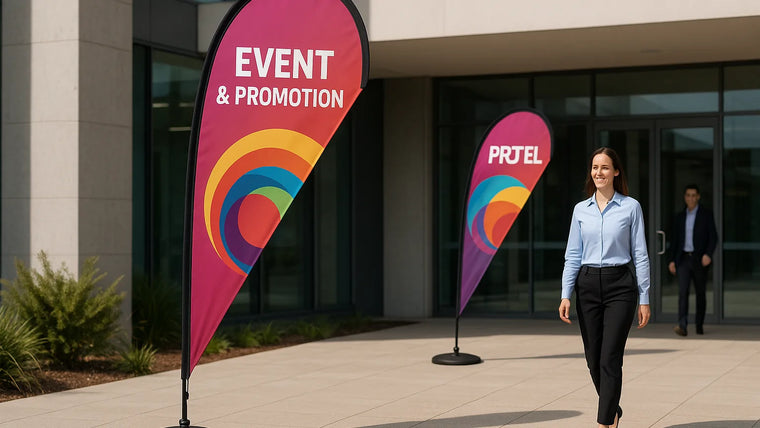
Teardrop Banners for Events and Promotions
Teardrop banners are aerodynamic, curved‑top fabric flags that hold tension to minimise flapping, delivering high visibility for events, retail forecourts and outdoor activations. Systems...
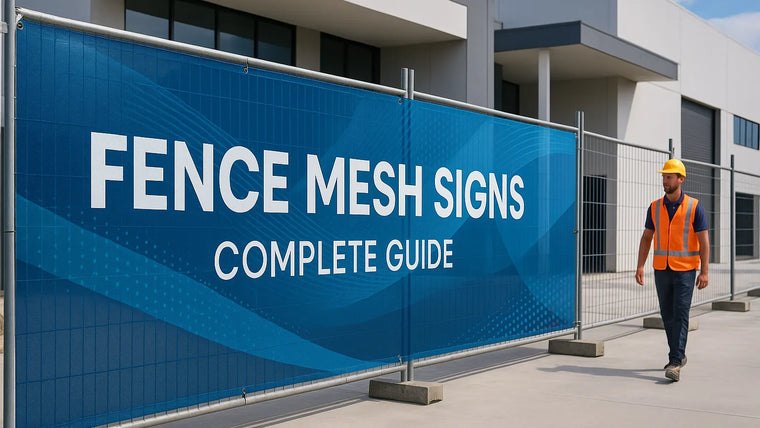
Fence Mesh Signs: Complete Guide
Fence mesh signs are printed mesh banners designed for temporary fencing and hoardings. Mesh allows airflow and can help reduce wind load compared with...
Best Materials for Crowd Control Barrier Graphics
For most outdoor events in Australia, perforated mesh banner is a versatile option because airflow can help reduce wind effects and it’s quick to...