Choose solid aluminium for rigid, vandal‑resistant safety signs that handle heat, harsh UV, chemicals and salt spray for long service life.
Selecting the right substrate for a safety sign is a risk decision as much as a branding choice. Materials behave differently in heat, sun, coastal salt, on fences or poles, and in high‑impact zones like warehouses and mine sites.
This guide explains where solid aluminium plate excels for safety signage, where it is not the best fit, and how Sign Portal manufactures aluminium signs in‑house for tough Australian conditions.
Quick decision guide
Use this as a fast filter before you dive into the details.
- Choose aluminium for high-impact areas, long-term outdoor use, high heat, bush or outback sun, coastal salt exposure, and where fire performance of plastics is a concern.
- Choose something else if the panel is very large and weight is critical, you need electrical isolation (non-conductive), or you require ultra-low cost for short-term use.
If you’re mounting to poles, fences or masonry and want a rigid, professional finish that endures, aluminium is often the safest long-term bet.
Need a durable, compliant panel fast? Order Solid Aluminium Safety Signs online — stocked in common sizes with 1.6 mm, 2.0 mm and 3.0 mm plate options.
For urgent replacements, our in‑house routing and flatbed print capacity means stocked plates typically dispatch in 24–48 hours. See live availability on Solid Aluminium Safety Signs.
What the material is

Aluminium plate (often called solid aluminium sheet) is a single, homogeneous metal substrate. Unlike aluminium composite panel (ACP), which sandwiches a plastic core between two thin aluminium skins, plate is metal all the way through.
For safety signage, this matters: edges can be rounded and deburred, holes can be drilled precisely, and the panel resists impacts without skin delamination. It also tolerates heat better than many plastics.
At Sign Portal we typically stock marine-capable grades and tempers suited to signage: 5005 (for uniform coating/printing) and 5052-H32 (for tougher, high-vibration or coastal installs). Standard thicknesses we cut daily: 1.2 mm (small plates), 1.6 mm (general purpose), 2.0 mm (fence/pole), and 3.0 mm (larger panels or high-wind sites).
- Common finished sizes: 300 × 225, 450 × 300, 600 × 450, 600 × 600, 900 × 600 mm (custom on request).
- Typical hole specs: 6.5 mm to clear M6 bolts; 8.5 mm to clear M8; hole-to-edge offset 15–20 mm.
- Corner radii options: 3 mm, 6 mm, 10 mm — all edges machine-deburred as standard.
Finish options we run daily: mill finish with direct UV print; pre‑painted (coil‑coated) white 5005 for ultra-uniform graphics; reflective film builds (Class 2, Class 1/1W) over aluminium plate where specified.
Strengths for safety signage
Impact and vandal resistance
In warehouses, loading docks and mine sites, signs cop knocks from pallets, tools and vehicles. Aluminium plate shrugs off many impacts that would permanently crease thinner composite skins or crack plastics.
For fence-mounted or pole-mounted signs exposed to public areas, the rigid metal substrate better resists flexing and blunt vandal damage.
Heat and fire performance
Where ambient temperatures climb (tin roofs, outback, plant rooms), aluminium retains shape without the heat softening seen in some plastics. In applications where reduced combustible content is preferred, a metal substrate is a sensible choice.
Dimensional stability
With temperature swings or prolonged sun, aluminium plate stays flatter and moves less than many polymer boards. This helps keep regulatory symbols, arrows and text aligned and legible at a distance.
Longevity and recyclability
With appropriate finish and maintenance, aluminium provides a long service life in outdoor conditions. At end of life, it is widely recyclable, helping reduce waste versus mixed-material substrates.
Optional protective laminates (including anti-graffiti films) further extend service life in public-facing areas and improve cleanability after marker or paint contact.
Limitations to note

Aluminium is not a one-size-fits-all answer. Keep these trade-offs in mind.
Weight on large panels
For very large signs, the weight of solid metal can complicate handling and increase fixing loads. Composite or lighter substrates may be more practical where spans are big and wind loading is a factor (seek engineering where required).
Electrical conductivity
Aluminium is conductive. In switch rooms, substations or near live equipment, confirm isolation, earthing and clearance requirements with a qualified electrician and site standards before selecting metal plates.
Edge and handling safety
Unfinished metal edges can be sharp. Always request edge rounding and deburring, and specify hole positions so installers avoid on-site drilling where possible.
Selection factors
- Environment: UV intensity, heat exposure, rainfall, dust, and coastal salt all influence substrate longevity and finish choices.
- Mounting surface: Wall, fence or pole mounting changes hardware needs and panel stress.
- Sign size: Larger panels amplify wind and weight considerations.
- Impact risk: Forklifts, pallets, tools and public areas push you toward tougher substrates.
- Reflectivity: If you need reflective graphics, plan whether the reflective film is applied to aluminium or a different base.
- Compliance: Check any site or authority requirements that specify substrate type, thickness or fixing method.
- Budget and lifespan: Balance upfront cost against replacement cycles and downtime.
For reflective requirements, we can produce Class 2 (Engineer Grade) or Class 1/1W reflective signs to AS/NZS 1906.1 on aluminium plate when specified. For OH&S facility signage, visual layout can be built to AS 1319 colour and symbol conventions.
Side-by-side comparison

This table compares two common safety sign substrates on attributes that matter in Australian conditions.
| Feature | Solid aluminium | Aluminium composite panel (ACP) |
|---|---|---|
| Impact resistance | High resistance to dents and creasing | Good, but skins can crease under heavy impact |
| Heat tolerance | Excellent dimensional stability in hot environments | Good, but plastic core can limit high-heat tolerance |
| Weight | Heavier for large panels | Lighter for equivalent size |
| Edge finish | Can be rounded and deburred; fully metallic edge | Edge exposes plastic core; sealing may be desirable |
| Vandal resistance | Resists blunt-force damage well | Good, but skin delamination is possible after severe impact |
| Fire performance | Metal substrate with no plastic core | Contains polymer core; assess against site requirements |
| Cost efficiency | Higher upfront for area; strong long-term value | Generally more economical at larger sizes |
| Recyclability | Widely recyclable metal | Mixed-material; recycling options vary |
| Best use cases | Mining, coastal, high-impact, hot plant rooms | General outdoor, large panels, lighter installs |
- Mine site hazard boards on star pickets withstand vehicle vibration and daily dust washdowns.
- Perimeter "Authorised personnel only" signs on cyclone mesh fences resist public tampering.
- Warehouse exclusion zone plates near bollards survive frequent trolley and pallet strikes.
- Jetty life-ring location plates on stainless stanchions remain flat and legible despite salt spray and sun.
How we manufacture it
At Sign Portal, aluminium sign plates are direct UV printed on our Mimaki JFX EX flatbed printers. UV-curable inks bond to the prepared metal surface, delivering crisp symbols and text suitable for regulatory safety graphics.
We then route and profile on the MultiCam SM2412 CNC router, allowing accurate custom shapes, hole patterns and corner radii. Edges are deburred for safe handling. Where projects benefit, protective laminates can be applied using our in‑house laminating capability.
We can print full sheets or pre-cut plates using registration for precise print-to-cut alignment. Completed signs are packaged with corner protection and shipped Australia‑wide, including regional and remote delivery.
Shop-floor process highlights unique to Sign Portal:
- Metal prep: mechanical scuff (Scotch-Brite), alkaline degrease, isopropyl wipe; inkjet primer (Mimaki PR-200) applied when required for extreme-duty adhesion.
- Adhesion verification: cross-hatch and tape test to ASTM D3359 on every new batch/finish combination before production runs.
- Edge quality: CNC route with finishing pass; burr inspection; optional clear edge seal for aggressive coastal chemical exposure.
- Graphics durability: optional anti-graffiti laminate for public areas; reflective builds available to AS/NZS 1906.1 classes.
- Traceability: job ID and batch code placed discretely on the reverse for maintenance and re-order accuracy.
Additional QA and production specifics:
- Printer bed size 2500 × 1300 mm accommodates full sheets; we fixture multiples with pin registration for repeatable hole patterns.
- We log UV lamp hours and perform daily nozzle checks; cure verified using cross-hatch/adhesion tests on a tagged witness panel per batch.
- Router tooling: carbide single-flute aluminium bits with a finishing pass; typical feed 4.0–5.5 m/min with 0.2 mm clean-up to minimise burrs.
- Corner rounding and deburr are completed, then edges are hand-checked with a stainless deburr gauge; Noga deburring tools used for micro-burr removal.
- Colour control: spot checks recorded; for projects with corporate colours, ΔE2000 ≤ 3 target on supplied swatches.
Installation pointers

Hardware choice depends on substrate, surface and exposure. For metal plates, use appropriate stainless or galvanised fixings sized to the sign and substrate. On steel posts, consider isolating washers to reduce galvanic corrosion risk between dissimilar metals.
- On fences: bolt through mesh with backing washers or use sign brackets designed for chain-link.
- On poles: banding or U‑bolts sized to the post, with two fix points minimum for stability.
- On walls: masonry anchors or screws with wall plugs; avoid drilling near electrical or plumbing services.
For critical safety installations, follow site procedures and any authority requirements for height, orientation and visibility. If in doubt, consult a qualified installer.
Installer tips we specify on drawings:
- Preferred fasteners: 316 stainless near coast; 304 inland. Typical sizes M6/M8 with 25–40 mm diameter washers to spread load on mesh.
- Isolation: nylon or fibre washers between stainless hardware and aluminium to reduce bimetallic corrosion in salt-laden air.
- Banding: 19 × 0.7 mm stainless band with buckles for round poles; two bands minimum per sign, 100 mm from top/bottom edges.
- Hole placement: minimum 15 mm from edge; avoid placing holes on bend lines or near sheet corners under high wind loading.
Torque guide (typical): 19 mm stainless banding buckles 4.5–6.0 N·m; M8 bolts on mesh 8–10 N·m with flat washer both sides. Retension after first week in high-vibration zones.
Australian conditions
Australia’s UV index, heat and coastal salt can punish signage. Aluminium plate handles heat well and, with suitable finishes, stands up to UV and salt-laden air better than many plastics. In tropical zones, frequent rain and high humidity call for corrosion-aware fixings and maintenance.
In high-wind regions, ensure the fixing method is adequate for panel size and exposure, and seek engineering advice where required. For coastal installs, stainless hardware and regular inspection reduce corrosion risk at fix points.
For spray and splash zones (jetties, desal, coastal plants), specify 2.0–3.0 mm plate, 316 stainless fixings, isolation washers, and consider anti-graffiti or hardcoat laminate to simplify cleaning.
Cost and lifecycle
Per square metre, solid metal typically costs more than lightweight boards. However, in harsh environments its resistance to impact and heat can reduce replacement frequency. Weigh upfront spend against downtime, reprint costs and the safety implications of damaged or illegible signs.
Consolidating orders and standardising hole patterns can also reduce long-term procurement and installation costs.
We can supply spares in the same batch (with matched lot codes) so future field replacements maintain a uniform look and mounting pattern.
Ordering and artwork checklist
- Confirm environment: outdoor exposure, heat sources, coastal proximity.
- Confirm mounting: wall, fence, or pole; provide post diameter if applicable.
- Specify hole count, positions and corner radius; request deburred edges.
- Artwork: supply vector PDFs with outlined fonts; include bleed where necessary.
- Decide on protective laminate based on cleaning regime and abrasion risk.
- If reordering, reference your Trade Portal catalogue item to match previous specs.
Ready to buy? See size, thickness and laminate options on our product page: Solid Aluminium Safety Signs.
Care and inspection
A simple maintenance routine preserves legibility and finish.
- Clean with mild soapy water and a soft cloth; avoid harsh solvents or abrasives.
- Inspect fixings for corrosion or loosening, especially in coastal and high-vibration sites.
- Check edges and corners for damage after impacts; replace if readability is compromised.
Anti-graffiti laminate simplifies removal of permanent marker and many paints using approved cleaners. Always test cleaners on an inconspicuous edge first.
Inspection intervals we recommend: quarterly in coastal spray zones; six‑monthly inland. Record sign ID (printed on reverse) during inspections to streamline any repair or replacement with our team.
Repair and refurbishment
When damage is localised, repair can extend service life without a full replacement.
- Loose fixings: replace corroded screws/bolts like-for-like (prefer 316 stainless near coast) and add nylon isolators if missing.
- Minor edge burrs: de-burr in situ with a fine file; seal with clear coat if in corrosive atmospheres.
- Scratches in print: if non-critical, leave; if within key text/symbols, replace the plate to maintain compliance.
- Laminate scuffs: panels with anti-graffiti laminate can often be cleaned; if laminate is breached, schedule replacement.
- Bent panels: for kinks or creases affecting legibility or flatness, replace — do not attempt to cold-straighten safety signs.
We can pre-pack site repair kits with spare plates, fixings, isolators and washers to match your standard hole pattern and post size, reducing downtime.
Repair workflow we run with maintenance teams
- Identify the sign via the reverse-side job and batch code; email a photo of the issue and code.
- We confirm spec from your Trade Portal catalogue item and ship a matched replacement plate and hardware.
- For reflective builds, we include cleaning wipes compatible with the specified film and laminate.
- On receipt, swap plate like-for-like using existing holes; torque to the values above and log the new batch code in your asset register.
Typical kit contents: pre-drilled plate, 316 fasteners (M6/M8 per your drawing), nylon isolation washers, large OD washers for mesh, alcohol wipes, and a QR card linking to re-order Solid Aluminium Safety Signs.
Case study: Pilbara mine hazard and exclusion signage
Scope: 72 signs for haul road crossings, HV bays and restricted zones across a Pilbara iron ore operation.
Specification delivered by Sign Portal:
- Substrate: 2.0 mm 5052-H32 aluminium plate, 600 × 450 and 900 × 600 mm formats.
- Graphics: direct UV print on Mimaki JFX EX with on-head primer where specified; layouts per AS 1319 conventions.
- Finish: high-gloss anti-graffiti laminate for public-facing areas; non‑reflective and Class 2 reflective variants to AS/NZS 1906.1.
- Fabrication: MultiCam SM2412 CNC, 8.5 mm holes, 6 mm corner radii, job/batch code printed on reverse.
- Hardware guidance: M8 316 stainless bolts with nylon isolation washers on cyclone mesh; two stainless bands per post for round poles.
Process notes unique to our shop floor:
- Batch adhesion test retained with job docket (ASTM D3359 cross-hatch pass recorded) before release.
- Dust management during print: compressed-air ionising bar pass; vacuum pin table registration for repeatability.
- Packed per run with corner guards and interleaves; site packs collated by area to speed install.
Outcome after routine 12‑month inspection: print and substrate integrity maintained; routine re-tensioning of banding in high-vibration zones completed by site; one panel replaced due to vehicle strike.
For a coastal comparison, our standard coastal build switches to 316 stainless hardware, mandates isolation washers, and often adds anti-graffiti laminate to simplify removal of salt deposits and public markings.
Case study: Coastal desalination plant — spray zone safety and wayfinding
Scope: 58 plates across intake jetties, chemical dosing areas and pump hall access in a high-salt spray environment.
- Substrate: 3.0 mm 5052‑H32 aluminium for jetty perimeter and splash zones; 2.0 mm inland of plant facades.
- Graphics: Class 1W reflective legends to AS/NZS 1906.1 for low‑light readability on jetties; non‑reflective for internal plant rooms.
- Finish: non‑PVC anti‑graffiti laminate on all external plates to ease salt and tag removal.
- Fabrication: 8.5 mm holes, 10 mm corner radii; clear edge seal applied to routed edges for added coastal protection.
- Hardware: 316 banding on round posts, 316 bolts and large OD washers on mesh; nylon isolators throughout to minimise galvanic coupling.
Process and QA:
- Adhesion witness panel retained; batch and job IDs printed on reverse for each area (Jetty, Intake, Dosing).
- On‑site template provided for consistent hole centres on mixed post diameters.
- Cleaning guidance issued to facility team, including approved pH‑neutral detergents for monthly washdown.
Result at 18‑month service check: no pitting at fix points; reflective performance and gloss intact; two banding sets re‑tensioned after winter storms; zero delamination observed.
Need the same coastal-ready specification? Order matched plates here: Solid Aluminium Safety Signs.
Ready to spec the same outcome on your site? Start here: Solid Aluminium Safety Signs.
Related Sign Portal resources: Fire Door Safety Sign - Do Not Obstruct or Keep Open · Mandatory Safety Vest Sign for Workplace Safety · Fire Equipment Arrow Sign - Directional Safety Sign
Frequently Asked Questions
Is solid aluminium better than ACP for safety signs?
It depends on the environment. Aluminium plate is tougher against impacts and heat, and has no plastic core. ACP is lighter and often more economical for large panels or general outdoor use.
Can you print directly onto aluminium?
Yes. We direct UV print aluminium plates on our Mimaki JFX EX flatbeds, producing crisp, durable safety graphics.
Will aluminium corrode near the coast?
Coastal environments are harsher on all metals. With suitable finishes, stainless/isolated fixings and routine inspection, aluminium performs well in coastal applications.
What mounting hardware should I use for metal signs?
Use appropriate stainless or galvanised fixings sized to the sign and substrate. For poles, use banding or U‑bolts; for fences, brackets or through-bolts with washers.
Is aluminium magnetic?
No. Aluminium is non‑magnetic. If you need a magnetic sign, use a magnetic substrate or separate magnet-compatible surface.
Do I need a protective laminate?
In high‑abrasion or frequent cleaning environments, a clear laminate helps preserve print. For low‑touch indoor areas it may be optional.
Can I get rounded corners and pre‑drilled holes?
Yes. We route, round and deburr corners, and drill holes to your specification to simplify installation and improve safety.
Keep learning
Related Articles
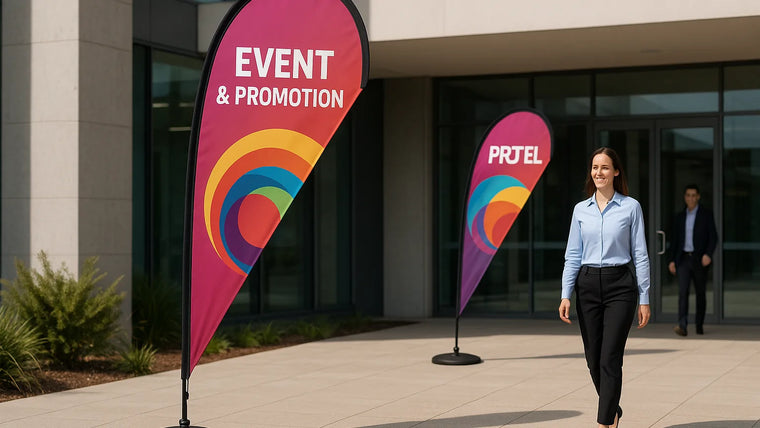
Teardrop Banners for Events and Promotions
Teardrop banners are aerodynamic, curved‑top fabric flags that hold tension to minimise flapping, delivering high visibility for events, retail forecourts and outdoor activations. Systems...
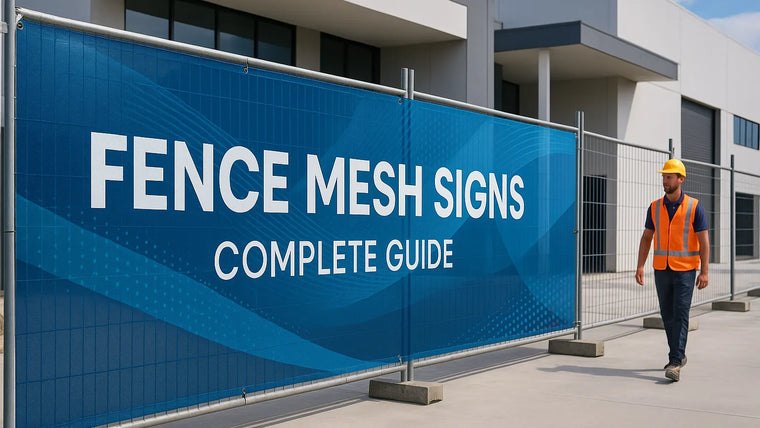
Fence Mesh Signs: Complete Guide
Fence mesh signs are printed mesh banners designed for temporary fencing and hoardings. Mesh allows airflow and can help reduce wind load compared with...
Best Materials for Crowd Control Barrier Graphics
For most outdoor events in Australia, perforated mesh banner is a versatile option because airflow can help reduce wind effects and it’s quick to...