Use Class 1/1W reflective on aluminium or ACP with AS 1319/1742 designs; keep messages large and clear, and place for long sightlines.
When haul trucks, loaders, cranes and other mobile plant move around an active site, signage becomes part of the controls that keep people and equipment separated. The aim is not just to display words, but to deliver instructions drivers and pedestrians can read at speed, in dust, rain or low light.
This guide explains which signs are commonly required on mining, quarrying and industrial sites, how to choose materials that survive harsh Australian conditions, where to place signs for maximum effect, and how Sign Portal manufactures heavy-duty signage in-house.
What these signs need to do
On heavy plant sites, signs serve three core jobs: warn of hazards, separate people from vehicles, and direct safe traffic flow. That means big, clear messages that can be read at a glance and seen early enough for a loaded vehicle to respond.

At typical site speeds (30–60 km/h), operators need 6–10 seconds of advance warning to perceive, decide and react with a full or partially loaded unit. That equates to 50–170 metres of usable reading distance depending on terrain, weather and dust. Size, reflectivity and placement must work together to deliver that window.
Because conditions change fast, signage should also support temporary controls during blasts, shutdowns or weather events. Portable and vehicle-mounted options help keep controls close to the work.
Every site’s traffic management plan will drive the specifics, but the principles below help you choose and implement signage that actually changes behaviour on the ground.
Common sign types on heavy plant sites
Control and warning
- Entry and induction: check-in points, radio channel/UHF signage, PPE requirements and speed on entry roads.
- Haul road controls: speed limits, give way to haul trucks, crest warnings, intersections, overtaking bans, night operations.
- Hazard alerts: reversing areas, blind spots, swing radius for cranes/excavators, water trucks operating, blast exclusion zones.
- Restricted access: no pedestrians, plant only, exclusion zones, permit-required areas, spotter required.
Traffic management
- Wayfinding: route arrows, one-way systems, detours during shutdowns, muster points.
- Parking and bays: loading zones, plant refuelling, maintenance bays, laydown areas.
- Crossings: zebra or controlled crossings at workshops, crib huts, and site offices.
Vehicle-mounted and portable
- Magnetic or bolted placards on service vehicles and light vehicles: UHF channel, convoy rules, do not overtake turning vehicle.
- A-frames and barricade boards: quick deployment for short-duration works.
- Flagging and bollard sleeves: supplement fixed signs where visibility drops in dust or rain.
Materials and construction choices
Industrial signage must withstand UV, wind, dust, vibration and occasional impact. Material choice affects readability, lifespan and whole-of-life cost.
- Rigid panels: aluminium composite panel (ACP) and solid aluminium remain the workhorses for fixed signs. They are rigid, lightweight relative to steel, and suitable for direct UV printing.
- Reflective faces: engineering-grade and high-visibility reflective films improve detection at dawn, dusk and night under headlights or work lights.
- Temporary substrates: corflute suits short-term controls around works, shutdowns and blast windows. It is light, low-cost and can be cable-tied to barriers.
- Vehicle and post wraps: premium cast vinyl and reflective striping mark swing radii, bumpers and bollards for better peripheral visibility.
Edge finishing matters. Rounded corners, deburred edges and grommeted fixing points reduce snag and injury risks when handling, and help signs survive vibration in wind.
Ready-to-spec options for permanent controls: choose Reflective ACP site signs for large, lightweight grouped controls, or Reflective aluminium site signs for compact plates mounted to posts, handrails and gantries in high-vibration zones.
- Large-format reflective ACP boards marking a haul road crest, spaced so drivers see at least two signs before the hazard.
- Corflute detour arrows cable-tied to temporary barriers during a plant shutdown, removed once the work ends.
Reflective performance and grades
For mobile plant environments, prismatic retroreflective films (AS/NZS 1906.1 Class 1 or Class 1W) are preferred on primary controls and hazard warnings. Class 2 is suitable for low-speed yards and internal wayfinding.
- Class 1W (wide-angle prismatic): best for oblique angles common on haul roads, long sight distances and night operations.
- Class 1: high performance where head-on approach is typical.
- Class 2: cost-effective for low-speed, well-lit areas.
Typical panel builds on site: 3 mm ACP for general use, 4–4.5 mm ACP where posts are widely spaced or wind load is high; 1.6–2.0 mm marine-grade aluminium (e.g., 5052-H32) where impact resistance, smaller panels, or magnetic interference avoidance is important.
Technical design and calculation guide
Sight distance, letter height and panel size
- Step 1 — Approach speed: confirm typical and maximum approach speed (e.g., 50 km/h on a haul road).
- Step 2 — Preview time: select 7–10 seconds for heavy plant to perceive–decide–act.
- Step 3 — Reading distance: D = speed (m/s) × preview time. Example: 50 km/h ≈ 13.9 m/s; D ≈ 13.9 × 8 s = 111 m.
- Step 4 — Letter height: plan 1 mm of cap height per 0.3–0.4 m of viewing distance. For 111 m, cap height ≈ 280–370 mm. Where space is limited, prioritise numerals/symbols and increase reflectivity.
- Step 5 — Panel size: maintain at least 30% clear margin around message blocks and symbols; increase width when grouping controls so cap heights do not fall below 120–150 mm on any line.
Worked example: For a crest warning + give way + 40 km/h on a 60 km/h road with dust, specify a 1800 × 1200 mm Class 1W panel with 450 mm Series E Modified speed numerals and 150 mm cap-height text lines.
Wind loading and post selection (AS/NZS 1170.2)
- Determine wind region (A–D), terrain category and shielding for your site; derive site Vdes per AS/NZS 1170.2.
- Estimate force on the panel: F ≈ 0.6 × Vdes2 × Cf × A (N), where Cf ≈ 1.6–2.0 for flat panels; A = panel area (m²).
- Worked example (indicative only): 1800 × 1200 mm panel (A = 2.16 m²), Region C yard, Vdes = 45 m/s, Cf = 1.8 → pressure = 0.6 × 45² = 1215 Pa; F ≈ 1215 × 1.8 × 2.16 ≈ 4.7 kN. Typical solution: twin 65 NB galvanised posts with 900–1200 mm embedment in N-class soils and rated brackets. Verify with a competent person and bracket/post supplier data.
- Post spacing: keep edges within 150–200 mm of posts on wide panels to limit panel deflection and fix shear on brackets.
Fixings and torque in high-vibration areas
- Hardware: M8–M10 A2/A4 stainless with flat + spring washers or nylocs; isolation washers when mating aluminium to galvanised steel.
- Typical torque ranges: M8 = 10–14 Nm; M10 = 20–30 Nm. Always confirm with bracket manufacturer specs to avoid panel bowing.
- Hole pattern: match post centres; elongate one hole per post to allow thermal movement on aluminium.
Retroreflectivity for dust and oblique angles
- Choose Class 1W for haul roads with frequent oblique viewing angles; prismatic lenses maintain luminance across wider entrance angles, improving “pop” under work lights and headlights.
- Use high-contrast colourways (e.g., black/yellow, black/white, red/white) and avoid large mid-tone backgrounds that wash out in dust.
- Add chevrons/borders on primary hazards to increase edge definition for peripheral detection.
Documentation and compliance delivered with your order
- Certificate of Conformance for AS/NZS 1906.1 reflective class (1, 1W or 2) by film type and batch.
- Bill of materials per panel (substrate, thickness, film stack, overlaminate where used) and layout revision code.
- Wind/loading assumption notes for standard modules and recommended post/bracket sets.
- Reverse-label traceability: job number, manufacture date, substrate, reflective class.
Technical specifications and standards for mine and quarry signage
- Standards: AS 1319 (occupational safety signs), AS 1742 series (traffic control devices on roads and related areas), AS 1744 (standard alphabets for road signs), AS/NZS 1906.1 (retroreflective sheeting classes).
- Typeface and numerals: Series E Modified for speed numerals and high-legibility alphabets per AS 1744. Avoid condensed fonts.
- Minimum letter heights (rule-of-thumb): 120–160 mm cap height for primary controls viewed at 40–60 km/h; increase to 200+ mm where dust or curves reduce visibility.
- Recommended panel sizes: 1200 × 900 mm for give way/speed reminders on haul roads; 1500 × 1200 mm for crest/intersection warnings; 1800 × 1200 mm for grouped controls at major decision points.
- Mounting height: bottom of sign typically 1.5–2.2 m above finished ground to clear mud spray and bonnet lines; increase near bunds or windrows.
- Offset: 1.0–2.0 m from traffic edge where practicable to reduce strike risk while maintaining sightlines.
- Fixings: M8–M10 304/316 stainless with nyloc nuts; use isolation washers/spacers when fixing aluminium to galvanised steel to minimise galvanic corrosion.
- Post selection: 65 NB galvanised pipe or equivalent channel posts with rated brackets in high-wind or high-vibration zones; consider slip-base systems near vehicle routes.
- Edge radius and holes: 6–10 mm corner radius; 8–10 mm holes set ≥20 mm from panel edge.
Print and fabrication at Sign Portal
Sign Portal manufactures heavy-duty site signage in-house. Two Mimaki JFX EX UV flatbed printers allow direct printing to rigid substrates such as ACP and aluminium, producing high-opacity graphics that remain clear in outdoor use.
Panels are cut to size and shape on our MultiCam SM2412 CNC router for smooth edges, accurate holes and rounded corners. For labels, tags and smaller polycarbonate or acrylic components, we use our Trotec Speedy 500 laser. Roll media, including reflective and high-tack vinyls for vehicles and posts, are printed and contour-cut on our Roland VG-640.
Lamination options add abrasion resistance for dusty haul roads or high-wash areas. Because production is in a 480+ m² facility with clean print rooms, colour consistency is controlled across repeat orders.
Process detail and QA that matter on site:
- Colour control: spectrophotometer checks on key colours with target ΔE tolerances to keep repeat orders visually consistent across batches and materials.
- Surface prep and adhesion: solvent wipe and flame/chemical treatment per substrate before film application; optional edge sealing on reflective films to reduce moisture ingress in wet or dirty environments.
- Traceability: every panel labelled on the reverse with job number, substrate, reflective class and manufacture date for maintenance records.
- Kitting: multi-sign projects packed in route order with post centres, bracket counts and fixings listed on a pack sheet for faster field installs.
For permanent mine/quarry controls, our standard modules in Reflective ACP site signs and Reflective aluminium site signs shorten lead times and simplify spare holding on site.

Case study: 280-sign rollout for a WA iron ore haul network
Scope: refresh controls and warnings across 32 km of haul and access roads, including four major intersections and two crest approaches. Deliverables: 280 panels (Class 1W reflective), posts and hardware, kitted by zone.
- Design and specification: standardised panel modules (1200 × 900, 1500 × 1200 and 1800 × 1200 mm) with Series E Modified numerals; grouped control boards at intersections to reduce driver scan time.
- Manufacture: direct-print UV to 4 mm ACP for major controls; 2.0 mm aluminium for compact warnings near plant bays. All reflective edges sealed; corners radiused 10 mm.
- Delivery and kitting: three staged drops over 2.5 weeks; each pallet labelled per road section with a post-and-bracket schedule. Spare panels included for rapid swap-outs.
- Outcome (site-reported): overspeed events on two crest approaches reduced by 33% within 60 days; night-time recognition at an oblique T-intersection improved, evidenced by fewer late braking logs from fleet telemetry. Maintenance team cited faster installs from pre-drilled hole patterns and kitted hardware.
Case study: 96-sign quarry upgrade in Central Queensland
Scope: replace ageing controls and wayfinding across a hard rock quarry with mixed light/heavy vehicle interfaces, two weighbridges and a new wash plant access. Deliverables: 96 panels (Class 1W for primary controls, Class 2 for yard wayfinding), new posts and retrofit brackets, kitted by zone with install drawings.
- Design and specification: speed numerals increased from 250 mm to 400 mm on haul approaches; consolidated three separate boards at entries into a single 1800 × 1200 mm grouped control to reduce eye-time.
- Manufacture: 3 mm and 4 mm ACP for grouped controls, 2.0 mm aluminium for compact prohibition/mandatory plates near pedestrian interfaces. All panels serialised on reverse labels for asset register linkage.
- Install support: pre-marked hole patterns matched to existing post centres; supplied torque guidance (M8 12 Nm, M10 25 Nm) and SWMS for installation in live yard conditions.
- Outcome (site-reported, 90-day review): near-miss reports at the ROM pad access dropped from 7 to 3; weighbridge queue encroachment reduced after adding one-way and STOP controls; maintenance reported a 40% faster install time due to kitted hardware and route-ordered packing.
Temporary versus permanent controls
Most sites need a mix. Temporary signs respond to changing risks; permanent signs support the underlying traffic plan. The comparison below helps choose the right approach for each location.
| Feature | Option A | Option B |
|---|---|---|
| Option label | Temporary controls | Permanent installations |
| Typical substrate | Corflute, portable boards, flags, A-frames | ACP or aluminium on posts, walls, gantries |
| Typical use | Shutdowns, detours, weather events, short works | Speed limits, give way, crossings, restricted areas |
| Visibility | Good if placed close to work; can be missed if cluttered | High, with larger sizes and reflective faces |
| Lifespan | Weeks to months, depending on exposure | Years with appropriate materials and care |
| Fixing | Cable ties, sandbags, portable frames | Posts, brackets, fence mounts, mechanical fixings |
| Cost profile | Lower per sign; higher turnover | Higher upfront; lower replacement frequency |
| Changeability | Fast to deploy and remove | Stable; changes require planned works |

Artwork and legibility
Legibility is everything. Use high-contrast colour combinations, unambiguous symbols and simple wording. Drivers should recognise the message in one glance while maintaining focus on the road and surroundings.
- Keep key words short and large. Supplement words with standardised symbols where possible.
- Avoid visual clutter. One strong message per sign is usually more effective than multiple lines of small text.
- Plan for conditions: dust, glare and rain reduce contrast; reflectivity and larger type help compensate.
Practical legibility tips from field rollouts:
- Speed numerals: use Series E Modified; 300–450 mm numerals are commonly specified where approach speeds exceed 50 km/h.
- Grouped boards: when combining three controls, increase panel width to maintain minimum 120–150 mm cap height for line-one text.
- Colour coding: apply AS 1319 conventions (red = prohibition, yellow = warning, blue = mandatory) on workplace signs to match operator expectations.
Placement and installation considerations
Place signs so drivers can act before a hazard or decision point. Give time and distance for a loaded vehicle to slow, give way or stop. Ensure an unobstructed sightline and avoid positions where mud, dust or parked plant often block the view.
- Mount securely on posts, fences or structures suited to the wind exposure and vehicle-induced turbulence of your site.
- At intersections or crests, repeat key controls (e.g., speed) ahead of the feature and again at the point of risk.
- Check night-time visibility. Realign signs if glare from work lights reduces readability.
For portable signs, stabilise frames with sandbags and inspect daily during use. Replace damaged or bent frames promptly.
Installation detail that reduces rework:
- Foundations: set posts plumb with adequate embedment for soil class; in soft ground, increase footing size or use screw piles/sockets.
- Hardware torque: tighten stainless fixings sufficiently to resist vibration without bowing panels; use thread-lockers or nylocs.
- Corrosion control: isolate dissimilar metals; rinse after installation if cutting fluids or swarf are present.
Maintenance and inspection
Regular inspection keeps messages clear and credible. Faded or damaged signs are easy to ignore and may be unsafe.
- Cleaning: remove dust, mud and diesel film with mild detergent and fresh water. Avoid harsh solvents that can dull reflective faces.
- Damage: look for delamination, peeling edges, impact dents and graffiti. Address early before defects spread.
- Reflectivity: check night performance during routine inspections. Replace panels that no longer pop under headlights.
- Fixings: tighten loose hardware and replace corroded screws, brackets and cable ties.
Lifecycle guidance: Class 1W reflective faces typically provide 7–12 years of outdoor performance depending on exposure; plan proactive replacement at critical decision points before end-of-life.
Ordering information and repeat jobs
A clear brief accelerates production and reduces rework. Useful details include:
- Message list and any required symbols or colours from your traffic plan.
- Intended viewing distance and mounting method (post, fence, wall, gantry, vehicle).
- Environment: day/night operation, dust levels, water trucks, coastal exposure.
- Material preference (e.g., ACP, aluminium, reflective film level) if known.
- Artwork: supply vector files (PDF, AI, EPS) and fonts. We can assist with layout where needed.
For repeat orders, Sign Portal can set up customer-specific catalogues so sites can reorder proven signs without re-briefing each time. Australia-wide shipping, including regional and remote delivery, is available.
Recommended products for mine and quarry controls:
- Reflective ACP site signs — lightweight, rigid panels for permanent installations and larger grouped controls.
- Reflective aluminium site signs — robust solid aluminium for compact panels, high-vibration mounts and harsh exposures.
When to specify reflective or illuminated options
Reflective faces are recommended where night driving occurs, in shaded cuttings, underground entries, or during winter dawn/dusk shifts. They also help during dust events by boosting contrast under headlights or work lights.
Illumination may be appropriate at fixed entries, portals, or where reliable lighting exists. For most haul and access roads, a reflective face on a suitably large panel provides strong performance with simpler maintenance.
Selection quick guide:
- Primary controls on haul roads: Class 1W reflective, large panels, high mounting.
- Secondary reminders and yard wayfinding: Class 2 reflective or non-reflective where lighting is consistent.
- Critical entries/portals: reflective plus fixed lighting or internally illuminated solutions, subject to power and maintenance access.
How Sign Portal builds durability into site signage
Manufacturing choices improve lifespan in harsh conditions. Direct UV printing to rigid panels avoids edge-lift common with applied graphics in high-vibration areas. Where applied films are required (e.g., reflective), edge sealing and correct surface prep reduce moisture ingress and peeling.
- Panel sizing: consistent module sizes make stocking spares and swapping panels faster.
- Hardware: pre-drilled holes and rounded corners speed installation and reduce handling injuries.
- Overlaminates: optional clear laminates add abrasion resistance in gritty environments.
Additional measures we implement for mine-spec durability:
- High-bond film systems and edge seal on reflective faces exposed to frequent washdown or water truck overspray.
- Mechanical fix as primary retention; VHB-type tapes used only as supplementary where appropriate.
- Packaging for remote transport: corner protectors, interleaving and palletisation that withstands long road legs to site.
Cost and lead-time factors
Budget and timing are driven by panel size and quantity, reflective requirements, substrate choice, and installation hardware. Consolidating orders for standardised sizes can improve pricing and reduce changeover time when signs need replacing.
If you operate multiple sites, a standard catalogue with approved messages, colours and sizes streamlines purchasing and ensures consistent on-site communication.

Related Sign Portal resources: Security Notice: Use Of Mobile Phones Prohibited Signs · Public Area Notice - No Mobile Phones Sign · Danger Stencil for Industrial Hazard Marking
Frequently Asked Questions
What size should heavy vehicle signs be on haul roads?
Bigger is safer. Choose sizes that can be read at speed from well before a decision point. If unsure, step up one panel size to increase letter height and symbol size.
Do I need reflective faces for daytime-only operations?
Reflective faces still help in dust, shade and low-contrast conditions. For sites with any early-morning, late-afternoon or adverse weather driving, reflective is recommended.
Which substrate lasts longer outdoors: ACP or aluminium?
Both perform well when fabricated correctly. Aluminium resists edge damage, while ACP offers a good weight-to-rigidity balance. The right choice depends on mounting method and exposure.
Can you match our site traffic management plan colours and symbols?
Yes. Supply your plan and vector artwork, and we will match approved colours, symbols and typography across all signs for consistency.
How fast can you produce replacement signs for remote sites?
Production is in-house and Australia-wide shipping is available, including regional and remote delivery. Lead time depends on size, quantity and reflective requirements—contact us with your list for scheduling.
What is the best way to fix signs to mesh fences?
Use suitable brackets or heavy-duty ties through pre-drilled holes with large washers or backing plates. Ensure the fence can handle wind loads and re-check fixings after strong winds.
Can temporary corflute signs be reused?
Yes if clean and undamaged. Store flat, avoid heat that can warp panels, and keep out of direct sun when not in use to extend usable life.
Keep learning
Related Articles
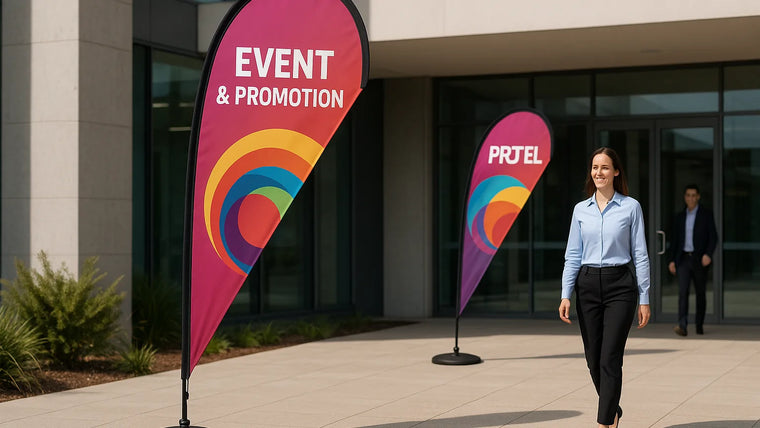
Teardrop Banners for Events and Promotions
Teardrop banners are aerodynamic, curved‑top fabric flags that hold tension to minimise flapping, delivering high visibility for events, retail forecourts and outdoor activations. Systems...
Fence Mesh Signs: Complete Guide
Fence mesh signs are printed mesh banners designed for temporary fencing and hoardings. Mesh allows airflow and can help reduce wind load compared with...
Best Materials for Crowd Control Barrier Graphics
For most outdoor events in Australia, perforated mesh banner is a versatile option because airflow can help reduce wind effects and it’s quick to...