Use solid PVC banners for bold colour in calmer sites; choose mesh for airflow on exposed fences. Finished with hems/eyelets or pockets for fast insta
When you need fast, bold visibility for festivals, pop-ups, retail launches or site branding, flexible banners remain one of the most practical options. They roll for transport, print beautifully, and can be finished to suit fences, hoardings, truss, facades and temporary structures.
This guide explains how to choose between solid PVC and mesh, how to plan sizes and finishing, what affects durability outdoors in Australia, and how Sign Portal produces and ships banners nationally.
Quick selection guide
If your priority is strong colour and legibility, choose a solid PVC banner and fix it with an adequately tensioned hem and eyelets. If the site is known for gusty conditions or you’re spanning open fencing, consider mesh so air can pass through the graphic and reduce wind loading on the fixings and structure.
- Maximum visual impact: solid PVC with a reinforced hem and eyelets
- Windy or exposed locations: mesh to relieve pressure on the structure
- Backlit or double-sided needs: plan material and finishing early
- Fast installs and removals: standard eyelet spacing and clear fixing plan

Ready to order?SeeCustom PVC Event Bannersfor standard sizes, fast-turnaround options and artwork help.
Prefer to spec now and order later? You can still price and configure the job atCustom PVC Event Banners— artwork can be uploaded at checkout or sent via email afterwards.
Material and print choices
Two common banner constructions are used for outdoor campaigns: a solid printable PVC and an airflow mesh. Both are designed for tensioned installation using hems, eyelets, pockets or specialist edges like keder. The best choice depends on viewing distance, wind exposure, lighting and how the banner will be fixed.
Solid PVC for colour fidelity
Solid PVC keeps the print surface continuous, so colours appear strong and graphics remain crisp even for fine detail. It’s typically selected for retail promotions, stage backdrops and branded hoardings where lighting and legibility matter.
For events and hoardings we typically specify 440–510 gsm frontlit PVC banner film with a matte, low-glare face. Double-sided builds use an opaque blockout layer to prevent show-through; plan finishing and pole orientation early so pockets and seams don’t interrupt critical artwork.
- Typical build: 510 gsm frontlit PVC, matte; optional 610 gsm blockout for double-sided
- Inks: TR2 eco-solvent (GREENGUARD Gold); target ΔE00 < 3 to brand references
- Backdrops: specify wrinkle-resistant handling and reinforced corners
Mesh for airflow and reduced loading
Mesh introduces small perforations that let wind pass through. This can reduce the load on fences and temporary structures compared with an equivalent solid panel. Mesh is widely used on perimeter fencing, scaffolding wraps and exposed venues where gusts are expected.
Event mesh is commonly 270–330 gsm with a balanced weave to retain colour while improving airflow. Because perforations reduce surface area, allow for slightly larger type and bolder graphics than you’d use on solid PVC for the same viewing distance.
- Open area: typically 30–40% (pattern dependent)
- Best practice: closer eyelet spacing and more fixing points to share load
- Design tip: increase text height 10–20% compared with solid PVC
Avoid wind slits.Cutting half-moons weakens the panel and concentrates stress around the cuts. Correct material choice (mesh), closer eyelet spacing and even tensioning are more effective and look cleaner.
Not sure which way to go? Send photos of the site and we’ll recommend media and fixings, then quote live pricing viaCustom PVC Event Banners.
Finishing and fixing methods
A banner’s edge construction and attachment plan are as important as the print. Outdoor media are normally finished with a reinforced hem and eyelets at a nominated spacing. Alternatives include rope-in-hem, keder edges for track systems, or welded pockets to slide over pipes or poles.
- Hem and eyelets: a versatile default for fences, hoardings and truss
- Pockets/sleeves: slide over a rail or pipe for a clean leading edge
- Rope-in-hem: integrated cord adds strength for tensioning
- Keder: splined edge for aluminium tracks on frames or facades
Fixings should suit the supporting structure: cable ties for temporary fencing, shock cord for truss, screws with washers for timber hoardings, or track clips for keder systems. Select corrosion-resistant hardware for coastal installations.
Typical event setups we supply: 40 mm heat-welded hems, 12 mm ID nickel-plated brass eyelets set at 250–300 mm centres for mesh (to spread load) and 400–500 mm centres for solid PVC on sheltered faces. Keder edges are usually 7.5–10 mm to suit common banner-track systems.
- Timber hoardings: 10–12 g timber screws with 25–30 mm OD washers through the hem
- Temporary fencing: UV-rated black nylon 66 cable ties, 4.8–7.6 mm wide, at every panel intersection
- Truss/rigging: 6–8 mm shock cord (bungee) to keep even tension and allow micro‑movement
- Coastal: 304/316 stainless fixings; avoid mixing metals to reduce galvanic corrosion
Size, layout and artwork preparation
Decide viewing distance first. Larger letterforms and simpler messages carry further and are easier to read from moving crowds or vehicles. Keep key content clear of edges and eyelets.
- Viewing distance drives text height and message density
- Allow bleed around the perimeter so hems do not clip artwork
- Provide a clean vector logo and original high-resolution images
- Mark cut edges, eyelet positions and pocket dimensions in artwork layers
Where a banner needs to exceed a single roll width or transport constraints, plan panel joins and alignment during design. This reduces on-site surprises and helps installers place fixings where they won’t interfere with key graphics.
- Safe area: keep essential content at least 40–50 mm clear of the finished edge (more for large eyelets)
- Bleed: supply 10–20 mm external bleed on all sides
- Colour: provide Pantone or CMYK target values for critical brand colours
Text size quick rules
- Pedestrian viewing: 5–7 mm cap height per metre of viewing distance
- Mixed foot traffic/slow vehicles: 8–10 mm per metre
- Fast vehicle glance readability: 12–15 mm per metre with high contrast
Example: a message intended to be read at ~20 m by pedestrians should use 100–140 mm cap height; for passing vehicles, 240–300 mm is more realistic.

Text size and viewing distance calculator
Use this quick tool to estimate minimum cap height. Adjust to suit contrast, lighting and audience speed.
Viewing distance (metres)Context
Pedestrian (5 mm/m)Mixed foot/slow traffic (8 mm/m)Fast vehicle glance (12 mm/m)Material
Solid PVCMesh (add 15%)Contrast/lighting
High contrast, good lightMedium contrast or mixed light (+10%)Low contrast or poor light (+25%)
Need help applying this to your layout? Attach a draft when ordering atCustom PVC Event Bannersand we’ll mark up safe areas and eyelet paths before print.
Australian outdoor conditions
Local conditions are hard on printed graphics. UV, heat, dust, wind and coastal salt will influence appearance and service life. Orientation matters too: north- and west-facing surfaces often receive stronger sunlight.
- UV exposure: select media and ink systems suited to the site conditions
- Wind: choose mesh for exposed installs; increase attachment points
- Coastal: use corrosion-resistant fixings and plan more frequent inspection
- Cleaning: use compatible methods and avoid abrasive pads or harsh solvents
A clear overlaminate can add handling and abrasion protection in some applications. A laminate is not a cure-all and must be compatible with the base film; choose it for the actual environment rather than assuming any laminate will solve UV and wear.
Expected service life varies. As a guide, event banners on TR2 eco-solvent inks performed 6–18 months outdoors in SEQ tests depending on orientation and exposure; sheltered retail hoardings exceed that considerably. Coastal installs benefit from more frequent inspection and rinsing.
How we manufacture and finish
In Brisbane, our team produces flexible graphics using in-house wide-format printing. The Roland VG-640 roll printer/cutter is suited to flexible media, allowing consistent colour output and efficient production scheduling for short runs and urgent campaigns.
- Artwork proofing: you receive a proof to verify spelling, colours, dimensions and placement before production
- Printing: wide-format digital print tuned to the selected banner media
- Finishing: hems, eyelets or pockets prepared for the specified fixings
- Quality control: inspection between stages prior to dispatch
For national projects, packaging is designed to protect printed faces and edges during freight. Larger graphics may use reinforced packaging or face-to-face separation to reduce transport damage risk.
Production detail (Sign Portal, Brisbane): Roland TrueVIS VG‑640 with TR2 inks (GREENGUARD Gold), RIP-managed via VersaWorks 6 with custom ICC profiles built using X‑Rite i1Pro 3. Welded hems and pockets produced on a Miller Weldmaster T300 for consistent 30–40 mm seams. Eyelets set on a Jopevi pneumatic press for clean, burr‑free setting in reinforced hems. Typical colour tolerance for brand spot colours ΔE00 < 3 when suitable references are supplied.
- Media: 440–510 gsm frontlit PVC, 270–330 gsm mesh; FR-rated options available
- Hardware: nickel-plated brass eyelets, stainless or galvanised fixings to suit site
- Documentation: colour proofs on request; SWMS supplied for public-facing installs
Technical notes (process parameters): T300 wedge welding at 450–520 °C with 30–40 mm hem widths; speed 6–9 m/min depending on media. Jopevi eyelets: 12 mm ID (approx. 25 mm OD) through reinforced hems. We proof critical brand colours under D50 lighting and spot-check seam strength with peel tests on offcuts.
PVC versus mesh at a glance
| Feature | Option A | Option B |
|---|---|---|
| Material surface | Solid PVC for maximum colour density | Perforated mesh for airflow |
| Wind exposure | Best for low-to-moderate wind when well-tensioned | Preferred for gusty or exposed sites |
| Print appearance | Strong saturation and fine-detail legibility | Slightly reduced vibrancy due to perforations |
| Typical uses | Retail promos, stage backdrops, hoardings | Fence wraps, scaffolds, perimeter branding |
| Noise and flapping | Can drum if under-tensioned | Airflow helps reduce pressure and flapping |
| Fixing density | Standard eyelet spacing usually sufficient | Often benefits from closer eyelet spacing |

Installation planning and approvals
Match the banner and fixing plan to the structure. On fencing, use many evenly spaced attachment points to share the load. On timber hoardings, screws and washers through hemmed edges can create a neat, tensioned face. For track systems, specify keder edges to slide into the frame.
Large spans, building wraps and public-facing installs may need engineering or building approval. Where the area is traffic-adjacent or on a road reserve, separate traffic-control requirements can apply. Always confirm site rules, access and any permit obligations before installation.
Our install crew holds Construction White Cards, EWP Yellow Cards (SL) for elevated work, and Working at Heights training. We provide SWMS and insurances on request. Electrical connections (for backlit frames) are completed by licensed contractors.
Care, storage and re-use
Clean graphics with methods compatible with the media and any overlaminate. Avoid abrasive pads, aggressive solvents and high-pressure jets at the edges. For coastal sites, occasional fresh-water rinsing can reduce salt buildup on fixings.
- Roll face-out on a core; do not crease the hem or fold eyelets
- Store dry and out of direct sun to limit heat deformation
- Inspect eyelets, hems and any small tears before re-use
Replace graphics that have faded, cracked, torn or lost legibility. Replacing only the printed face is usually faster and more sustainable than rebuilding a whole frame if the structure remains sound.
Repair and field service
Many banner issues can be repaired, extending service life and reducing waste.
- Small tears (solid PVC): clean with isopropyl alcohol and apply PVC repair tape to the rear; for higher strength, bond a welded backer patch using a heat-weld (preferred) or vinyl cement.
- Mesh snags: reinforce with a welded patch that overlaps by 25–30 mm beyond the damaged area. Avoid adhesives that can wick through perforations.
- Eyelet failures: we can remove and reset eyelets on reinforced hems; field kits with snap-on grommets work in a pinch but factory-pressed eyelets last longer.
- Loose tension: add intermediate fixings and re-tension from the centre outwards to prevent puckering and drumming.
- Graphics updates: where dates or sponsor logos change, we can overprint and replace the face while retaining frames or tracks.
Field repair procedure (Sign Portal method):
- Assess and mark: photograph the damage; mark a rounded-rectangle patch area with 25–30 mm overlap.
- Surface prep: clean both sides with mild detergent, rinse, then wipe with isopropyl alcohol; dry thoroughly.
- Patch cut: cut a matching PVC patch with rounded corners from compatible stock; for mesh, use solid PVC as a rear backer plus a front mesh cosmetic patch if required.
- Weld: use a Leister Triac AT hot-air welder with a 20 mm nozzle; set 420–520 °C depending on media thickness; use a silicone roller to consolidate. Work evenly to avoid scorch.
- Inspect: allow to cool; check peel strength by trying to lift a corner; re-weld edges if needed. For FR-rated jobs, only use FR-rated patch stock.
- Reinforce fixings: add or replace adjacent ties/screws to rebalance tension.
For urgent event repairs, ask about our on-site service window in SEQ or courier return-to-base repairs. Turnarounds are typically 1–3 business days depending on scale.
Ordering checklist
Providing clear information up-front shortens lead times and reduces rework. When requesting a quote or placing an order, include:
- Final size (overall width × height) and orientation
- Material preference (solid PVC or mesh) and reason (e.g. wind exposure)
- Finishing (hem and eyelets spacing, pockets size, rope-in-hem, keder)
- Fixing method and supporting structure details (fence, hoarding, truss)
- Viewing distance and key message hierarchy
- Artwork files (vector logos, images at output size), and any colour references
- Delivery site, deadline, installation access or staging constraints
Prefer to get moving now? Order directly viaCustom PVC Event Bannersand upload artwork at checkout. Standard lead times are 2–5 business days; express options available subject to capacity.
- Festival perimeter: mesh wraps on temporary fencing with close eyelet spacing and cable ties at every panel intersection.
- Retail pop-up: solid PVC panels on hoarding, hem and eyelets screwed with washers along the top and sides for a clean face.
- Sports day: 610 gsm blockout PVC, double-sided on crowd barriers with 300 mm eyelet spacing; copy sized to 200 mm cap height for 15–20 m viewing.

Case snapshots
- Perimeter fencing, inner-Brisbane event: 180 m of 270 gsm mesh at 250 mm eyelet spacing with UV-rated ties. Monitored gusts to 65 km/h over a 3‑week activation; zero panel losses and negligible edge fray.
- Retail hoarding, West-facing: 20 m of 510 gsm PVC with 40 mm welded hems and screw/washer fixings at 300 mm centres. High-contrast text (cap height 180 mm) achieved comfortable readability at 25–30 m.
- Regional showground, exposed oval: 75 m of 320 gsm mesh on temp fence with 7.6 mm ties at every vertical; two panels received on-site welded patches after handling damage and completed the 4‑week season without replacement.
Related Sign Portal resources: Vinyl Banners · Outdoor Signs · Custom Floor Decals for Safety & Promotions
Frequently Asked Questions
Should I choose solid PVC or mesh for a windy site?
Mesh is often selected where wind exposure is significant because its perforations allow some air to pass through. Solid PVC suits locations where colour impact and fine detail are the priority and exposure is lower. Match the media choice with a fixing plan that provides sufficient attachment points for the site.
What finishing do you recommend for fence installs?
A reinforced hem with eyelets at regular spacing is a common choice for fences. Where a rail or pipe is available, pockets can provide a clean leading edge. Final finishing should suit the structure and expected exposure.
How should I supply artwork for a large banner?
Provide vector logos where possible, high-resolution images suitable for the final output size, clear finished dimensions, and note hems, pockets and eyelet positions in separate layers. Include recognised colour references if brand colour is important. A proof will be supplied for checking before production.
Do banners need lamination outdoors?
Not always. A protective overlaminate can help with handling and abrasion in some applications, but it must be compatible with the media. Select based on the actual environment rather than assuming a laminate suits every case.
How do I prevent a banner from flapping or tearing?
Install the banner evenly tensioned, provide sufficient attachment points, and choose mesh where exposure is high. Very large spans may need intermediate support. Inspect fixings periodically and replace any that are damaged.
Can you ship large graphics to regional sites?
Yes. Packaging is planned to protect printed faces, corners and edges, and national freight can be arranged. Large or fragile items may use reinforced packaging or separation between finished faces to reduce transit damage risk.
What sizes work best at festivals and pop-ups?
Size the message for the expected viewing distance and audience movement. Keep wording concise, maintain strong contrast, and avoid placing critical content within areas reserved for hems, pockets or eyelets.
Are council permits needed for building wraps?
They may be. Large, public-facing or structural installations can require approvals or engineering. Check site rules and local requirements before installation and plan permits early to avoid delays.
Can I reuse banners for recurring events?
Often, yes, if the media and finishing remain serviceable. Clean with compatible methods and inspect hems and eyelets before re-use. Replace if legibility or integrity is compromised.
How quickly can you produce one-off promotional pieces?
Short-run digital production supports one-offs and small batches efficiently. Clear specifications and production-ready artwork help reduce turnaround time.
Keep learning
Related Articles
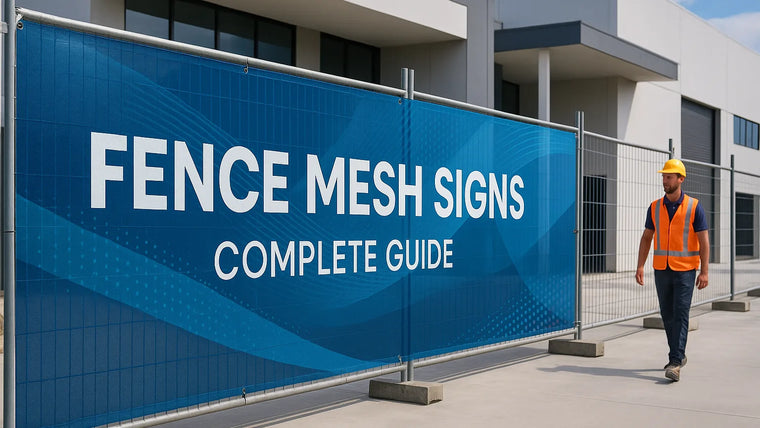
Fence Mesh Signs: Complete Guide
Fence mesh signs are printed mesh banners used on temporary fencing and hoardings. The perforated material allows airflow compared with a solid banner, while...
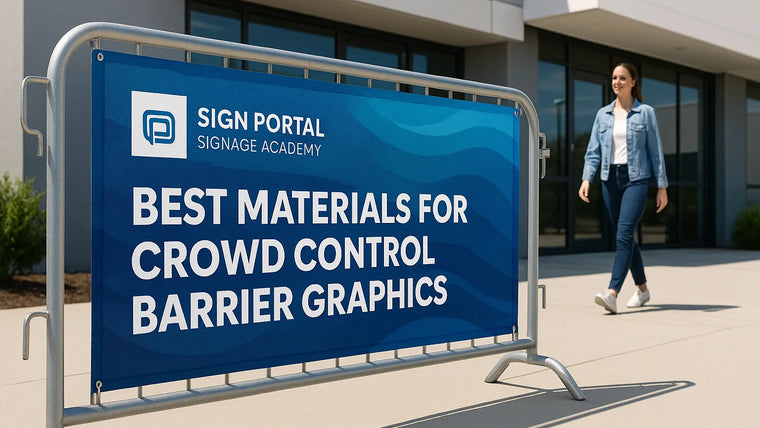
Best Materials for Crowd Control Barrier Graphics
For most outdoor events in Australia, perforated mesh banner is a versatile option because airflow can help reduce wind effects and it’s quick to...
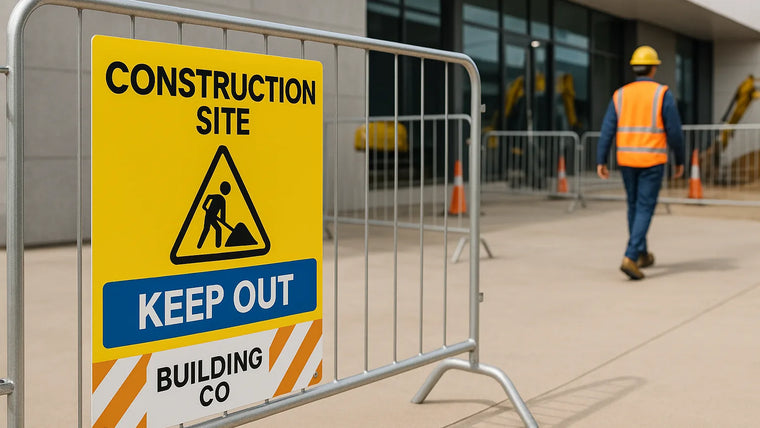
Crowd Barrier Signage for Construction Sites
Crowd barrier signage for construction sites uses panels, banners or decals mounted to portable barriers to guide pedestrians, brand perimeters and reinforce safety messages....