Great for promos, events and fence branding. Choose solid PVC for impact; mesh for windy fences and scaffolds.
Vinyl banners remain one of the most versatile large-format signage options for Australian businesses. They are fast to produce, easy to transport and effective at scale when fixed to fences, facades, event structures and retail fronts. This guide explains where banners excel, how to choose between solid PVC and mesh, what to consider for artwork and installation, and how Sign Portal manufactures and ships banners nationally.
Where vinyl banners shine
Vinyl banners work best when you need a large, eye-catching message that can be installed quickly and removed without major structural work. They suit pop-up events, seasonal promotions and temporary site branding where rigid signs may be impractical or costly to install.
In practice, banners are most effective on fences, temporary hoardings, building facades, scaffolds, markets and indoor backdrops where size-to-weight ratio matters. You can roll them, transport them in cars or small vans and mount them with simple fixings.
Not sure which way to go? For solid-face impact, see ourCustom PVC Vinyl Banners. For windy or long fence lines, chooseCustom Mesh Banners. If you’re coordinating multiple pieces or need colour consistency across a campaign, our in-housewide-format printingkeeps production, finishing and quality control under one roof in Brisbane.
Why Sign Portal for banners: Brisbane-based production on our Roland VG‑640 platform with colour-managed workflows; hems hot-wedge welded on a Miller Weldmaster line for consistent, load-bearing seams; eyelets set on Stimpson bench presses for accurate placement; and reinforced edges using 50 mm seatbelt webbing where high loads are expected. Our X‑Rite i1Pro3 profiling maintains ΔE00 tolerances typically under 2.0 across multi-roll jobs, and internal pull testing of reinforced hems routinely exceeds 400 N per eyelet on 440–510 gsm PVC.

Common applications by industry
Events and venues
Events use banners for entry branding, sponsor walls, stage backdrops and directional wayfinding between ticketing, food and amenities. Short lead times and simple fixings help organisers react to last-minute layout changes.
- Stage and media backdrops
- Queue and entry branding
- Sponsor panels and photo walls
- Directional arrows and area IDs
Our event team preflights files against the venue’s rigging method (pole pockets, keder, or fly bars) and supplies test drops where sightlines or lighting warrant it. For brand-critical campaigns, we’ll proof colours and typography per your style guide and can provide a printed sample via ourwide-format printingservice.
Retail and hospitality
Retailers and venues deploy banners for seasonal sales, grand openings and promotions that don’t justify a permanent sign. A banner can occupy large window spans or external walls temporarily without altering the structure.
- Clearance and seasonal campaigns
- Pop-up store launches
- Food-truck and market stall menus
We often pair a facade banner with window decals from the same colour profile to keep tints consistent across substrates. See examples and options viawide-format printing.
Construction and property
Site fencing and scaffolding are natural homes for mesh banners. They brand the perimeter, hide clutter and help convey wayfinding around site gates and amenities. Large or facade-mounted banners may require engineering or approval depending on the installation.
Education, sport and community
Schools, clubs and councils use banners to promote enrolments, fixtures and community events. Mesh works well on oval fences and perimeter rails because it reduces wind loading compared to a solid face.
For recurring annual events, we can date-strip designs so the headline banner is reused; only the small date strip is reprinted—reducing cost and waste.
Warehouses and industrial
Inside large sheds, banners serve as low-weight identification and safety communications where permanent structures are not desirable. For regulated safety content, ensure the banner does not replace mandatory fixed signage where standards or site rules apply.
Indoor versus outdoor considerations
Indoors, nearly any banner material will present well, and installation focuses on neat edges and glare control. Outdoors in Australia, UV exposure, wind and rain drive material and finishing choices. North- and west-facing walls can experience strong sunlight; inks, laminate choices and fixation method all influence longevity.
- High UV zones: Confirm appropriate print system and consider protective lamination suitable for the banner media.
- Wind exposure: Mesh reduces wind load on fences compared with solid PVC; ensure frequent fixings and reinforced edges.
- Rain and pooling: Avoid horizontal spans without tension; water pooling adds load and can deform edges.
Where required by landlords or councils, Sign Portal can provide shop drawings and arrange site-specific engineering for frames and tracks.
On harsh coastal sites, opt for 316 stainless eyelets and UV-stabilised ties. Where graffiti is a risk, ask about anti-graffiti coatings compatible with the selected banner media. For expected lifespans by climate and orientation, see our guide tooutdoor sign durability.

Material and finishing choices
Most banners are produced on flexible printable media designed for hem and eyelet finishing, pole pockets or keder edges that slide into a track. The correct choice depends on where the banner will live, how windy the site is and whether you need to roll and reuse it often.
Choosing between solid PVC and mesh
Solid PVC gives strong image impact for photography and saturated colour. Mesh helps air pass through and is a practical choice for long fence lines and scaffolds exposed to wind. Both benefit from reinforced hems and regular fixing intervals to distribute load.
Typical specs we use in production:
- Solid PVC: 440–510 gsm frontlit banner; welded 30–40 mm hems; 12 mm stainless or brass eyelets at 300–500 mm centres.
- Mesh: 250–270 gsm with ~1 mm apertures; welded or taped hems; 12 mm eyelets at 250–400 mm centres for fence lines.
- Pole pockets: Finish to suit bar OD; allow pocket depth = pole OD × 2 + 20–30 mm; add webbing at the pocket edge for strength.
- Keder: 7.5–10 mm core for extrusion tracks; specify track type if reusing existing hardware.
Explore product options:Custom PVC Vinyl Bannersfor maximum image impact, orCustom Mesh Bannersfor exposed sites and perimeter fencing.
| Feature | Solid PVC banner | Mesh banner |
|---|---|---|
| Best use | Retail promos, indoor backdrops, photo-heavy designs | Fences, scaffolds, windy sites, long perimeters |
| Wind behaviour | Acts like a sail; needs tight fixings and support | Airflow reduces loading compared to solid faces |
| Image impact | High colour density and solid coverage | Slight visual softness from perforation pattern |
| Typical finishing | Hem and eyelets, pole pockets, keder | Hem and eyelets, reinforced edges |
| Reuse and handling | Rolls well; protect printed face during transport | Similar handling; avoid snagging mesh apertures |

Finishing details that matter
- Hems: Folded edges improve strength and reduce tearing at eyelets.
- Eyelets: Space fixings regularly (not just at corners) to distribute load.
- Pole pockets: Useful for stage backdrops and frames; specify finished pocket size to suit the pole.
- Keder: Slides into an aluminium track for a neat, tensioned edge on facades and frames.
A well-specified finish can extend practical life by reducing stress at the perimeter and keeping the graphic flatter, which improves legibility and presentation.
Sign Portal’s finishing line uses hot-wedge welding for hems (consistent weld bead vs. adhesive tape alone), 50 mm seatbelt webbing for reinforced edges where required, and bench-mounted presses for accurate eyelet setting. Where applicable, we stitch pockets after welding for double security on mobile stage backdrops.
Additional finishing upgrades available on request: corner gussets for large spans, shock-cord (bungee) loops to reduce point loading, and choice of brass or 316 stainless eyelets for marine environments.
Design and artwork tips
Large-format graphics are assessed at distance. Prioritise short messages, strong contrast and simple hierarchy over fine detail. QR codes can complement information but should not replace critical on-sign content.
- Viewing distance: Increase letter height and simplify copy for longer reads. As a guide, minimum letter height (mm) ≈ viewing distance (m) × 1.5–2.0.
- Contrast: Use light on dark or dark on light; avoid busy imagery behind text.
- Bleed and margins: Allow adequate bleed for trimming and keep critical text clear of hems, eyelets and pockets.
Supply vector logos and original high-resolution images to avoid pixelation when enlarged. If brand colours are critical, provide recognised references and allow time for a printed sample where necessary, because screen colours and print output differ.
Before you export, run through ourArtwork Checklistfor bleed, fonts, spot colours and scale. If you’re coordinating a mixed-media rollout, see our overview ofwide-format printingfor colour-consistent production.
Technical design guardrails our prepress team uses in practice: minimum stroke weight ≥ 2 mm on banners viewed beyond 10 m; QR codes at least 25–30 mm with high contrast and quiet zone; bitmap images ideally supplied at 100–150 ppi at final size for close viewing, or 60–100 ppi for distance reads.
Installation methods and site notes
Most banners are installed with cable ties, rope, bungee cords or track systems. The goal is even tension without overloading a few points. On fences, use more ties rather than fewer, and secure to the wire every 300–500 mm along edges where practical.
- Fences and mesh: Mesh banners excel here; fix at frequent intervals along all edges.
- Walls and facades: Use appropriate anchors and avoid relying on a few corner points.
- Frames and stages: Pole pockets or keder edges give a neat, tensioned result.
Assess wind exposure and the supporting structure before installation. Large banners or facade installs may require engineering, landlord consent or authority approval depending on the site and method. Where installation occurs near vehicles or public areas, plan traffic and pedestrian management for safety.
Installer tips from our field team:
- Use UV-stabilised cable ties 4.8–7.6 mm wide; increase density on windward edges. On long fence runs, aim for 300 mm centres along the top and 400–500 mm on the sides and bottom.
- For walls, spread load using multiple anchors and shock cord loops rather than rigid rope to avoid point loading.
- When reusing frames, confirm track size (e.g., 7.5 mm keder) and check for burrs that can abrade hems.
On live construction sites, our installers work to documented SWMS and can coordinate with your site manager for access windows. For exposed locations, consider ourCustom Mesh Banners; for solid facades with minimal wind,Custom PVC Vinyl Bannersprovide stronger image impact.
Durability, care and storage
Outdoor banner life depends on UV, orientation, wind, handling and cleaning. Protective laminates can improve abrasion resistance and cleanability when compatible with the media, but they do not override the limitations of an unsuitable print system or extreme exposure.
- Cleaning: Use mild methods compatible with the banner media; avoid aggressive solvents and abrasives.
- Inspection: Check edges, eyelets and fixings periodically, especially after high winds.
- Storage: Roll loosely with the print face out, avoid creasing, and keep dry and out of direct sun.
Typical lifespans (indicative): indoor use 2–5 years; outdoor retail promotions 3–12 months; fence mesh on construction 6–18 months depending on wind and exposure. See our guide tooutdoor sign durabilityfor more on climate, orientation and maintenance.
Replace a banner when fading, cracking, edge tearing or distorted eyelets reduce readability or safe mounting. Reusing existing frames or tracks is often possible if they remain serviceable and appropriate for the new banner size.
Cleaning details we recommend in-house: wipe with microfibre and a pH‑neutral detergent (pH 6–8); rinse and air dry before rolling. Avoid high-pressure washers at close range, chlorinated cleaners and citrus solvents which can soften PVC plastisols and inks.
Repair and refurbishment
Many banners can be repaired, extending their useful life when the print is still serviceable.
- Edge and hem repairs: We can hot-weld new hems or add 50 mm reinforcement webbing, then re-eyelet to restore secure fixing points.
- Eyelet replacement: Individual eyelets can be replaced where corrosion or tearing has occurred; we’ll often add extra eyelets to improve load distribution.
- Tear patches: Localised tears in solid PVC can be hot-weld patched on the reverse; mesh repairs use matching mesh and perimeter stitching or weld tape to prevent further run.
- Pole pocket/keder refresh: We can resew or re-weld pockets and replace worn keder cores if the graphic area remains intact.
- Trim and re-square: For creased or frayed edges, we can trim back, re-hem and re-finish to suit a slightly smaller size.
DIY quick fixes (temporary): use UV-stable gaffer for very short-term stops, but prioritise a welded repair as soon as practical. If a banner is load-bearing (e.g., on a facade or stage), remove it at the first sign of structural damage and arrange a repair or replacement.
Where repairs aren’t economical, we can recut serviceable sections into secondary signage or back-of-house coverings and reproduce the primary piece with the original artwork on file.
How to book a repair with Sign Portal (Brisbane workshop):
- Send photos showing each edge, eyelets and any tears; include sizes and where it’s installed.
- We’ll advise feasibility, turnaround and cost. Typical lead time is 1–3 working days for weld/eyelet work once received.
- Drop off or courier to our production address (roll loosely, do not fold). We’ll return-pack on a core with edge guards.
Technical note: Our welders run controlled hot‑wedge settings tuned to media thickness to avoid heat-shadowing on the print face. For high-load edges, we combine welded hems with seatbelt webbing and double eyelets to spread the load path.
How Sign Portal manufactures banners
Sign Portal produces custom banners in-house in Brisbane using wide-format digital printing. For flexible banner media, roll-fed production is supported by our Roland VG-640 wide-format printer/cutter. In-house manufacturing allows printing, finishing and quality checks to be coordinated efficiently for short runs or project work.
We run a colour-managed workflow (X-Rite profiling and device calibration) through Roland VersaWorks and Onyx RIPs with custom ICCs built for our media set. Finishing includes hot-wedge welded hems, seatbelt webbing reinforcement for high-load edges, and bench-set stainless/brass eyelets.
Before production, we provide artwork proofing so stakeholders can confirm wording, spelling, colours, dimensions and quantities. For brand-critical work, recognised colour references and, where needed, a printed sample can help confirm expectations prior to full manufacture.
- Wide-format digital printing for banners, decals and large graphics
- Protective lamination options where appropriate for the selected media
- Cut-to-shape and finishing workflows planned around the installation method
Where a project involves unusual mounting, large panel joins or complex site conditions, a prototype can de-risk installation by validating scale, readability and fixings before the full run.
Recent outcomes: 260 metres of 2.4 m-high fence mesh delivered for a Brisbane health precinct in five working days, colour-matched to PMS within ΔE00 < 2.0 across batches; a 12 m × 4 m stage backdrop produced in three kedered drops with invisible joins under show lighting. Ask about ourwide-format printingcapability for multi-site rollouts.
Additional QC we apply: inline nozzle checks and test swatches per roll; spectro spot reads on critical brand colours with ΔE alerts; and tug tests on random eyelets. Files are preflighted (fonts, overprints, scale) against our internal checklist aligned with the publicArtwork Checklist.
Planning large banners and multi-panel runs
Very large graphics may be divided into manageable panels due to printer width, transport, access or installation constraints. Early planning of panel joins, artwork alignment, structural supports and installer access reduces surprises on site and improves visual continuity.
- Panel layout: Design joins through low-visibility areas of the artwork.
- Access: Confirm lift points, clearances and safe working zones in advance.
- Support: Ensure the receiving structure suits the banner’s size and expected loads.
Technical planning tips:
- Allow 30–50 mm overlap on seamed joins where a continuous image is required.
- For keder systems, note track centre-to-centre spacing and allow for panel stretch during tensioning.
- Provide a fixing diagram indicating eyelet positions relative to site constraints (gates, bracing, services).
For facade-scale work, we can supply shop drawings, panel maps and a fixing schedule, plus organise a pilot install of one drop to confirm tolerances before proceeding with the remainder.
Ordering and national delivery
Sign Portal supplies banners Australia-wide. Packaging protects printed faces, corners and edges, with separation used where finished faces could rub. Large or fragile shipments can be arranged with project-specific freight plans to reduce transit risk.
To order efficiently, provide final dimensions, installation method (fence, wall, track, pockets), desired material (solid PVC or mesh), artwork files with bleed and any colour notes. If your project spans multiple sites, a sign schedule helps maintain consistency and simplifies reordering.
Typical lead times: 2–5 working days from proof approval for standard banners; complex finishing, engineering and multi-site kitting may require longer. For recurring activations, we can hold colour profiles and dielines on file for rapid repeat production.

- A community festival uses mesh banners along perimeter fencing for sponsor recognition and clear entry points.
- A retailer installs a solid PVC banner across a facade for a two-week seasonal sale, then rolls and stores it for next year.
- A builder brands a scaffold wrap with mesh banners, planned in panels to align with bay widths and tie-off points.
Ready to brief your project? Compare materials and order online:Custom PVC Vinyl BannersandCustom Mesh Banners. For longevity recommendations by climate and orientation, visitOutdoor Sign Durability.
If you’re coordinating a multi-site rollout or need colour consistency across mixed substrates, talk to our Brisbane team aboutwide-format printing. Before you upload files, run through theArtwork Checklistto avoid delays.
Related Sign Portal resources: Vinyl Banners · Custom Floor Decals for Safety & Promotions · Aluminium Cut to Size for Custom Signage and Fabrication
Frequently Asked Questions
Should I choose mesh or solid PVC for a fence banner?
Choose mesh for windy or exposed fence lines because it can reduce wind loading compared to a solid face. Choose solid PVC when you need maximum image impact in lower‑wind or framed installs.
What size works best for a street-facing promotion?
Select a size your site can support safely and that offers readable letter heights at the viewing distance. Short, high‑contrast messages are generally easier to read than crowded designs.
Do I need lamination on a vinyl banner?
A compatible protective laminate can improve abrasion resistance and cleanability, but it does not replace choosing the right media and print system for the environment. Ask if lamination suits your banner material and exposure.
How do I supply artwork for a banner?
Provide print‑ready files with vector logos where possible, adequate image resolution at final size, correct bleed, and clear margins away from hems, eyelets and pockets. Include any recognised colour references for brand‑critical work.
How do I install a banner on a chain-link fence?
Use frequent fixings along all edges and tension evenly. Mesh is recommended for exposed sites. Avoid relying on only the corners.
Can vinyl banners be reused?
Reuse may be possible when a banner remains in good condition. Handle carefully to avoid creasing, store in a dry area out of direct sun, and reinstall on a suitable structure after checking hems and eyelets.
Are permits or engineering needed for large banners?
They can be. Very large banners or facade installs may require landlord consent, engineering or authority approval depending on site conditions and fixing methods.
Keep learning
Related Articles
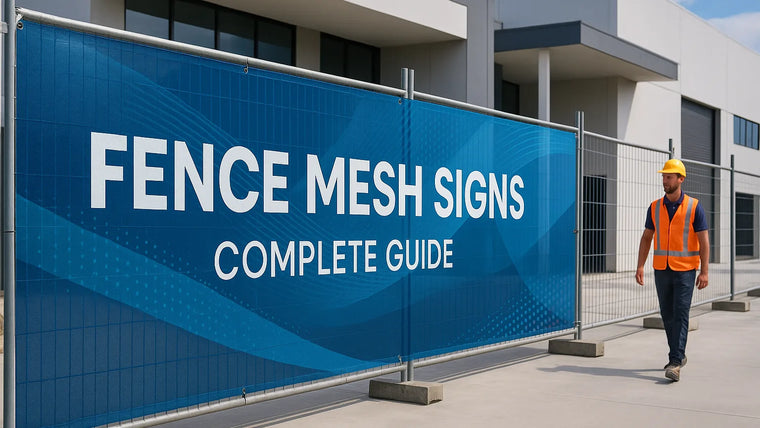
Fence Mesh Signs: Complete Guide
Fence mesh signs are printed mesh banners used on temporary fencing and hoardings. The perforated material allows airflow compared with a solid banner, while...
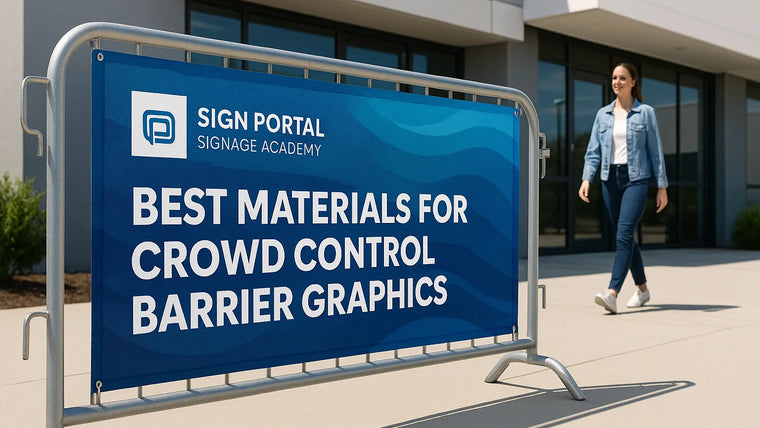
Best Materials for Crowd Control Barrier Graphics
For most outdoor events in Australia, perforated mesh banner is a versatile option because airflow can help reduce wind effects and it’s quick to...
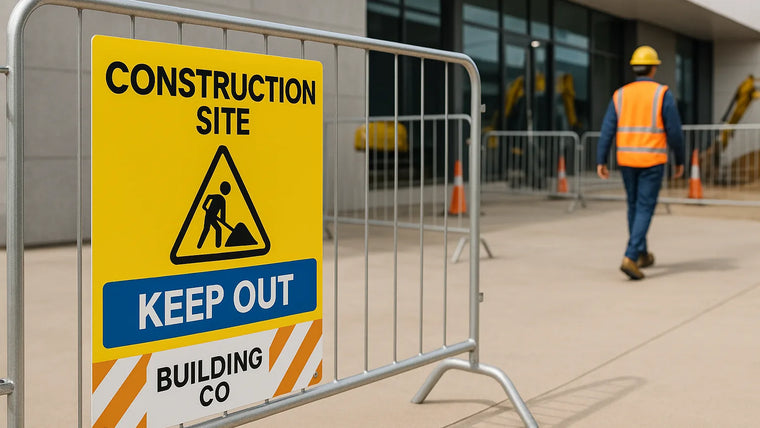
Crowd Barrier Signage for Construction Sites
Crowd barrier signage for construction sites uses panels, banners or decals mounted to portable barriers to guide pedestrians, brand perimeters and reinforce safety messages....