Choose vinyl for bold, opaque graphics in low to moderate wind; choose mesh for fences and windy sites to cut wind load and ease install.
The fastest way to decide between vinyl and mesh is to match the banner material to its environment. Solid vinyl gives the most vibrant print and blocks what’s behind it, but it catches more wind. Mesh lets air pass through, reducing wind load and fence strain, but it sacrifices some opacity and fine-detail sharpness. This guide explains the trade-offs so you can specify the right banner for your site, artwork and mounting method in Australian conditions.
Quick answer
If your banner sits in a relatively sheltered location, needs bold colour, and must hide what’s behind it, a solidvinyl banneris usually the best fit. If the banner will be mounted on a fence or exposed to gusts,meshreduces wind pressure and stress on fixings, making it the safer and more stable choice when installed correctly.
Ready to choose now? Compare options and get an instant quote on ourVinyl BannersandMesh Bannersproduct pages.

Material basics
Vinyl banners are printed onto a flexible PVC banner film and finished with hems and eyelets or pockets for fixing. They present a continuous, opaque print surface that delivers strong colour and legibility. Typical weights are 440–510 gsm single-sided or 510–610 gsm blockout for double-sided use. Blockout layers prevent show-through when both faces are printed.
Behind the scenes, most PVC banner films use a woven polyester scrim (commonly 500 × 500 D or 1000 × 1000 D yarns) laminated with PVC for tear resistance. Blockout vinyl typically includes a black light-stop interlayer for maximum opacity. Nominal thickness for 510 gsm vinyl is ~0.48–0.55 mm; blockout variants run thicker.
Mesh banners use a perforated banner media designed to allow some wind to pass through. Common open areas are 30–40%, which reduces wind loading compared with a solid face. The trade-off is lower opacity and a slightly more textured print appearance. Mesh weights are typically 250–370 gsm, so long fence runs are lighter to handle.
- Common finishes: hem and eyelets for cable ties or ropes, and pockets for poles or rails. Keder (sail-track) edging or webbed hems can further increase edge strength.
- Mounting options: fences, temporary event structures, building facades and frames. For very large faces, consider keder track or framed systems to spread load.
- Production: wide-format digital printing matched to the media and outdoor exposure. Fire-retardant (FR) media options available; check site requirements (e.g.
Need help choosing? SeeVinyl Bannersfor opaque, high-impact graphics andMesh Bannersfor fence runs and windy sites.
Wind and installation conditions
Wind is the primary environmental driver when choosing between the two materials. A solid banner behaves like a sail; as wind increases, the load transfers into the fence, frame or fixing points. Mesh allows airflow through the face, which reduces (but does not eliminate) wind pressure.
On open, coastal or elevated sites, mesh is often preferred on fences and scaffolds because it helps manage gusts. In more sheltered courtyards or internal atriums, vinyl performs well and keeps edges crisp and colours saturated.
Large banners should be planned with panel joins, support and installation access in mind. Depending on the structure, very large banners can require engineering or building approval; size and fixings should be selected for the site rather than copied from an unrelated installation.
- Rule of thumb: a 30–40% open-area mesh can reduce face pressure versus solid by roughly 15–30% in steady flow, but peak gust loads can still be significant. Always size fixings and spacing for worst-case gusts at your site.
- Fence reality: chain-wire fences flex; distribute load with close eyelet spacing and add mid-span ties to top and bottom edges.
- Regional note: in cyclonic Regions C/D (QLD/WA), prefer mesh on temporary fencing, increase fixing density, and consider keder-track or framed systems for large faces.

Print quality and opacity
Vinyl provides a smoother, opaque print surface. It’s the better choice for detailed artwork, gradients, small text and brand colours that must appear bold from a distance. Because the face is continuous, background show-through is minimised. Double-sided prints are feasible on blockout vinyl.
Mesh slightly diffuses the image due to its open weave. Fine detail can appear softer and the background may remain partially visible, especially in backlit conditions. If you need to screen what’s behind the banner (e.g. a storage area), vinyl is usually the clearer option. Mesh is not recommended for double-sided print where precise registration is required.
- For maximum visual impact: choose vinyl.
- For visibility plus airflow on fences: choose mesh.
- For privacy screening: vinyl is typically more effective than mesh.
- Legibility guide: minimum letter height of ~1 mm per viewing metre (e.g. 30–40 mm high letters for 30–40 m viewing) on vinyl; increase by ~10–15% on mesh to offset texture.
Durability and outdoor exposure
Both materials are designed for outdoor use when produced with suitable wide-format print systems. Service life depends on UV exposure, orientation, cleaning, abrasion and installation quality. In Australian conditions, north and west exposures see higher solar load and faster ageing. Coastal sites (salt spray) accelerate degradation of inferior eyelets, ties and frames—specify UV-stable ties and corrosion-resistant fixings.
A clear overlaminate can be added where extra abrasion resistance is valuable, such as banners handled frequently or installed where contact is expected. A laminate can assist protection, but it does not replace choosing the right media and mounting method for the environment. Clean with mild detergent and soft sponges; avoid pressure washers on seams and edges.
Regular inspection is sensible for high-wind or high-traffic sites. Replace banners that have torn hems, damaged eyelets or significant fading that affects legibility.
- Cleaning cycle: quarterly in urban areas; monthly in dusty/coastal sites. Rinse salt spray from mesh to prevent cable tie embrittlement.
- Graffiti: request an anti-graffiti laminate where tagging risk is high; remove paint promptly with compatible citrus-based cleaners.
Weight and handling
Mesh is typically lighter per square metre than comparable solid vinyl, which can make long runs easier to handle on fences. Lighter weight can also help with freight for very large orders when shipping Australia-wide.
Regardless of material, packaging should protect printed faces and edges. For large or long-run projects, reinforced packaging and separation between printed faces reduce the risk of transit damage. Store rolled (not folded) to minimise crease memory.
- Manual handling: aim to keep individual rolls under ~25 kg for one-person lifts; split long runs into labelled bays.
- Cores: 76 mm (3”) heavy-wall cores reduce telescoping on long mesh rolls.
Size and tensioning
Correct finishing and fixing prevent premature damage. Hem and eyelets help distribute loads along the edge, while pockets allow banner rails or poles to tension the face more evenly. Fixing spacing should match the structure: closer ties or clips reduce flutter and stress on each point.
Long fences are best planned in bays so panel joins align with posts, improving support and appearance. Early planning of panel layout, artwork alignment and installer access reduces on-site issues and speeds installation. On chain wire, use ties at 250–300 mm centres on top and bottom edges, and 300–500 mm on sides; reduce spacing in high-wind corridors.
- Eyelet set-back: 25–40 mm from the finished edge on hemmed banners is typical; ensure adequate edge meat around each eyelet.
- Tension evenly from the centre outwards along the top edge first, then bottom, then sides to minimise wrinkles.
Side-by-side comparison
| Feature | Vinyl banner | Mesh banner |
|---|---|---|
| Wind exposure | Higher wind load; better in sheltered locations or on robust frames | Allows airflow; preferred for fences and wind-exposed sites |
| Print appearance | Strong colour, high opacity, crisp small text | Slightly softer detail; partial background show-through |
| Privacy screening | Good coverage and background blocking | Moderate coverage; background may remain visible |
| Typical uses | Retail promos, indoor atriums, event backdrops, hoardings (sheltered) | Fence branding, scaffolds, sports fields, windy construction sites |
| Finishing | Hems and eyelets, or pockets; tension to reduce flutter | Hems and eyelets, or pockets; close fixing spacing recommended |
| Weight and handling | Heavier per m²; robust feel | Lighter per m²; easier for long fence runs |
| Cost drivers | Media area, finishing, freight dimensions | Media area, finishing, potentially lower wind-related maintenance |
| Australian UV | Good with suitable print and care; inspect for fade on severe exposures | Good with suitable print and care; open weave reduces wind stress |

Cost considerations
Total cost reflects banner size, media choice, finishing method, quantity and freight. Vinyl and mesh are both economical for large-format promotions; differences often come from finishing complexity (e.g. pockets versus standard hems) and installation logistics rather than print alone.
Where high winds are likely, mesh can reduce the chance of damage-related reprints or site call-outs. Conversely, if you need maximum graphic impact and a stable mounting surface, vinyl often delivers the best value per impression. For a tailored quote, seeVinyl BannersorMesh Banners.
- Freight: oversize rolls may shift consignments into bulky freight classes; split runs into bay-length panels to optimise shipping.
Sustainability notes
Lower-impact choices can include PVC-free flexible media and systems designed for reuse or material recovery. The most sustainable option depends on durability, transport, reusability and whether a local recycling pathway exists for the chosen material.
Reducing waste by reusing frames or dividing very large graphics into replaceable faces can also cut the environmental and cost footprint across multi-site campaigns.
- Options we can discuss: polypropylene and PET banner films, polyester mesh, and modular frames that accept changeable skins.
- Ink systems: odourless, low-VOC latex inks are suitable for indoor installs and enclosed spaces.
Artwork and branding
Supply brand colours using recognised references and request a printed sample if critical. Screen colour does not equal print colour, and substrate, ink and lighting influence the result. Artwork should include bleed and keep small text away from eyelets, hems and pockets.
Before manufacture, an artwork proof lets you confirm wording, spelling, colours, dimensions and layout.
- File prep: PDF/X-4 preferred, fonts outlined or supplied, images embedded, 1:1 scale where possible (or supply exact scale ratio).
- Resolution: 120–200 ppi at final size for stand-off viewing; 200–300 ppi for close-up installs.
- Bleed/safe areas: 10–25 mm bleed beyond trim depending on finish; keep critical text/logos 35–50 mm clear of edges and eyelets.
How they are made
Both banner types are produced using wide-format digital printing matched to the banner media. After printing, banners are typically hemmed and eyeletted or finished with pockets for poles or frames. A protective overlaminate can be added where abrasion is a concern.
Coordinating printing and finishing in-house helps align panel joins, register artwork across sections and control quality before dispatch to site.
- A suburban sports club uses mesh along perimeter fencing to manage gusts while displaying sponsors.
- A shopping-centre atrium installs vinyl backdrops for high-contrast brand reveals in a calm indoor environment.
- A construction site applies mesh to temporary fencing to reduce wind load and maintain site tidiness.
- An event stage backdrop uses vinyl to block backstage equipment from view and keep colours punchy on camera.
Choosing checklist
- Exposure: windy or calm? If windy, lean towards mesh.
- Mounting: fence, frame or wall? Fences favour mesh; solid walls can suit vinyl.
- Visual goal: privacy screen or maximum colour pop? Privacy and bold colour point to vinyl.
- Artwork detail: fine text or gradients? Vinyl keeps edges crisper.
- Size and access: plan panel joins, fixing spacing and installation method early.
- Care: consider inspection intervals for high-UV or high-traffic sites.

Banner finishing guide (technical)
Finishing determines how well a banner resists wind and handling. Use these specifications as a starting point and adjust for site conditions:
- Hems: Double-fold 30–50 mm hems on all sides. Heat-welded hems are preferred for PVC and mesh (strong, no stitch perforations). UV-stable stitched hems are suitable for low to moderate wind with bonded polyester thread.
- Edge reinforcement: 25–38 mm polyester webbing welded or stitched into hems for high-load edges and corners. Add triangular corner patches to spread load.
- Eyelets (grommets): Spacing 250–300 mm on top/bottom runs, 300–500 mm on sides. Use corrosion-resistant brass or stainless eyelets (approx. 12 mm internal). Back-up washers recommended on high-tension points.
- Pockets (sleeves): For poles/rails, pocket flat size ≈ 2 × pole OD + 20–30 mm. Common sleeves: 50–90 mm flat for 25–40 mm OD poles. Drill relief holes at low points to prevent water pooling on outdoor rails.
- Sail-track (keder): For very large faces or building wraps, 7.5–12 mm keder welded to the edge and fed into aluminium track for even tension and neat edges.
- Fixings: Use black UV-stable cable ties (7.6–9.0 mm width) or stainless banding on cyclone-prone or high-security sites. Avoid bungee cords on long-term installs; they allow flutter that fatigues edges.
- Wind slits: Generally not recommended; they weaken the face and rarely reduce peak loads meaningfully. Choose mesh or additional support instead.
- Tolerances: Allow ±3–5 mm on finished size; artwork bleed 10–25 mm beyond trim depending on finish.
- Thread and stitch: For sewn seams, use bonded polyester V92 (Tex 90) UV thread, 6–8 stitches per inch; lock-stitch is preferred for repair patches.
- Corner hardware: On permanent installs, consider bolted corner plates or banner tensioners to spread load and improve re-tensioning.
Unsure which finish you need? Our product pages include instant pricing for hems/eyelets, pockets and keder:Vinyl BannersandMesh Banners.
Lifecycle: order, inspect, repair, replace, reorder
Order
- Measure twice: record width and drop to the nearest 5 mm; note fence bay widths and post centres.
- Choose the right product:Vinyl Bannersfor opacity/impact,Mesh Bannersfor fences and wind-exposed sites.
- Artwork: supply high-res PDFs with 1:1 scale where possible; include bleed and keep critical text 35–50 mm clear of edges/eyelets.
- Lead time: standard 3–7 business days from proof approval; allow extra for complex finishing or keder systems.
- Installation kit: order spare UV ties or tensioners; allow ~1 tie per eyelet plus 10% spares.
Inspect
- On delivery: check size, finish type, eyelet spacing, and colours against the proof before installation.
- In service: monthly visual checks; after severe weather, look for loose ties, frayed hems, and fence movement.
- Checklist: confirm no cracked eyelets, no tears >10 mm at corners, and no excessive fluttering sounds in steady wind.
Repair
- Minor edge nicks: trim frays and apply compatible banner repair tape to both sides; replace adjacent ties to reduce flutter.
- Eyelet pull-out: install a larger reinforcement patch (inside hem) and re-eyelet; consider adding webbing in high-stress corners.
- Seam failures: heat-weld patching is preferable to adhesive-only repairs for PVC and mesh. For safety-critical installs, remove and repair off-site.
- Mesh tears: bridge with a welded patch that covers at least 50 mm beyond the tear on all sides; re-distribute load with closer ties.
Replace
- Criteria: tears >50 mm from the edge, widespread delamination, or fading that compromises brand legibility. If the supporting fence is distorted, rectify structure before refitting any banner.
- Upgrade path: if repeated damage occurs on a solid banner in a windy area, switch to mesh and increase fixing density or move to keder/track.
- Campaigns: for time-bound events, plan removal dates and storage; roll and tube-pack banners you intend to reuse.
Reorder
- Fast repeats: quote your previous job number for like-for-like reprints. We archive production notes (media, finish, eyelet pattern) to keep reorders consistent.
- Refresh artwork: when seasonal content changes, keep panel sizes and fixing patterns identical to streamline installation.
- Colour continuity: we retain ICC profiles and RIP presets used on your previous run to match colours on reprints.
How we build banners at Sign Portal (process and QA)
All banners are produced in-house for colour control and turnaround certainty. Our workflow includes:
- Colour-managed wide-format printing (eco-solvent and latex) up to 3.2 m wide, verified with spectrophotometer checks and media-specific ICC profiles to keep brand colours consistent across reorders.
- Heat-welded hems and pocketing using industrial hot-air welding for high-strength seams; automated eyeletting for consistent spacing.
- Preflight and proofing: artwork preflighted for scale, bleed, resolution and safe areas; PDF proofs signed off prior to production.
- QC at three stages: print verification, finishing inspection, and final size/finish check against the job ticket before packing.
- Packaging for transit: interleaved faces, edge guards on heavy rolls, and clear labelling for bay order on multi-panel runs.
The result is consistent colour from batch to batch, neat panel joins on multi-bay fence runs, and fewer site call-backs after installation.
- Equipment we run: high-resolution Roland wide-format printers for fine colour work and HP Latex for low-odour indoor/outdoor applications; heavy-duty hot-air welders for hems/pockets; automated eyelet presses for repeatable spacing; and a digital flatbed cutter for accurate trimming.
- Traceability: every job travels with a barcode job ticket; we log media batch, RIP settings, and finishing specs so reorders match the original.
Order the right product
- Vinyl banners: bold colour, high opacity, and double-sided options — seeVinyl Banners.
- Mesh banners: airflow for fences and windy sites — seeMesh Banners.
Ready to proceed? Get instant pricing, upload artwork and book production on ourVinyl BannersandMesh Bannerspages.
Related Sign Portal resources: Fence Mesh Signs · Emergency If You Come In Contact Sign - First Aid & Emergency · Premium Pull Up Banners
Frequently Asked Questions
Will mesh banners stop wind damage completely?
No. Mesh allows airflow and can reduce wind pressure compared with a solid face, but it does not remove it. Correct finishing, fixing density and a suitable supporting structure are still required.
Which is better for fence installations?
Mesh is often chosen for fences because the open construction allows airflow, which can reduce stress on ties and posts compared with a solid vinyl face.
Do banners need lamination?
Not always. A clear laminate can improve abrasion resistance for handling and cleaning, but suitability depends on the media, exposure and application.
How should I supply artwork for banners?
Provide vector logos where possible, use suitable image resolution at final size, include bleed if graphics run to the edge, and keep small text away from hems, eyelets or pockets. An artwork proof lets you check wording, colours, dimensions and layout before manufacture.
Can very large banners be made in one piece?
Often large signs are divided into manageable panels due to media width, transport and installation. Planning panel joins, structural support and access early helps produce a cleaner result.
Which lasts longer outdoors, vinyl or mesh?
Service life depends on the complete construction and conditions such as UV exposure, orientation, cleaning, abrasion and installation quality. Both can perform well when matched to the environment and inspected periodically.
Do you ship banners across Australia?
Yes. Packaging should protect printed faces, corners and edges. Large or fragile jobs may need reinforced packaging or project-specific freight to reduce transit damage risk.
Keep learning
Related Articles
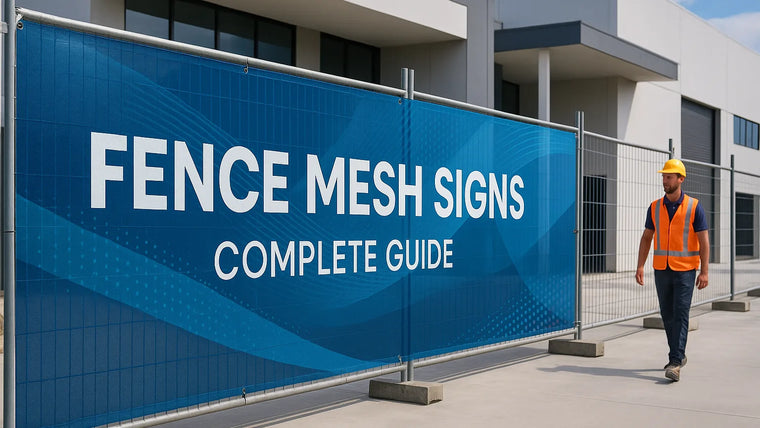
Fence Mesh Signs: Complete Guide
Fence mesh signs are printed mesh banners used on temporary fencing and hoardings. The perforated material allows airflow compared with a solid banner, while...
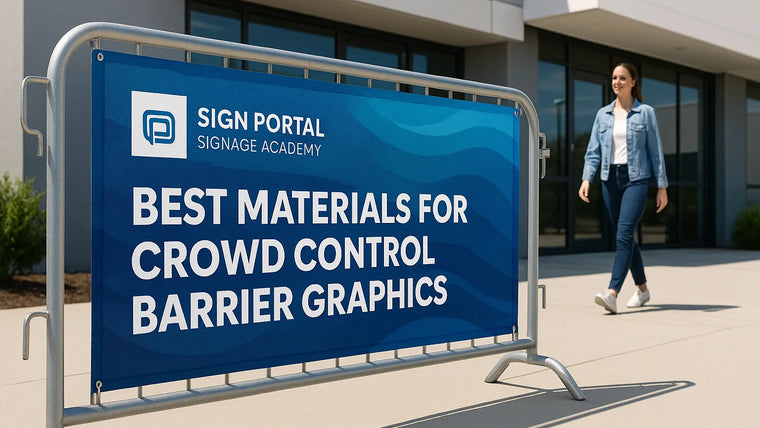
Best Materials for Crowd Control Barrier Graphics
For most outdoor events in Australia, perforated mesh banner is a versatile option because airflow can help reduce wind effects and it’s quick to...
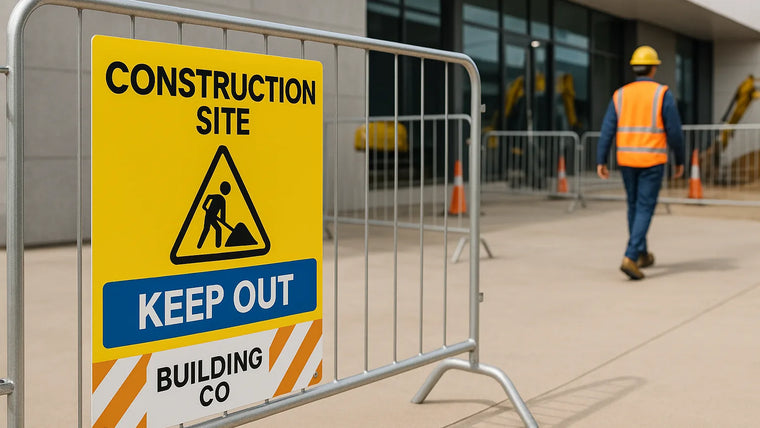
Crowd Barrier Signage for Construction Sites
Crowd barrier signage for construction sites uses panels, banners or decals mounted to portable barriers to guide pedestrians, brand perimeters and reinforce safety messages....