In Australia, use AS 1319 categories: Danger, Warning, Prohibition, Mandatory, Emergency and Fire. Reserve Danger for life-threatening hazards.
If you only remember one thing about safety signs, make it this: colour and shape signal intent before anyone reads a word. Red demands caution or prohibition, yellow flags a hazard, blue directs required actions, and green points to help and safe outcomes. Once you understand these categories, selecting the right sign for your site becomes straightforward.
What the categories mean
Safety sign categories help people recognise intent at a glance. In Australian workplaces, six broad categories are widely used: Danger, Warning, Prohibition, Mandatory, Emergency Information and Fire. These categories are defined by colour, shape and typical message style to reduce confusion and speed recognition.
- Danger: Signals an immediate life-threatening hazard; used sparingly for the most serious risks.
- Warning: Highlights a hazard or risky condition that could cause injury if ignored.
- Prohibition: States actions that are not allowed (e.g., No smoking, No entry).
- Mandatory: Communicates required actions (e.g., Wear eye protection).
- Emergency information: Identifies first aid, exits, assembly points and emergency equipment.
- Fire: Locates fire-fighting equipment and related instructions.
These categories work together. A well-signed site typically uses multiple types so people can identify hazards, know what not to do, understand what to do, and find help fast when something goes wrong.
Standards and symbol mapping (Australia)

In Australia, the category system aligns primarily to AS 1319:1994 Safety signs for the occupational environment. Other standards regulate specific applications (e.g., exits, fire equipment). Use the latest versions and your site risk assessment to select appropriately.
- AS 1319:1994 – Defines the safety categories used in workplaces (Danger, Warning, Prohibition, Mandatory, Emergency information), their colours, shapes and general layout conventions.
- ISO 7010 pictograms – Not mandated in AS 1319, but widely understood and often adopted for clarity and consistency. Common examples include: P002 No smoking; M004 Wear eye protection; W012 Forklift trucks; E003 First aid; F001 Fire extinguisher. Where your procedures rely on symbols, prefer ISO 7010-compliant artwork.
- AS 2293 series – Emergency escape lighting and exit signs. Governs the design, colour and placement of “EXIT”/running-man signs; these are separate to general Emergency information signs under AS 1319.
- AS 3745 – Planning for emergencies in facilities. Defines emergency planning, diagrams and assembly area information that your Emergency information signage should support.
- AS 2444 – Portable fire extinguishers and fire blankets – Selection and location. Guides which extinguisher/blanket goes where and associated identification signs.
- AS 2419.1 – Fire hydrant installations. Influences the identification of hydrants, boosters and related fire services equipment.
- AS 2700 – Colour standards for general purposes. Often referenced to specify consistent safety colours across suppliers.
Sign Portal maintains a curated symbol library mapped to AS 1319 categories and ISO 7010 codes. For multi-site clients, we lock approved artwork and wording so repeat orders remain consistent with your internal standards and any regulator approvals.
Standards mapping by category (what to use where)
- Danger (AS 1319 Type D): Text-led panels for life-threatening hazards. Symbols optional; if used, select ISO 7010 symbols only where they do not dilute the urgency of the text.
- Warning (AS 1319 Type W): Yellow/amber with black triangle and a hazard symbol (e.g., ISO 7010 W012 Forklift trucks, W017 Hot surface). Use to flag non-immediately life-threatening hazards.
- Prohibition (AS 1319 Type P): Black symbol with red annulus/diagonal (e.g., ISO 7010 P002 No smoking, P003 No open flame). Text clarifies the rule.
- Mandatory (AS 1319 Type M): Blue disc with white symbol (e.g., ISO 7010 M004 Wear eye protection, M016 Wear hearing protection). Reinforce with plain-language text.
- Emergency information (AS 1319 Type E): Green panels indicating safe conditions (first aid, emergency shower/eyewash, assembly area). Note that exit signs fall under AS 2293 and use the running-man/EXIT design conventions, not AS 1319 artwork.
- Fire (AS 1319 Fire group; equipment under AS 2444/AS 2419.1): Red panels identifying extinguishers, hose reels, hydrants and boosters; pair with equipment-appropriate text/symbols (e.g., ISO 7010 F001 Fire extinguisher). Location signs for extinguishers are required overhead; refer to AS 2444 for exact mounting requirements.
- Related systems: Hazardous chemicals are labelled under WHS Regulations and the GHS (Safe Work Australia Code of Practice). Pipe contents and direction-of-flow are identified to AS 1345 and can be coordinated with nearby safety signage.
Technical sources and notes
- AS 1319 predates ISO 7010; select one pictogram style across your site to avoid mixed symbol vocabularies.
- Exit signage is regulated by AS 2293 and the NCC, separate to general Emergency information signs.
- Fire equipment selection/placement and their location signs are set out in AS 2444 and, for hydrants/boosters, AS 2419.1. Always verify state/territory fire authority requirements.
- Colour references are commonly specified with AS 2700 safety colours across suppliers for consistent appearance.
Colour, shape and symbol basics
Colour is the fastest signal. Symbols and shapes then reinforce intent before the message is read. Consistency improves comprehension, especially for visitors and contractors who move between sites.
- Red: Used for Danger headers and Fire signs; quickly draws attention to high risk or emergency gear.
- Yellow/Amber with black triangle: The conventional palette for Warning signs and general hazards.
- Blue circle: Used for Mandatory instructions, particularly personal protective equipment (PPE).
- Green rectangle/square: Indicates safe conditions, exits, first aid and assembly points.
- White/black circle with red slash: The universal Prohibition format.
Category breakdown with examples

Danger signs
Use Danger for life-threatening hazards where a failure to comply could result in serious injury or death. These should be reserved for the most severe situations so the signal retains impact.
- High-voltage switchrooms or open electrical panels under maintenance.
- Confined spaces with atmospheric risks.
- Running plant where entanglement, crushing or amputation is possible.
Typical wording is short and direct, e.g., “Danger – High voltage” or “Danger – Keep out”. Supplementary panels can add specific controls where needed.
Warning signs
Warning signs flag hazards that could harm people if precautions are ignored. They are common in workshops, warehouses and construction sites and often include a pictogram.
- Forklift traffic, low head clearance or uneven surfaces.
- Hot surfaces near boilers or ovens.
- Slip hazards near wash bays or loading docks.
Examples include “Warning – Forklifts operating” or “Warning – Hot surface”. If a hazard escalates to life-threatening, reassess whether a Danger sign is more appropriate.
Prohibition signs
Prohibition signs make rules explicit. Pair the red slash symbol with a plain-language instruction so there’s no ambiguity.
- No smoking or vaping near fuel or oxygen storage.
- No entry to unauthorised personnel during crane lifts.
- No mobile phones in areas with sensitive instrumentation.
Where a prohibition applies only at certain times (e.g., during lifts), consider supplementary timing or process signage to avoid confusion.
Mandatory signs
Mandatory signs describe the actions people must take to be safe, frequently around PPE or process steps. These are often positioned at entry points to controlled areas.
- Hearing protection must be worn in compressor rooms.
- Eye protection and gloves required at chemical decanting stations.
- Hard hats and safety boots on active construction sites.
When multiple PPE items are required, a site entry board summarising all requirements reduces sign clutter and improves compliance.
Need a consolidated entry board? Browse our standard site entry boards or request a custom layout matched to your SWMS and induction process.
Emergency information signs
Emergency information signs guide people to assistance and safe outcomes. They are essential for quick wayfinding during an incident.
- Exit routes and final exit doors.
- First aid rooms, kits, eyewash and defibrillators.
- Emergency assembly areas and emergency phones.
Consistency of symbols and mounting heights across a site helps people navigate under stress or low visibility conditions such as smoke.
Fire signs
Fire signs identify fire-fighting equipment and related instructions. Use clear red backgrounds and keep messages unambiguous.
- Fire extinguishers, hose reels and hydrant boosters.
- Fire blankets in kitchens and laboratories.
- Fire indicator panels and isolation points.
Where different extinguisher types are present, ensure each location clearly indicates the suitable classes of fire.
- A fabrication shop uses a Mandatory sign at the roller door: “Eye and hearing protection required beyond this point”.
- A warehouse marks a low mezzanine beam with a Warning sign and high-vis hazard striping to reduce head knocks.
- A hospital corridor pairs Emergency information “Exit” signs with directional arrows to the nearest final exit.
- A fuel farm uses Prohibition “No smoking” and Danger “Flammable liquids – Authorised personnel only”.
Materials and manufacturing for durability
Clarity is only half the job — the sign also needs to survive its environment. At Sign Portal, rigid safety panels can be directly UV printed on our Mimaki JFX EX flatbed printers for crisp, durable graphics. For labels and multi-surface applications, our Roland VG-640 prints and contour-cuts high-quality films. Complex shapes, tags and panels are finished on our MultiCam SM2412 CNC router and Trotec Speedy 500 laser, with laminating available for extra abrasion or anti-graffiti protection.
Substrate selection depends on location, impact risk and lifespan goals. Typical choices include aluminium composite panel (ACP) for long-term outdoor panels, acrylic or polycarbonate for clear or high-impact areas, and lightweight plastics for temporary works. For high-contact zones, consider an overlaminate to resist scuffs and cleaning chemicals.
- Outdoor fixed signage: Rigid panels with direct UV print, optional laminate for longevity.
- Indoor equipment labels: Durable decals or small rigid plates with clean edges from laser or CNC.
- Temporary works: Lightweight panels or removable decals to match the project timeline.
Australian conditions — high UV, heat, tropical rain and coastal salt — can accelerate wear. Specifying appropriate materials and finishes up front reduces replacements and downtime.
How we control quality in-house: We preflight every file (fonts outlined, spot colours checked), manage colour with calibrated device profiles, then barcode each job for traceability through print, finishing and packing. Edges are de-burred, holes de-nibbed and fixings kits can be included on request. Consistency across repeat orders is maintained by locking your approved artwork, panel sizes and hole patterns in our system.
For installation-critical jobs we can supply mounting packs (mechanical fixings or high-bond tapes with compatible primers) matched to the substrate: coated steel, sealed masonry, powder coat, or low-energy plastics. Ask for adhesive recommendations if you are unsure about surface energy or exposure to cleaning chemicals.
Ready to order now? See our standard safety panels or supply your specification for a custom build.
Sizing, legibility and placement

People must be able to see, understand and act on a sign in time. That means choosing a size and layout that suits the viewing distance and task speed (walking, driving, operating plant) and placing signs where lines of sight are clear.
- Viewing distance: Increase size and text height as distance grows or where people are moving quickly.
- Contrast and glare: Use high-contrast colours and consider matt finishes to reduce reflections under strong Australian sun.
- Height and angle: Mount signs at consistent eye levels for pedestrians; angle towards the approach path.
- Redundancy: Reinforce critical messages at multiple decision points (e.g., before entry and at the hazard).
Where routes change (e.g., construction staging), review and relocate temporary signage so messages are accurate and visible.
Viewing distance to text height calculator
Use this quick calculator to estimate minimum text size. It is a guide only — always assess your actual environment and choose larger where doubt exists.
Fast-moving/vehicle approach (≈ 5 mm cap-height per metre)
Custom factor: mm per metre
Rule-of-thumb factors above derive from common industrial legibility practice and align with the intent of AS 1319 guidance: select sizes that suit viewing distance, task speed and lighting, then err larger for safety-critical content.
Danger versus Warning — what’s the difference?
Both categories describe risk, but they are not interchangeable. Using the stronger signal only where justified preserves its impact and helps people prioritise their response.
| Feature | Danger | Warning |
|---|---|---|
| Risk level | Life-threatening if ignored | Could cause injury or damage |
| Typical colour cue | Strong red header elements | Yellow/amber with black hazard triangle |
| Common locations | High-voltage, confined spaces, dangerous machinery | Forklift zones, hot surfaces, low clearances |
| Example wording | “Danger – High voltage” | “Warning – Forklifts operating” |
| Symbol use | Often text-led; symbol optional | Frequently symbol-led with supporting text |
If you are unsure which to use, assess the worst credible consequence and the likelihood of exposure, then select the category that best matches the actual risk.
Ordering and repeat ordering

To speed up production, supply clear wording, any required symbols, preferred size and the installation surface. Vector artwork (with fonts outlined) helps us produce clean, accurate graphics and scale to any size without loss.
At Sign Portal, safety panels are printed and finished in-house — from UV flatbed printing to CNC routing and laser cutting — which keeps quality consistent and lead times efficient. We ship Australia-wide, including regional and remote locations.
Trade buyers can streamline repeat orders through our Trade Portal and request customer-specific catalogues so reorders match your site standards. This is particularly useful for multi-site rollouts and replacement programmes.
First-time order check: We can supply drill templates, pre-drilled panels to your hole pattern, or adhesive mounting options (e.g., VHB tapes with primer for sealed substrates). For coastal installs, specify 316 stainless fixings; for porous masonry, specify mechanical fixings with appropriate plugs.
Standard sizes kept in stock for fast turnaround include 300×225 mm, 450×300 mm, 600×450 mm, 900×600 mm and 1200×900 mm. Browse current options under standard safety panels or request a custom board set that integrates with your site entry boards.
Maintenance and inspection
Signs should remain legible and securely fixed for their whole service life. Put simple checks on a maintenance schedule — especially for outdoor or high-traffic areas.
- Cleaning: Wipe with mild detergent; avoid harsh abrasives that can dull finishes or lift edges.
- Fixings: Inspect screws, rivets, brackets and adhesive bond; replace if loose or corroded.
- Fading and wear: Replace panels that have lost contrast or are cracked, bent or vandalised.
- Accuracy: Update signs when processes, routes or PPE requirements change.
A quick quarterly review of critical areas (entries, plant rooms, evacuation routes) prevents gradual deterioration from becoming a safety risk.
Repair and refurbishment
Not every damaged sign needs a full replacement. Sign Portal offers repair-friendly options to restore legibility and extend service life while keeping your site compliant.
- Re-face existing panels: Apply a new high-adhesion graphic to sound substrates (e.g., ACP) when only the print is worn. We colour-match to your existing set so mixed-age signs still read as a system.
- Replace protective films: Swap anti-graffiti or abrasion-resistant overlaminates where the base print is intact but the film is scratched.
- Hardware refresh: Replace corroded brackets, add backing washers or upgrade to 316 stainless fixings in coastal zones without changing the panel.
- Edge and hole remediation: Seal exposed ACP cores and cleanly re-route ovalled holes to a new pattern where mounting points have worn.
- Component swap for boards: On site entry boards, we can replace individual PPE icon tiles or update wording panels without remaking the entire board.
Because we store your approved artwork, panel sizes and hole patterns, we can produce like-for-like parts for rapid repairs — reducing re-drilling and minimising downtime at the point of installation.
Repair triage tips: If the substrate is structurally sound and flat, re-facing is usually fastest. If the panel is bowed, delaminated, or the fixing points are compromised, replace the panel and retain the existing hole pattern from your locked library for a quick swap-out.
Need one-for-one replacements fast? Order direct from your saved library under standard safety panels or request a partial refresh to suit your site entry boards.
Common mistakes to avoid
- Using a Danger sign where a Warning will do — it reduces the impact of the Danger signal.
- Cluttered walls with conflicting or redundant messages that people tune out.
- Poor contrast or glossy finishes that glare in bright sun.
- Mounting at inconsistent heights so messages are missed in motion.
- Letting temporary construction signs outlive the hazard and confuse staff.
Why specify Sign Portal
- End-to-end control: UV flatbed printing (Mimaki JFX EX), eco-solvent print-and-cut (Roland VG-640), CNC routing (MultiCam SM2412) and laser cutting (Trotec Speedy 500) all in-house.
- Repeatability: We lock your sign library (wording, sizes, symbols, hole patterns) so reorders drop-in alongside existing sets without visual drift.
- Fit-for-purpose build: Material and laminate stacks are matched to the environment (UV, heat, wash-down, chemical contact), not just the artwork.
- Traceability: Batch and substrate IDs are recorded against each job so you can audit what’s installed where.
Our production workflow includes digital preflight, colour-managed printing with calibrated ICC device profiles, barcode scanning at each stage, and final QC sign-off against your approved master. For multi-site programmes, we assign controlled part numbers to wording variants and symbol sets so site teams can reorder exactly what they need without guesswork.
Next steps
- Browse our standard safety panels for fast turnaround.
- Set up consolidated PPE requirements with site entry boards to lift compliance and reduce clutter.
- Need a custom standard across multiple sites? Ask us to build a locked artwork set mapped to your AS 1319 categories and internal terminology.
Related Sign Portal resources: Fire Safety Equipment Directional Sign - White Arrow on Red · Fire Door Safety Sign - Do Not Obstruct or Keep Open · Danger - Moving Parts Safety Sign for Industrial Machinery
Frequently Asked Questions
What are the main types of safety signs?
Common categories are Danger, Warning, Prohibition, Mandatory, Emergency Information and Fire. Each uses distinct colours and shapes to signal intent quickly.
When should I choose a Danger sign instead of Warning?
Use Danger for life‑threatening hazards. If the credible worst outcome is serious injury or death, Danger is appropriate. Use Warning for general hazards.
What size safety sign do I need?
Match size to viewing distance and approach speed. Larger signs and taller text are needed for vehicle routes and long sightlines. Prioritise contrast and low‑glare finishes.
Can you make custom site entry boards listing all PPE?
Yes. We produce custom site entry and PPE boards in‑house, with direct UV printing and precision cutting for sizes, symbols and layouts that match your site standards.
Do you ship to regional and remote areas?
Yes. Sign Portal ships Australia‑wide, including regional and remote delivery, with packaging suited to protect rigid panels and decals in transit.
How do I supply artwork for safety signs?
Vector files (PDF, AI, EPS, SVG) with fonts outlined are ideal. Clear wording, symbols and size notes help us produce accurate, scalable results.
How often should safety signs be replaced?
Replace when messages are inaccurate or the panel is faded, damaged or loose. Outdoor signs in harsh UV or coastal areas may need more frequent review.
Keep learning
Related Articles
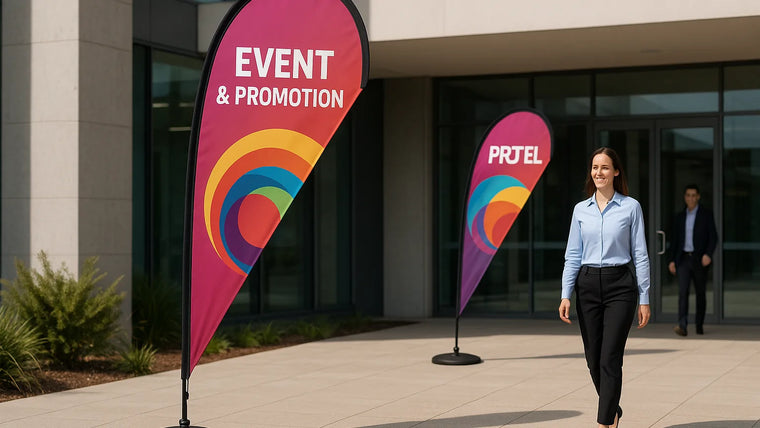
Teardrop Banners for Events and Promotions
Teardrop banners are aerodynamic, curved‑top fabric flags that hold tension to minimise flapping, delivering high visibility for events, retail forecourts and outdoor activations. Systems...
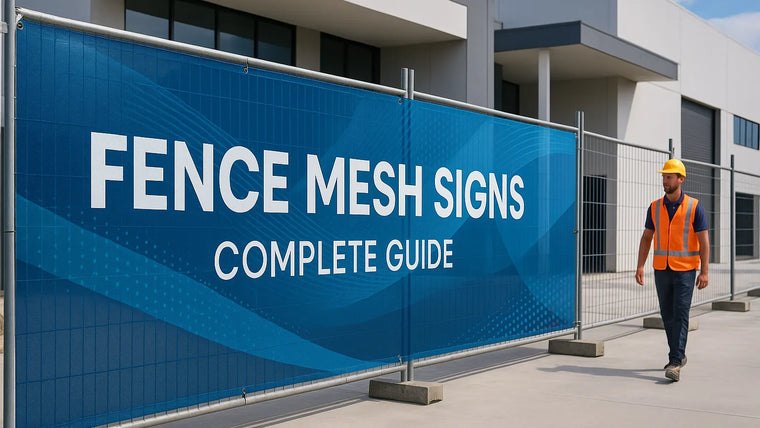
Fence Mesh Signs: Complete Guide
Fence mesh signs are printed mesh banners designed for temporary fencing and hoardings. Mesh allows airflow and can help reduce wind load compared with...
Best Materials for Crowd Control Barrier Graphics
For most outdoor events in Australia, perforated mesh banner is a versatile option because airflow can help reduce wind effects and it’s quick to...