Match materials and fixings to site: UV-stable substrates, OEM-warranted print/laminate, 316 hardware, sealed edges, and AS/NZS-rated design.
Australian sun and salt will find the weak link in any sign. Weatherproof a sign by pairing UV-stable print systems with corrosion‑resistant substrates and hardware, allowing for thermal movement during installation, and then matching that build to the site’s real UV, heat, wind and salt exposure. Get those variables working together and you avoid the classic failures—faded faces, lifted edges and corroded fixings—years before they should happen.
Environmental factors shaping weatherproof signage for Australian conditions
Assess the site first: UV intensity, temperature swings and coastal salt dictate service life. Across Australia, UV intensity is high, temperature swings can be large, and coastal salt can be relentless. A sign built for a shaded courtyard will not survive as long on a north- or west-facing wall in the tropics or near the ocean.

Select materials and print systems after that assessment. If the environment is severe, a more robust substrate, protective laminate and mechanical fixings are typically warranted. Where vandalism is possible, anti-graffiti protection and regular inspection can reduce life-cycle costs.
- UV exposure: Drives fading and embrittlement; north- and west-facing installations see the most sun in many locations.
- Heat and expansion: Substrates move; allow for thermal expansion in fixings and joints. Aluminium and ACP expand roughly 23 μm per metre per °C—oversize holes and use washers or stand-offs for panels over 1.5 m.
- Rain and moisture: Edge ingress can lift films; seal quality and hardware matter.
- Wind and impact: Larger panels need suitable fixings and support.
- Coastal salt: Accelerates corrosion; prioritise compatible, corrosion-resistant metals and frequent cleaning.
- Vandalism and cleaning: Surfaces need to tolerate cleaning without removing the message.
For large panels or cyclone-prone regions, engage an engineer to confirm post sizes, footing depth and bracketry.
- Pre-site checklist: orientation, shade, prevailing winds, exposure to sprinklers/irrigation, fall hazards for installers, and access for cleaning.
- Coastal rule-of-thumb: specify 316 stainless fasteners and isolation washers within 5 km of surf coasts and 1 km of sheltered coasts.
As a quick sizing sense-check for expansion: a 3 m wide aluminium panel experiencing a 35 °C swing can move ≈2.4 mm across its width. Give it clearance at every fixing point so it can move without buckling; on long runs, slot a couple of holes in the direction of greatest movement.
Best materials for weatherproof signage in Australian conditions
Choose the sheet to match environment, size, fixing and expected life—there is no single “best” outdoor substrate. Common options include aluminium composite panel (ACP), solid aluminium, acrylic for premium displays, fluted polypropylene (Corflute) for short-term use, banner materials for flexible installs, and engraving laminates for labels.
- Aluminium composite panel (ACP): Lightweight, flat and stiff for general panels. Typical general-signage grade is 3 mm with 0.21–0.3 mm aluminium skins. Edges route cleanly and can be radius-finished to reduce snagging.
- Solid aluminium: Preferred where a non-composite metal sheet, higher impact tolerance or a specific specification is needed. Common thicknesses are 1.6–3 mm in marine-friendly alloys, with chromate conversion or powdercoat for corrosion resistance.
- Acrylic (PMMA): Premium look for reception and architectural panels; select grade and thickness for outdoor use if exposed.
- Fluted polypropylene (Corflute): Economical for temporary and project signs; less rigid and less durable for long-term exposure.
- Banner media: Designed to be tensioned; finishing (hems, eyelets, pockets) and installation method are critical.
- Engraving laminates: Durable for small labels and equipment markers where print-free permanence is preferred.
ACP notes: use signage-grade PE-core ACP for general panels and specify FR-core where required by project documentation. Seal any exposed core at cut-outs. Where long salt exposure is expected, anodising or high-build powder systems improve longevity.
For long-run external aluminium, architectural powdercoat systems with proper pre-treatment, or exterior anodising in the ~20–25 μm range, provide durable finishes. Avoid mixing aluminium panels with copper or Corten fixtures—galvanic couples in coastal air will mark panels quickly.
- Urban construction hoarding (3–6 months): 5 mm Corflute, cable-tied to mesh with extra ties at corners; plan for early replacement if north-facing.
- Coastal facility hazard board (5+ years): 2–3 mm solid aluminium, applied RA2/RA3 reflective + anti-graffiti laminate, 316 SS fixings with nylon isolation; freshwater rinse schedule.
- Retail carpark wayfinding (2–5 years): 3 mm ACP, printed film + UV laminate for face-only renewal; oversize holes and penny washers on spans over 1.5 m.
- Reception-to-exterior continuity: 6–10 mm clear acrylic with reverse print and white back-up; mechanical stand-offs with rubber isolators under caps.
When reflective performance is required for night visibility or compliance, follow the authority’s specification rather than appearance. In Australia this commonly references AS/NZS 1906.1 reflective classes—RA2/RA3 microprismatic (often called Class 1 or Class 1W) and RA1 engineer grade (often called Class 2).
Choosing between material options? Our team can assist with a quick specification based on exposure, size and fixing method, then manufacture in-house so print, cutting and hardware remain consistent across the batch.
Get a fast quote on ACP panels, or specify solid aluminium safety signs for high-impact or long-term coastal installs.
ACP or solid aluminium for weatherproof signage in Australia?
Use ACP for large, flat informational panels where light weight matters; choose solid aluminium when higher impact resistance or a non-composite metal sheet is specified. Both materials are widely used for rigid outdoor signage. They are not interchangeable for every project. The comparison below outlines practical differences to help guide selection for Australian conditions.
| Feature | Aluminium composite panel (ACP) | Solid aluminium |
|---|---|---|
| Weight | Light weight for size; easy handling and mounting | Heavier for the same thickness; robust feel |
| Rigidity and flatness | Good flatness on large panels | Rigid; thickness selection affects stiffness |
| Impact tolerance | Suitable for general use; avoid heavy point impacts | Generally higher resistance to dents at appropriate thickness |
| Fire and specification | Check product and project requirements before use | Often preferred where a non-composite metal sheet is specified |
| Edge and fabrication | CNC routs cleanly; edges remain neat | Can be drilled, routed and formed to suit fixings |
| Print compatibility | Direct UV print or applied film/laminate | Direct UV print or applied film/laminate |
| Typical applications | General site panels, wayfinding, project boards | Long-term external signs, safety panels, engineered installs |
| Coastal considerations | Use appropriate hardware; inspect for galvanic pairing | Select corrosion-resistant alloy/finish and compatible fixings |

Further guidance: use ACP for large, flat informational panels where light weight and ease of handling matter; choose solid aluminium where higher impact resistance, threaded inserts, or thin edges (no composite core) are required.
For temporary works, fluted polypropylene is cost-effective but should be sized and fixed conservatively in wind. For premium internal–external transitions (e.g. reception glazing), clear acrylic with reverse print provides a protected graphic and glass-like finish.
Print methods and protective finishes for weatherproof signage in Australian conditions
Choose direct UV print for a streamlined build, or printed film plus laminate for media flexibility and easier face-only renewal. Printing and protection are as important as the sheet material. Two common approaches are direct UV printing to the panel, or printing self-adhesive film then laminating and applying it to the substrate. Choose based on durability expectations, colour targets, face-only renewal needs and whether reflective or specialist films are involved.
- Direct UV printing: UV-curable inks are applied and cured during printing on compatible substrates. Streamlined construction with fewer layers. At Sign Portal, rigid panels up to 2.5 × 1.3 m are produced on our Mimaki JFX200-2513 EX with zoned vacuum and pin registration for repeatable panel alignment and sharp text down to 3 mm cap height.
- Printed film + laminate: Offers media flexibility, reflective options, textured/anti-graffiti laminates and easier face-only renewal. Ideal when regulatory updates are expected—swap the face, keep the structure.
- Protective lamination: Helps resist abrasion, handling and cleaning. Select a laminate compatible with the print film and environment (e.g. UV-stable gloss for colour vibrancy, matte to reduce glare, or hardcoat anti-graffiti where needed).
- Anti-graffiti laminate: Useful for public spaces and transport hubs; verify cleaner compatibility. We routinely test against isopropyl alcohol and citrus-based cleaners on production panels before sign-off.

For applied films, we profile the print/laminate pair, respect the film’s outgas window, and edge-seal where high-pressure washing or salted spray is expected.
Cast films typically hold colour and resist shrinkage longer than calendered films on harsh west-facing sites. Pair them with 70–100 μm outdoor laminates, and allow the printed film to outgas fully before lamination to avoid tunnelling and edge lift.
Colour matching and white ink for weatherproof signage on clear or coloured materials
Critical brand colours should be supplied using recognised references and, where necessary, confirmed with a printed sample because lighting, substrate colour and ink set affect the result. When printing on clear, coloured or metallic substrates, a dedicated white-ink layer may be required for opacity and colour strength. Our colour management pipeline uses device profiles created with an X‑Rite i1 spectrophotometer and Mimaki RasterLink RIP, enabling predictable ΔE results on standard media sets.
Fabrication tips to improve weatherproof signage performance
Clean edges, accurate holes and planned clearances prevent film lift and stress cracking. Well-made edges, accurate holes and clearances for fixings reduce the chance of film lift, cracking or stress points. Digital cutting, CNC routing and laser cutting allow precise shapes and components that account for fixings and panel joins.
- Cut-to-shape production: Provide clean vector cut paths and adequate clearance around text and holes.
- CNC routing: Useful for thicker materials, rebates and clean edges on ACP and aluminium. Our MultiCam SM2412 with vacuum hold-down and automatic tool change delivers consistent edge quality; we commonly use 3.2 mm single-flute cutters for ACP and 2–3 flute carbide for aluminium, with a light chamfer to deburr.
- Laser cutting (acrylic): Produces polished edges for letters and display components.
- Large-format planning: Big signs may need panelisation for handling, transport and access; plan joins early for alignment.
- Edges and corners: Radius corners (e.g. R3–R5) and sealed edges on film-applied panels reduce peel risk and handling damage.
We routinely slot key holes to allow thermal movement, countersink for flush fasteners where required, and use backing plates or rivnuts on thin structures. For aluminium, feeds/speeds and chip load are tuned to minimise burr; parts are deburred, wiped and packaged with interleaves to avoid transit scuffing.
Installation methods and fixings for weatherproof signage in Australia
Poor installation can shorten sign life; match fixings to wind exposure, substrate and structure, and isolate dissimilar metals in coastal areas. The most weatherproof sign can fail if installed poorly. Choose fixings according to size, wind exposure, substrate and supporting structure. In coastal locations, use corrosion-resistant hardware and avoid incompatible metals that can cause galvanic corrosion.
- Mechanical fixing: Screws, bolts, rivets, brackets or clips are preferred for large or wind-exposed signs. For aluminium panels on steel structures, use isolation washers or nylon spacers to separate dissimilar metals.
- Adhesive mounting: Reserve for clean, smooth, compatible surfaces and lighter signage; follow the media manufacturer’s surface prep guidance. High-bond tapes (e.g. black foamed acrylic families) perform best with primer on low-surface-energy substrates; observe cure times.
- Post mounting: Select posts, brackets and footings to suit size and wind exposure; verify underground services before digging.
- Hole sizing for expansion: Oversize panel holes by 2–3 mm on spans over 1.5 m and use washers to cover the clearance; this prevents stress and “oil canning”.
- Work environment: Near traffic or pedestrian routes, plan for separation and visibility; near electrical equipment, maintain clearances and enclosure integrity.
On tall walls or mast installations, plan access equipment and trained personnel. Weather during installation matters too—adhesive applications can be sensitive to temperature and moisture, and wind can make panel handling unsafe.
Installation QA at Sign Portal: we specify fastener type and torque, supply hardware packs for kit-sets, and include expansion guidance on the panel label. Where galvanic pairing is unavoidable, we insulate with nylon bushes and washers, and specify 316 stainless externally.
- ACP sign on a Colorbond fence near the coast: panel fixed with stainless self-drillers on slotted holes and 1 mm nylon spacers; no rust-stain run-off after two summers.
- Solid aluminium safety sign on a west-facing block wall: top row fixed firm, lower holes slotted horizontally with large OD washers; no oil-canning despite 40 °C days.
Maintenance and inspection for weatherproof signage in harsh Australian climates
Build cleaning and inspection into site maintenance and replace signs when legibility or integrity declines. Weatherproofing is not one decision at purchase; it is a life-cycle approach. Build cleaning and inspection into your site maintenance system and replace signs whose function has been compromised by fading, damage or corrosion.
- Cleaning: Use methods compatible with the print and laminate. Avoid aggressive solvents and abrasives unless specified as safe by the material supplier. In coastal zones, a freshwater rinse monthly and a soft-detergent wash quarterly reduces salt loading.
- Inspection: Frequency should reflect risk and exposure; coastal and vandal-prone areas often need more frequent checks. Look for fastener corrosion, film edge lift and chalking.
- Replacement: Swap out signs when fading, delamination, corrosion or impact damage reduces legibility. Reflective signs should also be assessed for night performance, not daylight appearance alone.
- Coastal care: Periodic fresh-water rinsing can reduce salt build-up on hardware and edges.
Record keeping: attach a small service label to the rear of each panel with install date, product type (e.g. ACP 3 mm, film+laminate), and cleaning notes; log inspections in your maintenance system.
Repair and mid-life refresh for weatherproof signage
Prioritise face-only renewals where the substrate is sound, and upgrade hardware to corrosion-resistant options when needed. Not every issue requires a full replacement. A structured repair approach can extend service life and reduce downtime, especially on engineered mounts or remote sites.
- Face-only renewal: Where the substrate is sound (e.g. ACP or solid aluminium), remove the old film, decontaminate, and apply new printed/laminated graphics. This is fastest where the original face was film-applied.
- Edge lift remediation: Small areas of laminate lift can sometimes be trimmed, edges re-sealed, and corners re-radiused. Replace if lift extends into the image area or reflective performance is affected.
- Fixing upgrades: Replace corroded hardware with 316 stainless in coastal areas. Add isolation washers between dissimilar metals to prevent galvanic attack. Where fixings have elongated holes, install rivnuts or backing plates to restore clamping pressure.
- Panel damage: Dents and creases in ACP generally require replacement of the affected panel. Solid aluminium dents may be locally dressed but repainting is rarely cost-effective for printed faces—renew the face instead.
- Graffiti removal: Use cleaners approved for the anti-graffiti system supplied. Test a small area first, then rinse thoroughly. If shadowing remains, replace the graphic face or anti-graffiti film.
- Documentation: Record the repair date, method and materials on a label on the rear of the panel; this supports future maintenance planning.
- Face renewal steps (film-applied signs): warm the film with a heat gun (≈60–80 °C), peel at a low angle, remove adhesive residue with citrus remover, wipe with isopropyl alcohol, dry, then re-apply the new face with firm squeegee pressure and edge-seal if specified.
- Hardware remediation: replace fixings one-by-one to retain alignment, add nylon isolators, torque evenly to avoid panel bowing, and confirm oversize holes are free to move under washers.
Artwork, proofing and procurement for reliable weatherproof signage outcomes
Provide clean vector artwork, clear dimensions and layers for print, cut and drill to minimise rework. Good files and approvals prevent rework. Provide vector logos and cut paths, suitable image resolution at final size, clear finished dimensions and separate layers for cut, drill and print instructions. Include bleed for edge-to-edge prints and note any special finishes or laminates.
Artwork proofing before manufacture lets stakeholders confirm wording, spelling, colours, dimensions and quantities.
For larger or unusual projects, a prototype can confirm scale, readability, colour and installation details. Where there are many variable labels or signs, a structured spreadsheet can drive accurate variable-data production.
Legibility tip: a simple rule-of-thumb is 1 mm of capital letter height per 0.3 m of viewing distance (e.g. ≈30 mm at 9 m). Keep critical text out of joints by at least 25 mm, and allow a safe area inside the panel edge or frame.
Finally, plan delivery and packaging. Corners, printed faces and fabricated parts should be protected for transport. National freight is available, including regional and remote delivery, but large or fragile signs may need reinforced packaging or project-specific freight arrangements.
Australian standards and regulated applications for weatherproof signage
Confirm the governing requirement before production and follow the relevant authority’s specification. Typical frameworks include AS 1319 (safety signs), AS 1744/1743 (road sign legends and manufacture) and AS/NZS 1906.1 (retroreflective sheeting classes). Many councils and facility owners issue their own specifications—follow those over generic “Class” labels.
- General site wayfinding on ACP, direct UV printed and edge-cleaned on our MultiCam SM2412 for accurate hole alignment; installed with stainless fixings.
- Coastal facility safety panels on solid aluminium with applied reflective film and anti-graffiti laminate; printed in-house and packaged with face separators for interstate freight.

- Mimaki JFX200-2513 EX flatbed + RasterLink RIP for direct-to-substrate printing on ACP and aluminium, with white ink layering for clear and metallic substrates.
- MultiCam SM2412 CNC routing with vacuum pods and dust extraction for precise cut-outs, countersinks and radius corners; typical dimensional tolerance ±0.3 mm on panel work.
- In-process QC: spectrophotometer spot checks for brand colours, adhesion cross-hatch testing on sample strips, and final fit-up verification before packing.
- Remote depot safety boards (3 mm ACP, laminate face): faces renewed on-site after 4 years due to regulatory updates; substrates retained, fixings upgraded to 316 SS with nylon isolation, downtime under 2 hours per board.
- Industrial gate sign (3 mm aluminium): edge lift at two corners trimmed and re-radiused, edges sealed, anti-graffiti re-applied; subsequent inspections at 6 and 12 months showed no further lift.
Ready to order? Choose a durable substrate and we’ll build it to suit your site: aluminium composite panel signs for general external panels, or solid aluminium safety signs where impact and longevity are critical.
Related Sign Portal resources: Outdoor Signs · Fire Extinguisher Black Dot Sign - High Visibility · Danger - 22,000 Volts High Voltage Warning Sign
Frequently Asked Questions
What outdoor sign material lasts longest in Australian sun?
There isn’t a single “longest‑lasting” option for every site. Solid aluminium and quality ACP are both widely used for durable rigid panels, but the best choice depends on exposure, size and the fixing method.
Do I need a laminate for UV protection?
A compatible laminate helps resist abrasion and cleaning, and some laminates offer added UV resistance. It complements, rather than replaces, selecting a suitable print system and substrate for the environment.
Are Corflute signs weatherproof?
Fluted polypropylene (often called Corflute) can be suitable for temporary outdoor use. It is lighter and less rigid than metal panels, so consider size, wind exposure, fixing and expected service life before use.
What should I use near the coast?
Choose corrosion‑resistant substrates and hardware, avoid incompatible metals that can cause galvanic corrosion, and plan more frequent inspection and cleaning. Solid aluminium may be selected where a non‑composite metal sheet is preferred.
Can Sign Portal ship large outdoor signs to remote sites?
Yes. Australia‑wide freight is available. Large or fragile signs may need reinforced packaging or project‑specific freight arrangements to reduce the risk of transit damage.
When should outdoor signs be replaced?
Replace signs when fading, delamination, corrosion, damage or reduced night reflectivity affects legibility. Use inspection and the manufacturer’s material guidance rather than a fixed age alone.
Keep learning
Related Articles
Fence Mesh Signs: Complete Guide
Fence mesh signs are printed mesh banners used on temporary fencing and hoardings. The perforated material allows airflow compared with a solid banner, while...
Best Materials for Crowd Control Barrier Graphics
For most outdoor events in Australia, perforated mesh banner is a versatile option because airflow can help reduce wind effects and it’s quick to...
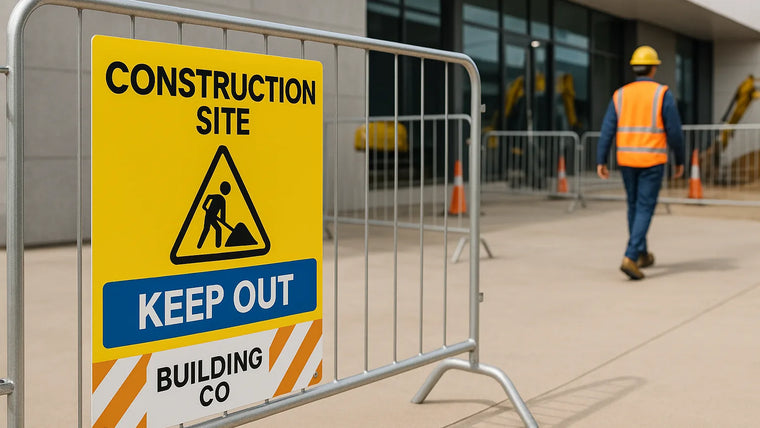
Crowd Barrier Signage for Construction Sites
Crowd barrier signage for construction sites uses panels, banners or decals mounted to portable barriers to guide pedestrians, brand perimeters and reinforce safety messages....