If you’re scanning a workplace or public facility and spot a green-and-white safety sign, you’re being directed to something that will help keep people safe — not warned away from danger. This article explains what green safety signs mean in Australia, the most common examples you’ll see, how to choose materials, and practical tips for placement and durability in local conditions.
Meaning at a glance
Green safety signs are used to communicate safe conditions and the location of assistance. Typical uses include indicating emergency exits and directions to them, first aid rooms or kits, automated external defibrillators (AEDs), evacuation assembly areas and emergency telephones or intercoms. They are informational and permissive — guiding people towards help — rather than prohibitive or warning-based. In Australia this category aligns with Emergency Information (safe condition) signs defined in AS 1319:1994.

In practice, that means a green sign reassures the viewer they are heading the right way or have found the right aid. Contrast this with red signs, which typically point to fire equipment or convey prohibitions, and yellow/amber signs, which issue warnings. Green is about access to help and safe routes.
In Australian projects we reference AS 1319 for category and layout, AS 2700 for colour guidance (safety greens), and where pictograms are used, we follow widely recognised ISO 7010 symbols for fast comprehension alongside local practice. Where illuminated exit signs are required, the NCC and AS/NZS 2293 series apply (see Standards and compliance in Australia below).
Where you will see them
Nearly every Australian workplace and public building uses green safety signs. You’ll most often see them in circulation spaces and near safety resources so people can quickly orient themselves in an emergency.
- Emergency exit and directional exit arrows through corridors, stairwells and car parks.
- First aid locations: wall-mounted kits, first aid rooms, nurse stations.
- AED (defibrillator) cabinets in reception areas, gyms, schools and shopping centres.
- Evacuation assembly points in loading areas, forecourts and outdoor yards.
- Emergency phone/intercom stations in car parks and large facilities.
- Safety shower/eyewash in laboratories and industrial wash-down zones.
Shop related products now:
- Emergency exit and directional exit signs
- First aid signs
- AED (defibrillator) signs
- Evacuation assembly point signs
Quick picks for common needs: Exit and directional for corridors and stairwells, First aid for kits and rooms, AED for cabinets, and Assembly point for outdoor muster areas.
Colour, symbols and shapes
Green safety signs typically use a green background with white pictograms and text for high contrast. The symbols (pictograms) are designed to be recognised at a glance — a running person for exits, a cross for first aid, a heart and lightning bolt for AEDs, a group of people for an assembly point. Pictograms consistent with ISO 7010 are widely recognised and commonly used alongside Australian practice for rapid comprehension.
Most safe condition signs are rectangular or square, which suits directional arrows and simple text where needed. Where space or visibility demands, supplementary arrows can be added to point left, right, up (ahead) or down (level change/nearby).
- Colour function: Green reassures and informs; it suggests the presence of help or a safe route.
- Pictogram role: Aids rapid recognition across language barriers and through smoke or low light.
- Text use: Short labels like "First Aid" or "Exit" can be added to reinforce meaning without clutter.
Manufacturing note: We reference AS 2700 colour swatches during prepress to keep greens consistent across batches and substrates, and we maintain internal tolerances so multiple panels read uniformly when installed side-by-side.

How green compares with red fire or prohibition signs
Because people often confuse green and red signage roles, here’s a concise side-by-side to clarify the main differences.
| Feature | Green safety signs | Red fire/prohibition signs |
|---|---|---|
| Primary meaning | Safe condition, assistance, directions to safety | Fire equipment location or actions that are not allowed |
| Typical symbols | Running person (exit), first aid cross, AED, assembly point | Fire extinguisher/hose, prohibition circle/slash |
| Common locations | Corridors, stairwells, reception, warehouses, car parks | Plant rooms, near extinguishers/hydrants, restricted areas |
| Urgency type | Guidance to help or route | Immediate hazard control or restriction |
| Action implied | Proceed towards aid or exit | Use fire equipment or stop a prohibited action |

Common misunderstandings to avoid
Green does not mean "go" for machinery. In process control, traffic or machinery contexts, green may have separate operational meanings. Safety signs use green purely for safe condition information and assistance, not machine states.
Fire equipment is not green. Fire extinguishers, hydrants and other fire-fighting equipment are usually identified with red signage. Green is for exits and assistance, not for locating extinguishers or declaring prohibitions.
Printed exit signs versus emergency lighting. Printed wall or door exit signs help with wayfinding, but illuminated emergency exit lighting has separate electrical and compliance requirements. If your building requires illuminated exit lights, check with your fire services contractor or building manager — a printed sign alone is not a substitute. In Australia, illuminated exit signs and emergency escape lighting must comply with AS/NZS 2293 and the National Construction Code (NCC).
Materials and manufacturing options
Green safety signs can be manufactured on a range of substrates to suit indoor offices through to harsh industrial and coastal environments. At Sign Portal, signs are produced in-house using direct UV flatbed printing on rigid sheets or wide-format print-and-cut vinyl for decals and applied graphics.
- Aluminium composite panel (ACP): Rigid, dimensionally stable and ideal for durable wall signs and outdoor wayfinding. Excellent print quality via UV flatbed on our Mimaki JFX EX units. Typical thicknesses: 3 mm for general use; 4 mm for larger panels or post-mounting.
- Acrylic (PMMA): Premium look for offices and healthcare reception areas; can be laser-cut to shape with polished edges and mounted with stand-offs.
- Foam PVC: Lightweight indoor option for corridors and doors; economical and clean finish.
- Polycarbonate: Impact-resistant choice for workshops and high-traffic areas; good chemical resistance.
- Corflute: Temporary or construction-stage signage; lightweight and cost-effective for short-term use.
- Vinyl decals: For doors, glass and wayfinding arrows; printed and contour-cut on our Roland VG-640. Use cast vinyl for exterior curves and long-term exposure; calendered vinyl for flat interior surfaces.
Our production capability includes two Mimaki JFX EX flatbed UV printers for high-opacity whites and crisp greens on rigid substrates, CNC routing on a MultiCam SM2412 for panel cutting, and laser cutting on a Trotec Speedy 500 or large-format CO2 laser for precise acrylic work. Where extra abrasion or chemical resistance is needed, protective lamination can be applied after printing. Panels can be supplied pre-drilled, edge-sealed (ACP) and kitted with 3M VHB tape or 316 stainless fixings for coastal installs.
First-party process highlights at Sign Portal:
- RIP-driven colour management with regular device calibration to keep greens consistent across reorders and mixed substrates.
- Barcode job travellers and rear-panel job numbers for end-to-end traceability and easy reordering.
- Controlled UV ink cure and substrate-specific surface prep to optimise adhesion, especially before applying laminates or VHB tapes.
- In-line panel QC: edge finish, hole patterns, arrow direction, symbol orientation and gloss level are checked before pack-out.
Photoluminescent and visibility options
For low-light resilience, we can produce photoluminescent (glow-in-the-dark) green graphics for non-electrical wayfinding. Where illuminated exit signs are required, use compliant luminaires to AS/NZS 2293 (printed photolum wall plates are not a substitute). For visibility in long corridors or high racks, specify oversized pictograms and supplementary arrow modules to maintain legibility at height.
Sizing, placement and legibility
Choose sizes based on viewing distance, corridor width and the time people have to interpret the sign while moving. Larger symbols and clear arrows improve recognition in stress and low-light conditions.
- Common panel sizes we produce: A5, A4, A3 and 450 × 300 mm for indoor walls; 600 × 450 mm or larger for warehouses and outdoors.
- Rule-of-thumb by distance: Under 10 m: A4–A3; 10–20 m: 450 × 300 mm; 20–30 m: 600 × 450 mm; 30 m+: 900 × 600 mm or larger. Increase size if the sign must compete with clutter or high mounting heights.
- Height and angle: Mount near eye level in corridors; higher placements suit large spaces like warehouses so the sign clears racking.
- Arrow clarity: Use a separate directional arrow module where turns occur; avoid stacking too much information on one panel.
- Glare control: Matte or satin finishes reduce reflections from overhead lighting.
For glass doors or partitions, apply a reverse-printed or opaque decal so the arrow and symbol remain visible against changing backgrounds.
Australian conditions and durability
Australia’s UV index and heat can be severe, especially in northern and inland regions. For outdoor or sun-exposed placements, select UV-stable inks (standard with our UV flatbed process) and consider a UV overlaminate on vinyl graphics. In coastal areas, choose corrosion-resistant fixings and substrates such as ACP with sealed edges, and clean salt spray periodically.
- High UV exposure: UV-printed ACP or laminated cast vinyl for longer colour stability.
- Coastal/salt air: Non-corroding fixings, sealed panel edges, regular fresh-water rinse as part of maintenance.
- Industrial wash-down: Polycarbonate or laminated ACP with rounded corners; avoid exposed paper labels.
- Graffiti-prone areas: Anti-graffiti laminate to enable solvent-safe cleaning.
- A warehouse installs 600 × 450 mm ACP assembly point signs with larger pictograms so they remain visible above parked vehicles.
- A clinic uses laser-cut acrylic first aid signs with stand-offs for a clean, professional finish in reception while matching back-of-house with foam PVC for economy.
- A coastal council specifies laminated vinyl exit arrows on powder-coated posts to resist salt and UV in a foreshore car park.
From production to replacement: deliver, inspect, repair, replace
Sign Portal manufactures in-house in a 480 m² facility with clean print rooms and ships Australia-wide, including regional and remote delivery. To keep your safe-condition signage effective over its lifecycle, use the following workflow.
-
Installation checklist (practical):
- Surface prep: wipe with 70% IPA/water, dry lint-free; avoid silicone residues.
- Adhesive installs: apply firm pressure to VHB tapes; allow 24–72 h dwell (temp > 15°C) for full bond strength.
- Mechanical installs: use stainless fixings; avoid overtightening on acrylic — use stand-offs or nylon washers.
- Orientation: confirm arrow direction and nearest-route logic before drilling.
- Routine inspection frequency: Offices and education — every 6 months; warehouses, car parks and coastal sites — quarterly. Verify visibility is not blocked by new fixtures or racking and that routes remain current.
- Cleaning guidance: Use mild detergent and water; isopropyl alcohol for adhesives/tape edges. Avoid strong solvents (e.g., acetone) on polycarbonate and acrylic.
Ordering and customisation
Most green safety signs are standardised enough to order quickly. You can supply a rough brief — for example, “First aid left arrow, A4, ACP” — and our team can set artwork, or you can provide print-ready files. We accept vector artwork (AI, EPS, PDF) and high-resolution raster where needed; ensure any arrows and pictograms are clean vector shapes for sharp edges.
- Custom arrows and distances: Add direction and distance (e.g., 30 m) to improve wayfinding in large sites.
- Site codes: Subtle location codes help audits (e.g., FA-01 for first aid kit 1).
- Mounting options: Pre-drilled holes, VHB tape, stand-offs or magnetic backing for steel surfaces.
- Repeat ordering: Trade customers can streamline reorders through Sign Portal’s Trade Portal and customer-specific catalogues.
In-house quality checks include preflight of supplied files, substrate verification against the purchase order, controlled colour output on our Mimaki JFX EX printers, and a final sign-off against an approved proof before packing. On request, we can supply batch photos and a material data sheet with each shipment.
Ready to order? Browse and buy: Emergency exit, First aid, AED and assembly point signs.
Standards and compliance in Australia
While this page provides practical guidance, always confirm your obligations with your building certifier or safety advisor. Key sources:
- AS 1319:1994 Safety signs for the occupational environment — category, colour and layout guidance for emergency information (green) signs. See Standards Australia: https://www.standards.org.au/
- AS/NZS 2293 (series): Emergency escape lighting and exit signs for buildings — requirements for illuminated exit signs and emergency lighting. Overview and adoption via the NCC: https://ncc.abcb.gov.au/
- National Construction Code (NCC) — building-level requirements for exit signage and egress: https://ncc.abcb.gov.au/
- Safe Work Australia — Model Code of Practice: First aid in the workplace (for first aid room/kit provisions and visibility): https://www.safeworkaustralia.gov.au/doc/model-code-practice-first-aid-workplace
- Safe Work Australia — Model Code of Practice: Managing the work environment and facilities (signage, emergency planning and information for workers): https://www.safeworkaustralia.gov.au/doc/model-code-practice-managing-work-environment-and-facilities
- Model WHS Regulations — includes duties for emergency plans (Reg 43) and information/education for workers: https://www.safeworkaustralia.gov.au/law-and-regulation/model-whs-laws/model-whs-regulations
Note: AS 1319 addresses traditional safety sign categories and general design. Where symbol-only signs are used, ISO 7010 pictograms are commonly adopted to improve rapid recognition in mixed-language workplaces.
Related sign colours at a glance
Understanding the broader colour system helps you specify a complete, coherent suite of safety signage across your site:
- Green: Safe condition and assistance — exits, first aid, AED, assembly points.
- Red: Fire equipment locations and prohibitions.
- Yellow/amber: Caution and hazard warnings.
- Blue: Mandatory actions or instructions.

Summary and next steps
Green safety signs in Australia point people towards help: exits, first aid, AEDs and assembly points. They are the backbone of safe evacuation and assistance wayfinding and should be sized, placed and manufactured to suit your building layout and local conditions.
If you’re setting up or refreshing your signage, list the key safe-condition points on your site, confirm the routes between them, then select materials for each environment — indoor office, busy warehouse, outdoor yard or coastal frontage. Our team can produce standard or custom green safety signs on ACP, acrylic, foam PVC, polycarbonate or vinyl, and help with durable finishes for UV, chemical or graffiti resistance.
Need help finalising a list? Send us a floor plan or photos and we’ll recommend a coherent set that’s easy to maintain and reorder. Or browse and buy now: Emergency exit, First aid, AED and assembly point signs.
Related Sign Portal resources: Fire Door Safety Sign - Do Not Obstruct or Keep Open · Safe Manual Handling Sign for Workplace Safety · Workplace Safety - First Response For Common Ailments Sign
Related Sign Portal resources: Workplace Safety - First Response For Common Ailments Sign · Mandatory Blind Intersection Sign for Workplace Safety
Related Sign Portal resources: Workplace Safety - First Response For Common Ailments Sign
Related Sign Portal resources: Workplace Safety - First Response For Common Ailments Sign
Related Sign Portal resources: Workplace Safety - First Response For Common Ailments Sign
Related Sign Portal resources: Workplace Safety - First Response For Common Ailments Sign
Related Sign Portal resources: Workplace Safety - First Response For Common Ailments Sign
Related Sign Portal resources: Workplace Safety - First Response For Common Ailments Sign
Related Sign Portal resources: Workplace Safety - First Response For Common Ailments Sign
Related Sign Portal resources: Workplace Safety - First Response For Common Ailments Sign
Related Sign Portal resources: Workplace Safety - First Response For Common Ailments Sign
Related Sign Portal resources: Workplace Safety - First Response For Common Ailments Sign
Related Sign Portal resources: Workplace Safety - First Response For Common Ailments Sign
Related Sign Portal resources: Workplace Safety - First Response For Common Ailments Sign
Related Sign Portal resources: Workplace Safety - First Response For Common Ailments Sign
Related Sign Portal resources: Workplace Safety - First Response For Common Ailments Sign
Related Sign Portal resources: Workplace Safety - First Response For Common Ailments Sign
Related Sign Portal resources: Workplace Safety - First Response For Common Ailments Sign
Related Sign Portal resources: Workplace Safety - First Response For Common Ailments Sign
Related Sign Portal resources: Workplace Safety - First Response For Common Ailments Sign
Related Sign Portal resources: Workplace Safety - First Response For Common Ailments Sign
Related Sign Portal resources: Workplace Safety - First Response For Common Ailments Sign
Related Sign Portal resources: Workplace Safety - First Response For Common Ailments Sign
Related Sign Portal resources: Workplace Safety - First Response For Common Ailments Sign
Related Sign Portal resources: Workplace Safety - First Response For Common Ailments Sign
Related Sign Portal resources: Workplace Safety - First Response For Common Ailments Sign
Related Sign Portal resources: Workplace Safety - First Response For Common Ailments Sign
Related Sign Portal resources: Workplace Safety - First Response For Common Ailments Sign
Related Sign Portal resources: Workplace Safety - First Response For Common Ailments Sign
Related Sign Portal resources: Workplace Safety - First Response For Common Ailments Sign
Related Sign Portal resources: Workplace Safety - First Response For Common Ailments Sign
Related Sign Portal resources: Workplace Safety - First Response For Common Ailments Sign
Related Sign Portal resources: Workplace Safety - First Response For Common Ailments Sign
Related Sign Portal resources: Workplace Safety - First Response For Common Ailments Sign
Related Sign Portal resources: Workplace Safety - First Response For Common Ailments Sign
Frequently Asked Questions
What does a green safety sign mean in Australia?
It indicates a safe condition or assistance point, such as emergency exits, first aid, AEDs and evacuation assembly areas.
Are green exit signs the same as illuminated emergency exit lights?
No. Printed green exit signs aid wayfinding, while illuminated emergency exit lights are separate electrical devices with their own compliance requirements.
Can I use green signs to mark fire extinguishers?
No. Fire equipment is typically identified with red signage. Use green for assistance and safe routes, not fire gear.
What materials are best for green safety signs outdoors?
UV-printed aluminium composite panel or laminated high-grade vinyl on a stable substrate suit outdoor and high-UV locations.
What size should my first aid or exit sign be?
Match size to viewing distance and environment. Common choices are A4 or A3 indoors and 450 × 300 mm or larger in warehouses and outdoors.
Do you ship green safety signs to regional or remote areas?
Yes. Sign Portal ships Australia-wide, including regional and remote delivery.
Can I add arrows and distances to my green signs?
Yes. Directional arrows and distance markers (e.g., 30 m) improve wayfinding in large or complex sites.
Keep learning
Related Articles
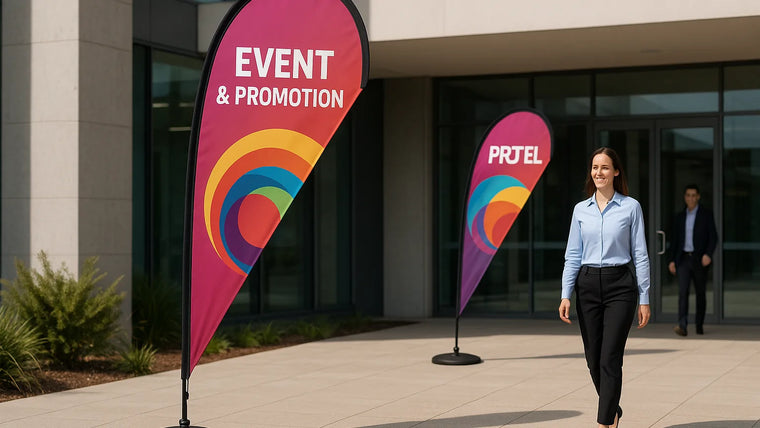
Teardrop Banners for Events and Promotions
Teardrop banners are aerodynamic, curved‑top fabric flags that hold tension to minimise flapping, delivering high visibility for events, retail forecourts and outdoor activations. Systems...
Fence Mesh Signs: Complete Guide
Fence mesh signs are printed mesh banners designed for temporary fencing and hoardings. Mesh allows airflow and can help reduce wind load compared with...
Best Materials for Crowd Control Barrier Graphics
For most outdoor events in Australia, perforated mesh banner is a versatile option because airflow can help reduce wind effects and it’s quick to...