Wherever a specific action must not occur—e.g. no smoking, no entry or no phones—in workplaces, public spaces and restricted areas.
If you need to stop a behaviour rather than guide or warn, you’re looking for a prohibition sign. These are the familiar red-circle-with-diagonal-bar symbols used to show that an action is not permitted. This article explains the situations where prohibition signs are used, how they differ from other safety sign types, and practical considerations for selecting, placing and maintaining them in Australian conditions.
Definition and purpose
Prohibition signs communicate that a specific action is not allowed. They are directive signs — their primary job is to stop something from happening, such as smoking, entering an area, using a phone, or operating equipment without authority.
They are commonly recognised by a red circular border with a diagonal slash over a black pictogram on a white background. The symbol quickly conveys the banned action, often supported by a short caption for clarity in multilingual or noisy environments.
Common workplace scenarios

Across Australian workplaces, prohibition signs are used when a rule must be consistently enforced for safety, compliance, security or process control. Typical situations include:
- No smoking or vaping near flammable materials, fuel bowsers or chemical stores.
- No entry to restricted zones such as plant rooms, switchboards, or authorised-personnel-only areas.
- No mobile phones in areas with sensitive equipment, explosive atmospheres or confidential information.
- No food or drink in laboratories, cleanrooms or production lines.
- No forklifts or pedestrian-free zones to control vehicle–people interactions.
- No photography in secure facilities or R&D spaces.
- A service station forecourt uses a no smoking sign at every bowser, plus at the site entry.
- A data centre lobby places no food or drinks and no unauthorised entry signs at the mantrap door.
- A fabrication shop marks a pedestrian exclusion lane with no forklifts symbols on posts and gates.
Public spaces and community settings
Outside workplaces, prohibition signs help the public understand rules quickly without lengthy text. Councils, schools, event operators and venue managers rely on them to keep spaces safe, fair and accessible.
- No dogs or pets in playgrounds or protected wildlife areas.
- No alcohol consumption in designated dry zones.
- No cycling or skating on certain footpaths or boardwalks.
- No swimming at unpatrolled beaches, water reservoirs or stormwater channels.
- No parking or no stopping to manage traffic flow and emergency access.
Design elements that identify them

Although visual styles can vary by supplier, prohibition signs share common visual elements that make them instantly recognisable:
- Red circular ring with a red diagonal bar.
- Black pictogram representing the banned action.
- White background for contrast and quick recognition.
- Optional short text caption to reinforce the meaning.
How they differ from other safety signs
Its easy to confuse sign categories, especially when several appear together. The table below highlights practical differences that matter on site when youre deciding what to install.
| Feature | Prohibition | Warning |
|---|---|---|
| Core function | Stops or forbids an action (Do not) | Alerts to a hazard (Be careful) |
| Typical use | No entry, no smoking, no phones | Forklifts operating, slippery floor, high voltage nearby |
| Primary cue | Red circle with diagonal bar over pictogram | Triangle symbol and hazard colour elements |
| Behavioural outcome | Do not perform the action | Proceed with caution, apply controls |
| Placement logic | At decision points where the action might occur | Before or near the hazard to give time to react |
Materials and durability for Australian conditions

Outdoor UV, heat and coastal salt accelerate sign fading and material breakdown. Selecting the right substrate and print method helps prohibition signs stay legible for their expected service life.
- Aluminium composite panel (ACP): Rigid, dimensionally stable and suited to long-term outdoor use. Direct UV printing produces durable colour with sharp pictograms.
- Corflute: Lightweight and economical for temporary worksites and events. Best for short-term outdoor or indoor placements.
- Foam PVC: Good for indoor facilities and sheltered areas. Not ideal for prolonged harsh sun.
- Self-adhesive vinyl labels: Apply to doors, machinery guards, switchboards or glass. Lamination adds abrasion resistance.
At Sign Portal, rigid prohibition panels are commonly direct-printed on our UV flatbeds and then routed to size. For labels, wide-format print-and-cut workflows create precise, clean symbols ready for application to smooth surfaces.
Manufacturing and customisation
Because we manufacture in-house, both standard and customised prohibition signs can be produced efficiently. Direct UV printing on flat substrates ensures crisp symbol edges and consistent red hues, while digital print-and-cut enables labels in small or large runs.
- UV flatbed printing: Two Mimaki JFX EX flatbeds handle rigid sheet printing for ACP and other substrates.
- CNC routing: Our MultiCam SM2412 produces clean edges and custom shapes (for example, round or custom plaques).
- Laser cutting and engraving: The Trotec Speedy 500 and a large-format CO2 laser support precise acrylic or laminate components.
- Wide-format print/cut: The Roland VG-640 creates high-quality adhesive labels and decals with contour or kiss cuts.
- Lamination: Adds scratch resistance to high-contact areas (doors, handrails, equipment).
Customisation options include size, substrate, symbol-only versus symbol-with-caption, bilingual captions, reflective films for low-light visibility, and hole drilling for easy mounting.
Placement and installation basics

Prohibition signs work best when they are seen at the exact point where someone might perform the forbidden action. Think about sightlines, lighting and approach direction.
- Place signs at entry points, door handles, control panels and gates where decisions are made.
- Maintain clear sightlines: avoid obstructions from shelving, vegetation or open doors.
- Use appropriate fixings for the surface: screws and wall plugs for masonry, rivets for metal posts, VHB tape for smooth internal walls, and suitable adhesives for glass.
- Consider repeaters along longer walkways or perimeters so the message is never out of view.
Ordering and reordering
If you need a one-off panel, a standard size in ACP or a vinyl label will usually ship quickly. For multi-site rollouts, consistent symbol libraries and pre-approved captions speed future orders and site compliance audits.
- Standard sizes keep costs predictable and simplify mounting.
- Site codes or asset IDs can be printed discreetly for maintenance tracking.
- Repeat orders are streamlined via customer-specific catalogues in our Trade Portal.
- Australia-wide delivery is available, including regional and remote locations.
Maintenance and replacement triggers
Even durable signs need periodic checks. A prohibition message that is faded, scratched or obscured can be missed at a critical moment.
- Cleaning: Use mild detergents; avoid harsh solvents on printed faces unless approved.
- Inspection: Look for UV fading, delamination, vandalism or missing fixings.
- Environmental impacts: Coastal salt and strong UV accelerate ageing; schedule more frequent checks in these areas.
- Replacement: If legibility drops or the panel is cracked, replace promptly to maintain clarity.
Common mistakes to avoid
Small oversights can undermine the intent of a prohibition sign. Avoid these pitfalls:
- Placing the sign where its not in the decision-makers line of sight.
- Using long, technical captions that reduce at-a-glance understanding.
- Mixing multiple messages on one panel so the key prohibition is lost.
- Choosing indoor-only materials for harsh outdoor locations.
- Failing to re-check sightlines after layout changes (new racking, fencing, equipment).
Linking signs to procedures
Signs work best when they support a broader system: inductions, permits, access controls, emergency plans and housekeeping. If the rule is important, back the sign with a clear procedure so supervisors can reinforce it consistently.
- No entry signs backed by access cards that alarm on unauthorised door opens.
- No smoking signs plus designated smoking areas with butt bins to reduce non-compliance.
Summary
Use prohibition signs wherever a specific action must not occur. Position them at decision points, choose materials suited to Australian conditions, and keep messages simple. When combined with procedures and regular inspection, they provide a reliable, visible control that supports safer, more compliant sites.
Related Sign Portal resources: Prohibition General - No Smoking Except In Designated Areas Sign · Prohibition - No Entry Sign · Prohibition - Smoking Prohibited Sign
Frequently Asked Questions
What does a prohibition sign look like?
A prohibition sign typically shows a black pictogram over a white background with a red circular ring and a red diagonal bar, indicating an action is not allowed.
Where should I place a prohibition sign for best effect?
Place it at the decision point where the action might occur — doorways, gates, control panels or at the start of a restricted zone — with clear sightlines and good lighting.
Which material is best for outdoor prohibition signs?
For long-term outdoor use, aluminium composite panel (ACP) with direct UV printing performs well. For temporary use, corflute is economical. Indoors, foam PVC or vinyl labels work well.
Can I order prohibition signs with custom captions or bilingual text?
Yes. You can customise size, captions, symbols and even add bilingual text. Reflective films and pre-drilled holes are also available.
How often should prohibition signs be inspected?
Include them in routine site inspections. In high-UV or coastal environments, check more frequently for fading, delamination or damage and replace if legibility drops.
Do prohibition signs need to include text, or is the symbol enough?
The symbol is primary for quick recognition. Adding a short caption improves clarity, especially for visitors or when the pictogram could be interpreted in multiple ways.
Can prohibition signs be used indoors and outdoors?
Yes. Select materials to suit the environment: ACP or laminated outdoor vinyl for exterior use; foam PVC, acrylic or standard vinyl labels indoors.
Keep learning
Related Articles
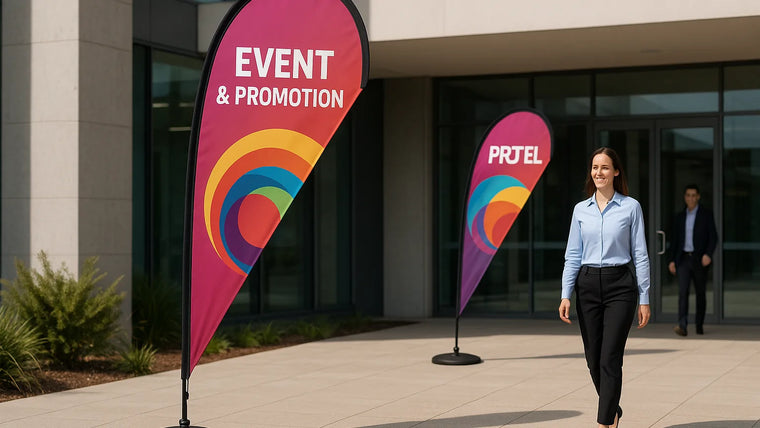
Teardrop Banners for Events and Promotions
Teardrop banners are aerodynamic, curved‑top fabric flags that hold tension to minimise flapping, delivering high visibility for events, retail forecourts and outdoor activations. Systems...
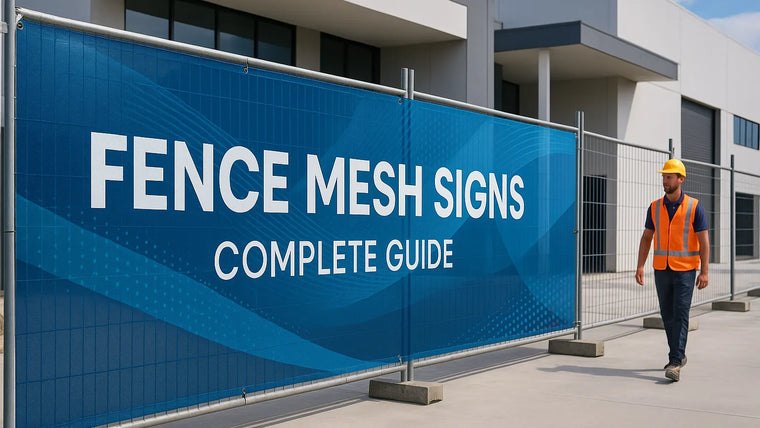
Fence Mesh Signs: Complete Guide
Fence mesh signs are printed mesh banners designed for temporary fencing and hoardings. Mesh allows airflow and can help reduce wind load compared with...
Best Materials for Crowd Control Barrier Graphics
For most outdoor events in Australia, perforated mesh banner is a versatile option because airflow can help reduce wind effects and it’s quick to...